10 Agency-Focused Risk Management Plan Examples for 2025

Running an agency is a high-wire act. Between client demands, project scope creep, team capacity, and fluctuating cash flow, a single misstep can quickly cascade into a major crisis. While you focus on delivering exceptional work and winning new business, unidentified risks are quietly gathering momentum, threatening your timelines, budgets, and reputation.
This isn't about being pessimistic; it's about being strategically prepared. A robust risk management plan is the framework that separates agencies that scale smoothly from those that crumble under pressure. It provides a structured process to identify, analyze, and mitigate potential threats before they derail your projects or impact your bottom line. Without one, you're essentially navigating high-stakes situations blindfolded, relying on reactive fixes rather than proactive strategy.
In this comprehensive guide, we move beyond theory to provide actionable insights. We will break down 10 battle-tested risk management plan examples from various industries, dissecting precisely how they work. For each example, you will find:
- An annotated risk register detailing specific threats.
- A clear risk matrix for prioritizing issues.
- Practical mitigation and contingency actions.
- Quick adaptation notes for agencies using an integrated platform like RGK.
This listicle is designed to give you a replicable blueprint. You'll learn how a structured approach to risk turns uncertainty into a competitive advantage, allowing you to protect your projects, operations, and profits with confidence. Instead of just hoping for the best, you'll have a clear system for ensuring it.
1. The Foundational: Project Management Risk Plan (PMBOK Inspired)
Every agency project, from a website build to a marketing campaign, is a minefield of potential risks. Scope creep, missed deadlines, budget overruns, and client miscommunication are common threats. This foundational risk management plan example, adapted from the Project Management Body of Knowledge (PMBOK) framework, acts as a project-level command center for neutralizing these threats.
This approach is the gold standard because it systematizes risk management into a clear, repeatable process: identify, analyze, plan a response, monitor, and control. It moves your agency from reactive problem-solving to proactive threat mitigation, which is essential for protecting profitability and timelines.
Strategic Breakdown
This plan is built on a structured, multi-step process. First, you identify risks through brainstorming, stakeholder interviews, and historical project data. Next, you analyze each risk's probability and impact using a risk matrix to prioritize them. High-priority risks then get specific response strategies, such as avoidance, mitigation, or transference.
A key component is the Risk Register, a living document that logs every identified risk. It includes details like the risk owner, trigger conditions, and the planned mitigation and contingency actions. This creates accountability and ensures nothing slips through the cracks.
Key Insight: The PMBOK-inspired approach forces a shift from a "what-if" mindset to a "what-will-we-do-when" strategy. It converts abstract fears into a concrete, actionable plan, giving project managers a clear playbook for handling adversity.
Actionable Takeaways for Your Agency
To implement this model, start by integrating risk identification into your project kickoff meetings. Make it a mandatory agenda item.
- Create a Standardized Risk Register: Develop a template that every project manager uses. Include fields for Risk ID, Description, Category (e.g., Technical, Resource, Client), Probability Score, Impact Score, and Mitigation Plan.
- Assign Risk Owners: Every identified risk needs a designated owner responsible for monitoring its status and executing the response plan. This prevents diffusion of responsibility.
- Schedule Regular Risk Reviews: Hold bi-weekly or monthly risk review meetings to update the register, discuss new threats, and assess the effectiveness of current mitigation efforts.
2. The High-Stakes Guardian: Healthcare Clinical Risk Management Plan
In healthcare, risks aren't just about budgets or timelines; they directly impact patient safety and lives. A clinical risk management plan, often mandated by bodies like The Joint Commission, is an organization-wide framework for identifying, assessing, and mitigating hazards related to patient care. This includes everything from medication errors and surgical complications to hospital-acquired infections and diagnostic mistakes.
This plan is critical because it creates a systematic defense against preventable harm and malpractice liability. It formalizes processes for incident reporting, root cause analysis, and implementing corrective actions. For any agency working in the highly regulated health tech space, understanding this framework is non-negotiable for ensuring compliance and client trust.
Strategic Breakdown
This plan centers on proactive patient safety rather than reactive incident response. It begins with a comprehensive risk assessment of all clinical processes, from patient admission to discharge. Risks are then prioritized based on severity and likelihood, often using a Failure Modes and Effects Analysis (FMEA) to pinpoint potential process failures before they occur.
A core element is the Incident Reporting System, a non-punitive mechanism for staff to report adverse events and near misses. This data feeds into a root cause analysis (RCA) to uncover system-level vulnerabilities, not individual blame. This "just culture" approach, championed by the Institute for Healthcare Improvement (IHI), encourages transparency and continuous learning.
Key Insight: The clinical risk management plan shifts the focus from "who made the error" to "why did our system allow this error to happen?" It treats patient safety events as opportunities to improve systems, protocols, and training, creating a resilient and safer care environment.
Actionable Takeaways for Your Agency
Even if you aren't a hospital, agencies in health tech or pharma marketing can adapt these principles to manage regulatory and reputational risks.
- Implement a "Just Culture" for Errors: Create a process for reporting mistakes (e.g., a HIPAA compliance slip, incorrect data in a patient-facing app) without immediate blame. Focus on analyzing the process breakdown that led to the error.
- Develop Standardized Incident Forms: Create a simple, confidential form for employees to report potential compliance or safety issues related to client work. Include fields for the event description, immediate impact, and suggested system improvements.
- Engage Leadership in Risk Oversight: Establish a compliance or risk committee that includes senior leadership. This team should regularly review incident reports and oversee the implementation of corrective actions, demonstrating a top-down commitment to quality and safety.
3. Financial Services Enterprise Risk Management (ERM) Framework
For organizations in highly regulated sectors like banking and finance, risk isn't just a project-level concern; it's a core business function. This enterprise-level framework, guided by bodies like the Basel Committee and FINRA, provides a comprehensive structure for managing interconnected financial threats such as credit, market, operational, and liquidity risk.
This approach is crucial because it creates an integrated view of risk across the entire organization. It moves beyond siloed departments to build a unified defense mechanism, ensuring that a risk identified in one area (like market volatility) is analyzed for its potential impact on others (like credit defaults), a necessity for complying with regulations like Dodd-Frank.
Strategic Breakdown
This framework operates on a top-down, holistic principle. It begins with the board of directors setting the firm's "risk appetite," which defines the amount and type of risk the organization is willing to accept to meet its strategic objectives. This directive then cascades down through the organization, influencing everything from lending decisions to technology investments.
A central element is the use of sophisticated quantitative models and stress testing. For example, firms like JPMorgan Chase and Goldman Sachs use complex simulations to model how their portfolios would perform under severe economic downturns. These forward-looking analyses allow them to proactively adjust capital reserves and hedging strategies instead of reacting after a crisis hits.
Key Insight: The ERM framework transforms risk management from a compliance-focused cost center into a strategic enabler. By understanding its complete risk profile, a firm can make more informed capital allocation decisions and confidently pursue opportunities that align with its defined risk appetite.
Actionable Takeaways for Your Agency
While your agency doesn't face Basel III regulations, the ERM principle of integrated risk thinking is highly valuable. You can adapt its holistic view to manage interconnected business-level threats.
- Define Your Agency's Risk Appetite: As a leadership team, formally document the types of risks you are willing to take. Are you comfortable with high-risk, high-reward clients? What level of financial leverage is acceptable for expansion?
- Create a Cross-Functional Risk Committee: Establish a small group with leads from finance, operations, sales, and delivery. Have them meet quarterly to discuss how risks in one area (e.g., a slowdown in sales) could impact others (e.g., resource allocation and project profitability).
- Conduct Business-Level Scenario Planning: Once a quarter, model potential "what-if" scenarios. For example: "What happens to our cash flow and projects if we lose our largest client?" or "How do we operate if a key technology platform we rely on has a major outage?" This exercise builds resilience.
4. Manufacturing Quality and Safety Risk Management (ISO 45001/ISO 14001)
In manufacturing, risks aren't just about project timelines; they involve worker safety, environmental compliance, and product quality. A single equipment failure can cause injuries, regulatory fines, and production shutdowns. This integrated risk management plan example, grounded in ISO 45001 (Occupational Health & Safety) and ISO 14001 (Environmental Management) standards, provides a holistic framework for managing these high-stakes threats.
This model is critical because it forces a shift from reactive incident response to proactive hazard prevention. By systematically identifying safety and environmental risks before they materialize, manufacturers can protect their workforce, ensure regulatory compliance, and maintain operational continuity. It transforms safety from a checklist into a core operational value, as seen in the stringent protocols at facilities run by Siemens and Toyota.
Strategic Breakdown
This plan operates on a continuous improvement cycle: Plan-Do-Check-Act. It begins with a thorough Hazard Identification and Risk Assessment (HIRA), where every process, piece of machinery, and chemical substance is evaluated for potential harm to people or the environment. Risks are then prioritized based on severity and likelihood, dictating the urgency of control measures.
A central element is the Integrated Management System (IMS), which documents all procedures, safety protocols, and environmental controls. This system logs everything from near-miss incidents and worker training records to chemical handling procedures and emergency response drills. This creates a single source of truth for all safety, quality, and environmental risk management activities, ensuring standardized and compliant operations.
Key Insight: The ISO-based approach links operational safety directly to business performance. It treats a safe and compliant workplace not as a cost center, but as a prerequisite for quality production, employee retention, and long-term profitability.
Actionable Takeaways for Your Agency
Even for agencies not in manufacturing, the principles of proactive hazard control are highly applicable, especially for workplace safety and data handling.
- Implement a Near-Miss Reporting System: Encourage employees to report potential issues before they cause harm. For an agency, this could be a near-miss data breach or a client conflict that was narrowly avoided, providing valuable learning opportunities.
- Conduct Regular "Toolbox Talks": Start weekly team meetings with a brief, 5-minute discussion on a specific operational risk, such as phishing awareness, password security, or recognizing client red flags.
- Benchmark Against Industry Standards: Just as manufacturers track incident rates, your agency can track metrics like project overruns, client churn, or security incidents against industry benchmarks to identify areas for improvement.
5. Software Development and Cybersecurity Risk Management (NIST Cybersecurity Framework)
For any agency involved in software development, handling sensitive data, or managing IT infrastructure, cybersecurity threats are not just risks; they are existential threats. A data breach, service outage, or vulnerability exploit can cause irreparable financial and reputational damage. This risk management plan example, grounded in the National Institute of Standards and Technology (NIST) Cybersecurity Framework (CSF), provides a robust structure for defending digital assets.
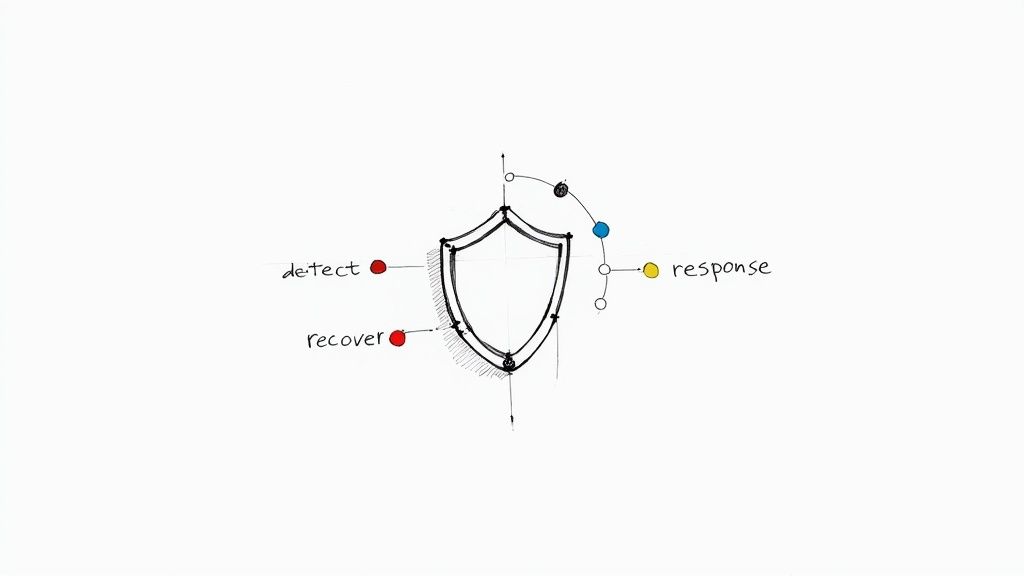
The NIST CSF is a gold standard because it organizes cybersecurity activities into five core functions: Identify, Protect, Detect, Respond, and Recover. This approach provides a common language and a strategic, top-down view of an organization's security posture, moving it from a reactive, tool-based defense to a proactive, risk-informed strategy. It helps agencies answer the critical questions: "What are our most important assets?" and "How well are we protecting them?"
Strategic Breakdown
This plan revolves around a continuous cycle of security improvement. It begins with identifying critical systems, data assets, and potential threats, from external attackers to internal negligence. The protect function involves implementing safeguards like access control, data encryption, and employee training. Detect focuses on continuous monitoring to find anomalies and security events in real-time.
When an incident occurs, the respond and recover functions are activated. This involves executing a pre-defined Incident Response Plan to contain the impact, eradicate the threat, and restore normal operations. This framework is exemplified by models like Microsoft's Security Development Lifecycle (SDL) and Google's BeyondCorp zero-trust architecture, which integrate security into every stage of development and operations.
Key Insight: Adopting a NIST-aligned framework fundamentally changes the conversation from "Are we secure?" to "How are we managing our cybersecurity risk?" It turns security into a measurable business function rather than a purely technical cost center.
Actionable Takeaways for Your Agency
Integrating this model requires a security-first culture, not just a set of tools. Start by identifying your "crown jewel" assets-the data and systems most critical to your operations.
- Implement "Security by Design": Embed security checks into your development lifecycle (DevSecOps). Use automated vulnerability scanners in your CI/CD pipelines to catch flaws before they reach production.
- Develop an Incident Response Playbook: Create a clear, step-by-step guide for what to do during a security breach. Define roles, communication protocols, and technical procedures. Conduct regular tabletop exercises to test and refine it.
- Prioritize Security Awareness Training: Your team is your first line of defense. Conduct mandatory, regular training on topics like phishing, password hygiene, and social engineering to reduce human error.
6. Supply Chain Risk Management (APICS, SCOR Model)
For agencies managing physical products, promotional materials, or complex event logistics, supply chain disruptions are a direct threat to client satisfaction and profitability. A sudden supplier failure, a customs delay, or a transportation bottleneck can derail an entire campaign. This risk management plan example, based on frameworks like the APICS body of knowledge and the Supply Chain Operations Reference (SCOR) model, provides a strategic blueprint for building resilience.
This approach is crucial because it treats the supply chain not as a simple linear process but as a complex ecosystem of interconnected nodes. It focuses on identifying single points of failure, assessing vendor reliability, and creating contingency plans that ensure operational continuity even when a critical link breaks. For an agency, this means the difference between a successful product launch and a warehouse full of unusable, late-arriving merchandise.
Strategic Breakdown
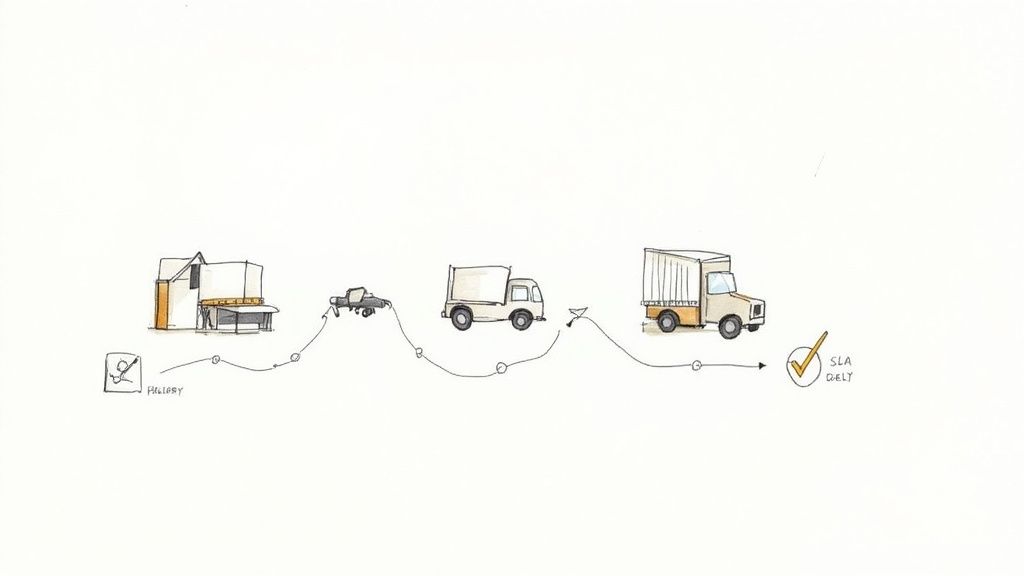
This plan starts with a comprehensive mapping of your entire supply chain, from raw material suppliers to final delivery carriers. Each node is then assessed for potential risks like geopolitical instability, financial solvency, or quality control failures. The SCOR model provides a framework to Plan, Source, Make, Deliver, and Return, allowing you to pinpoint risks within each specific operational stage.
A cornerstone of this model is the development of a Supplier Risk Profile for each key vendor. This profile goes beyond price and lead times to include metrics on financial health, historical performance, and geopolitical exposure. This data-driven approach allows you to segment suppliers and develop proactive strategies, such as diversifying your supplier base for high-risk components or holding strategic inventory buffers.
Key Insight: This framework transforms supply chain management from a purely logistical function into a strategic risk mitigation powerhouse. It shifts the focus from cost-optimization alone to building a resilient and agile network that can absorb shocks without collapsing.
Actionable Takeaways for Your Agency
Begin by identifying the five most critical suppliers for your largest clients. These are the vendors whose failure would cause the most significant operational disruption.
- Implement Supplier Scorecards: Create a simple scorecard to rate critical vendors on metrics like on-time delivery, quality acceptance rate, and communication responsiveness. Review these scores quarterly to identify declining performance before it becomes a crisis.
- Identify and Vet Backup Suppliers: For each critical component or service, identify at least one pre-vetted alternative supplier. This doesn't mean you need active contracts, but you should have a relationship and pricing ready to go.
- Run Disruption Scenarios: Conduct tabletop exercises for likely scenarios. For example, "What is our plan if our primary print vendor's facility floods one week before a major event?" This makes your response plans practical and battle-tested.
7. Real Estate and Construction Project Risk Management
For agencies managing large-scale physical builds, a generic project plan is insufficient. Construction and real estate development projects face a unique and high-stakes set of risks: material cost fluctuations, labor shortages, subcontractor defaults, regulatory hurdles, and unforeseen site conditions. This specialized risk management plan example is tailored to the tangible, often unpredictable nature of the built environment.
This approach is crucial because the financial and safety consequences of failure are severe. Unlike a digital campaign, you cannot simply revert to a previous version of a half-built structure. This framework, championed by industry leaders like Turner Construction and Skanska, provides a rigorous, phase-gated methodology for managing risks from initial site survey to final handover.
Strategic Breakdown
This plan emphasizes pre-construction analysis and continuous on-site monitoring. It begins with intensive due diligence, including geotechnical studies and environmental assessments, to identify foundational risks before a single shovel breaks ground. Throughout the project, it relies heavily on technology and stringent process controls to manage emerging threats.
A cornerstone of this model is a dynamic Contingency and Change Order Log. This isn't just a risk register; it's an active financial management tool that tracks the use of the contingency budget (typically 10-15% of the total project cost) against specific, documented risks. It’s paired with Building Information Modeling (BIM) to visualize potential clashes and sequencing issues, turning abstract risks into tangible 3D models that can be addressed proactively.
Key Insight: This framework treats the project site as a live risk environment. By integrating financial controls, strict documentation, and visualization technologies, it transforms risk management from a theoretical exercise into a daily operational discipline that directly protects the project's physical and financial integrity.
Actionable Takeaways for Your Agency
If your agency oversees experiential builds, office renovations, or other construction-related projects, adopt these construction-centric tactics.
- Implement a Strict Change Order Protocol: No change is made without a formal, approved change order that details the cost, schedule impact, and reason. This prevents scope creep and protects the budget.
- Use Visual Progress Verification: Mandate weekly site photos or use time-lapse photography. This creates an undeniable visual record of progress and quality, which is invaluable for resolving disputes with subcontractors or clients.
- Establish a Multi-Layered Contingency Budget: Instead of one large fund, allocate specific contingency amounts for different risk categories (e.g., weather delays, material price increases, design changes) to improve tracking and control.
8. Pharmaceutical and Life Sciences Regulatory Risk Management (ICH Q9)
For agencies operating in or serving the pharmaceutical, biotech, or medical device sectors, the margin for error is nonexistent. Risks aren't just about budgets; they involve patient safety, regulatory sanctions, and clinical trial integrity. This specialized risk management plan example, based on the International Council for Harmonisation's (ICH) Q9 Quality Risk Management guideline, provides a framework to manage these high-stakes threats.
This approach is mission-critical because it directly links quality and patient safety to every stage of a product's lifecycle, from research and development to post-market surveillance. It shifts risk management from a compliance checkbox to an integral part of scientific and manufacturing processes, ensuring adherence to strict FDA and EMA standards. For agencies creating medical content or technology, understanding this framework is key to client success.
Strategic Breakdown
The ICH Q9 model is a systematic process for assessing, controlling, communicating, and reviewing risks to the quality of a drug product. It begins with identifying hazards, like cross-contamination in manufacturing or data integrity issues in a clinical trial. Each risk is then analyzed for its severity, probability of occurrence, and detectability to determine its overall priority.
A core document is the Risk Management File (RMF), which compiles all risk-related activities and documentation. This isn't just a log; it’s a comprehensive history that proves due diligence to auditors. It details risk assessments, control measures like implementing statistical process controls, and the rationale behind every quality-related decision, such as those made in Pfizer's pharmacovigilance programs.
Key Insight: The ICH Q9 framework transforms risk management from a purely defensive activity into a proactive tool for quality improvement. It forces a focus not just on what could go wrong, but on how to systematically build quality and safety into a process from the very beginning.
Actionable Takeaways for Your Agency
If your agency supports life sciences clients, adopting principles from this model demonstrates industry expertise and protects both you and your client.
- Establish a Quality-Focused Mindset: When developing marketing materials or software for a pharma client, integrate a quality review step that specifically checks for regulatory compliance (e.g., fair balance in drug ads).
- Document Everything Rigorously: Mimic the RMF by keeping detailed records of client feedback, version control on creative assets, and approvals related to medical or legal claims. This creates a defensible audit trail.
- Conduct "Mock Audits" of Deliverables: Before a major launch, conduct an internal review simulating a regulatory inspection. Check all claims, data references, and required safety information to catch potential compliance risks early.
9. Event and Venue Management Risk Plan
For agencies planning conferences, product launches, or large-scale corporate events, the risks extend far beyond digital threats. Managing crowds, ensuring physical security, navigating venue liabilities, and preparing for weather disruptions are paramount. An Event and Venue Management Risk Plan is a specialized framework designed to address the unique, high-stakes challenges of live gatherings.
This plan is critical because live events are dynamic and unpredictable, with countless variables that can derail success or even endanger attendees. Inspired by protocols from organizations like the Event Safety Alliance, this approach provides a structured method for identifying physical, operational, and reputational risks. It ensures that from vendor setup to the final guest's departure, every potential hazard has been anticipated and planned for.
Strategic Breakdown
This plan begins with a thorough venue and operational walkthrough to identify potential hazards, from unsafe wiring to inadequate emergency exits. Risks are then categorized (e.g., security, crowd management, medical, weather) and analyzed for their likelihood and potential severity. The response strategy focuses heavily on prevention, on-site mitigation, and emergency response coordination.
A core element is the Incident Response Plan (IRP), a detailed playbook for handling specific scenarios like a medical emergency, security breach, or severe weather warning. This document outlines clear chains of command, communication protocols for staff and attendees, and pre-determined evacuation routes. It ensures that in a crisis, the event team can act swiftly and decisively rather than reacting chaotically.
Key Insight: This type of risk management plan example shifts the focus from purely project-based risks to encompass public safety and liability. It forces event planners to think like emergency responders, creating a resilient operational structure that protects attendees, staff, and the brand's reputation.
Actionable Takeaways for Your Agency
To apply this, make risk assessment a non-negotiable part of your event planning process, starting from venue selection.
- Develop a Venue Risk Checklist: Create a standardized checklist for site inspections. Include items like accessibility compliance, fire suppression system status, emergency exit clarity, and capacity limits.
- Hold Mandatory Pre-Event Briefings: Before the event begins, gather all staff, security personnel, and key vendors to review the Incident Response Plan. Walk through critical scenarios and clarify everyone's roles and responsibilities.
- Establish a Central Communication Hub: Designate a single point of contact or use a dedicated communication channel (like a specific Slack channel or radio frequency) for all incident reporting during the event. This prevents misinformation and ensures a coordinated response.
10. Corporate Governance and Enterprise Risk Management (COSO Framework)
For agencies scaling beyond project-level risks, a more holistic approach is necessary. The COSO Enterprise Risk Management (ERM) framework provides a top-down, strategic view, enabling senior leadership to manage risks across the entire organization. This model connects risk management directly to strategy and performance, addressing threats in operations, finance, compliance, and strategic direction, as seen in the governance structures of companies like Microsoft and Nestlé.
This framework is the gold standard for mature organizations because it elevates risk management from a departmental function to a C-suite and board-level responsibility. It shifts the focus from avoiding individual project failures to protecting and creating enterprise value. For a growing agency, adopting COSO principles means building a resilient organization that can weather market shifts, regulatory changes, and major operational disruptions with confidence.
Strategic Breakdown
The COSO framework integrates risk management into the strategic planning and decision-making process. It begins with defining the agency's risk appetite and tolerance, which then guides all subsequent risk identification, assessment, and response activities. The framework is organized around five interrelated components: Governance & Culture, Strategy & Objective-Setting, Performance, Review & Revision, and Information, Communication, & Reporting.
A central element is the use of risk heat maps to visualize the entire enterprise risk portfolio. These maps plot risks based on their likelihood and impact, allowing leadership to instantly identify the most critical threats and allocate resources effectively. This strategic oversight ensures that risk management efforts are aligned with the agency's most important business objectives.
Key Insight: The COSO framework transforms risk management from a purely defensive exercise into a strategic advantage. By understanding the full spectrum of enterprise risks, agencies can make more informed strategic bets, seize opportunities others might fear, and build a more durable business model.
Actionable Takeaways for Your Agency
Integrating a COSO-inspired model requires commitment from the top. It’s a cultural shift that instills risk awareness throughout the agency.
- Establish a Risk Management Committee: Create a cross-functional committee, potentially led by a designated Chief Risk Officer (or an operations lead in smaller agencies), responsible for overseeing the enterprise risk portfolio.
- Integrate Risk into Strategic Planning: During annual or quarterly planning sessions, explicitly discuss strategic risks. Ask questions like, "What internal or external events could prevent us from hitting these goals?"
- Link Risk Management to Performance: Consider incorporating risk management objectives into leadership performance reviews and even compensation plans. This creates powerful incentives for proactive risk governance.
Side-by-Side Comparison of 10 Risk Management Plans
| Template | Implementation Complexity 🔄 | Resource Requirements ⚡ | Expected Outcomes ⭐📊 | Ideal Use Cases 💡 | Key Advantages |
|---|---|---|---|---|---|
| Project Management Risk Register (PMBOK Standard) | Moderate–High: formal process, scalable for large projects | Moderate: PM tools, cross‑functional time upfront | Clear accountability, quantified risks, improved decision-making | Construction, IT, engineering projects | Industry standard; integrates with PM software; owner assignment |
| Healthcare Clinical Risk Management | High: regulatory layers and clinical workflows | High: reporting systems, training, clinical expertise | Improved patient safety, fewer malpractice incidents, compliance | Hospitals, clinics, patient‑safety programs | Meets Joint Commission/CMS standards; fosters safety culture |
| Financial Services ERM Framework | Very High: multi‑dimensional, regulatory complexity | Very High: analytics, stress‑testing platforms, specialists | Enterprise risk visibility, capital protection, regulatory compliance | Banks, insurers, investment firms | Comprehensive, data‑driven, aligns with Basel/Dodd‑Frank |
| Manufacturing Quality & Safety (ISO 45001/14001) | High: ISO integration, continuous improvement cycles | High: safety equipment, audits, training and monitoring | Fewer injuries, environmental compliance, efficiency gains | Manufacturing, automotive, industrial production | Certifiable standards; improves reputation and waste reduction |
| Software Development & Cybersecurity (NIST CSF) | High: continuous updates, cross‑team practices | High: security tools, DevSecOps, trained analysts | Reduced breaches, faster incident response, regulatory readiness | Tech companies, IT ops, SaaS, cloud providers | Aligns with NIST/ISO; protects data; supports DevSecOps |
| Supply Chain Risk Management (APICS/SCOR) | Moderate–High: network complexity, supplier variability | Moderate: data systems, supplier management, inventory buffers | Greater resilience, fewer disruptions, improved lead times | Retail, manufacturing, logistics, CPG | Supplier visibility, diversification strategies, business continuity |
| Real Estate & Construction Project Risk Management | High: site‑specific risks, many stakeholders | High: geotech/BIM, insurance, inspections, contingencies | Reduced overruns/delays, compliance, safer worksites | Developers, contractors, large construction projects | BIM-enabled risk visualization; strong contingency planning |
| Pharmaceutical & Life Sciences (ICH Q9) | Very High: strict regulatory and clinical processes | Very High: R&D, clinical trials, quality systems, docs | Patient safety assurance, regulatory approvals, fewer recalls | Pharma, biotech, medical devices, clinical research | Regulatory alignment (ICH/FDA/EMA); rigorous QRM and PV systems |
| Event & Venue Management Risk Plan | Moderate: detailed planning, time‑bound execution | Moderate: staff, security, insurance, contingency resources | Safer events, reduced liability, better attendee experience | Concerts, conferences, festivals, venues | Operational readiness, crowd control, crisis communication |
| Corporate Governance & ERM (COSO Framework) | High: enterprise‑wide, cultural and structural change | High: executive time, governance tools, risk talent | Strategic alignment with risk, board oversight, stakeholder confidence | Large enterprises, public companies, boards | Holistic risk view; aligns risk with strategy and reporting |
From Reactive Firefighting to Proactive Strategy
The journey through these diverse risk management plan examples reveals a powerful, universal truth: structure creates freedom. Whether managing a complex software development project, a large-scale construction site, or the intricate web of a global supply chain, the underlying principles of proactive risk identification, assessment, and mitigation are the bedrock of sustainable success. These plans are not bureaucratic exercises in creating documents that collect dust; they are living blueprints for building resilience into the very DNA of your operations.
Moving beyond generic templates, we've dissected real-world frameworks from the PMBOK standard to the NIST Cybersecurity Framework. Each example underscores a fundamental shift in mindset. It's the transition from constantly reacting to unforeseen problems to strategically anticipating and neutralizing them before they can derail progress, erode profits, or damage your agency's reputation. This is the difference between firefighting and fire prevention.
The Core Takeaway: From Threat to Strategic Variable
The most crucial insight gleaned from analyzing these examples is the transformation of risk. Without a plan, risk is an unpredictable, often terrifying threat. With a structured approach, risk becomes a manageable variable within your strategic equation. You gain the ability to make informed decisions, consciously accepting certain risks, actively mitigating others, and preparing contingency plans for those you cannot avoid.
This proactive stance creates a stable foundation, which is particularly vital for agencies. When project timelines, client relationships, and team capacity are not constantly being disrupted by preventable crises, your team is free to focus on what they do best: delivering exceptional creative and strategic work.
Strategic Insight: A well-implemented risk management plan doesn't eliminate all risk. Instead, it provides the clarity and control needed to navigate uncertainty confidently, turning potential liabilities into opportunities for demonstrating competence and strengthening client trust.
Actionable Next Steps for Your Agency
Absorbing these concepts is the first step, but implementation is what drives real change. Here is a clear path forward to integrate these principles into your agency's workflow:
- Start Small and Focused: Don't attempt to implement a comprehensive Enterprise Risk Management (ERM) framework overnight. Begin with a single, high-impact area. The Project Management Risk Register (Example 1) is the perfect starting point for most agencies. It’s tangible, directly impacts profitability, and provides a quick win.
- Adapt, Don't Just Adopt: Use the provided examples as a guide, not a rigid script. Tailor the risk categories, impact scales, and response strategies to fit your agency's specific services, client types, and operational realities. A digital marketing agency's risks differ significantly from a construction management firm's.
- Centralize Your Risk Data: One of the biggest failure points is having risk registers scattered across different spreadsheets and project folders. A central repository is non-negotiable for identifying patterns and cross-project risks. An integrated platform makes this process seamless, connecting project risks to financial forecasts and resource allocation.
- Make It a Continuous Process: Risk management is not a one-time setup. Schedule regular risk review meetings as part of your project management cadence (e.g., weekly or bi-weekly). This ensures the plan remains a relevant, dynamic tool rather than a static artifact.
Mastering the art and science of risk management, as demonstrated through these detailed risk management plan examples, is no longer a luxury reserved for large corporations. For modern agencies, it is a critical competitive advantage. It empowers you to promise with confidence, deliver with predictability, and build a more stable, scalable, and ultimately more profitable business. The peace of mind that comes from knowing you are prepared for what lies ahead is the ultimate return on this investment.
Ready to move your risk management from scattered spreadsheets to a centralized, intelligent platform? RGK provides the integrated tools to manage project, financial, and operational risks in one place, giving you the visibility and control demonstrated in these examples. See how our platform can help you build a more resilient agency by visiting RGK today.