8 Powerful Example of Goal Statement Frameworks for 2025


A well-crafted goal statement is the most powerful tool for turning ambition into reality. Yet, most goals are vague wishes like 'increase sales,' 'get healthier,' or 'improve teamwork' that lack the structure needed to drive meaningful action. They are declarations of intent without a clear roadmap, leaving teams and individuals to guess at the specific steps required for success. This ambiguity is where progress stalls and potential is lost.
This guide moves beyond generic advice to provide a strategic breakdown of effective goal-setting frameworks used by top organizations and high-achievers. We will dissect not just what makes a good goal, but why it works and how you can replicate its structure for your own career, team, or personal life. For each example of goal statement we explore, you will find a detailed analysis, actionable insights, and adaptable templates.
The purpose here is to equip you with a practical toolkit for defining objectives with absolute clarity. You will learn to build goals that are not just aspirational but also measurable, directional, and motivating. Prepare to transform how you define and pursue your objectives, moving from abstract desires to concrete, achievable outcomes. We will explore a wide range of applications, from business performance and project management to personal development and team collaboration, ensuring you have the right model for any situation.
1. SMART Goals for Business Performance
The SMART framework is a cornerstone of effective goal-setting, transforming vague aspirations into actionable objectives. Popularized by George T. Doran in a 1981 article titled "There's a S.M.A.R.T. Way to Write Management's Goals and Objectives," this method ensures every goal statement is clear, trackable, and aligned with broader strategic aims. It's an indispensable tool for agency owners, project managers, and directors seeking to drive measurable results.
The acronym stands for:
- Specific: Clearly define what you want to accomplish. Who is involved? What are the constraints?
- Measurable: Define how you will track progress and measure success with concrete metrics.
- Achievable: Ensure the goal is realistic given available resources, time, and team capabilities.
- Relevant: The goal must align with larger business objectives or team priorities.
- Time-bound: Set a clear deadline to create urgency and focus.
Strategic Breakdown of a SMART Goal Example
Let's look at a common business objective and transform it into a powerful example of a goal statement using the SMART framework.
- Vague Goal: "Improve customer support."
- SMART Goal: "Reduce the average first-response time for high-priority customer support tickets from 45 minutes to 25 minutes by the end of Q3. This will be achieved by implementing a new ticket routing system and providing two additional training sessions for the support team."
This revised statement works because it hits every SMART criterion. It specifies the metric (first-response time), sets a measurable target (45 to 25 minutes), is achievable with defined actions (new system, training), is relevant to customer satisfaction, and has a clear deadline (end of Q3).
Actionable Takeaways and Implementation Tips
To effectively integrate this into your operations, focus on clarity and alignment.
Key Insight: The power of a SMART goal isn't just its structure; it's the strategic conversation it forces. Defining each element requires teams to agree on priorities, baselines, and success metrics upfront.
Follow these tips for successful implementation:
- Document Baseline Metrics: Before setting a target, you must know your starting point. What is the current response time or conversion rate?
- Collaborate with Stakeholders: Involve the team responsible for achieving the goal in its creation. This builds ownership and ensures the "Achievable" element is grounded in reality.
- Connect to Larger Strategy: Explicitly state how achieving this specific goal contributes to a larger company objective, like increasing customer retention or improving brand reputation.
- Review and Adjust Quarterly: Business environments change. A quarterly review allows you to adjust goals based on new data, resource availability, or shifting market demands, ensuring continued relevance.
2. OKR (Objectives and Key Results) Framework
The OKR framework is a powerful methodology for creating organizational alignment and driving ambitious growth. Developed by Andy Grove at Intel and later popularized by John Doerr at Google, OKRs link a high-level, aspirational Objective with specific, measurable Key Results that track its achievement. This system is ideal for fast-moving companies that need to align large teams around a shared, inspirational vision.

The framework is defined by two core components:
- Objective: The "what." This is a qualitative, ambitious, and memorable statement of what you want to achieve.
- Key Results: The "how." These are 3-5 quantitative outcomes that measure progress toward the Objective. They must be measurable and verifiable.
Strategic Breakdown of an OKR Goal Example
Let's break down a common organizational goal into a clear example of a goal statement using the OKR framework.
- Vague Goal: "Make our new product launch a success."
- OKR Goal:
- Objective: Successfully launch the 'Project Nova' platform and establish it as the market's leading solution for enterprise clients in Q4.
- Key Result 1: Achieve 1,500 new enterprise sign-ups by the end of the quarter.
- Key Result 2: Secure product reviews and features in 5 major industry publications.
- Key Result 3: Maintain a user engagement score of 8/10 or higher from post-onboarding surveys.
This OKR works because the Objective is inspirational and sets a clear direction ("market's leading solution"). The Key Results are specific, measurable outcomes that directly prove the Objective was met without dictating the exact tasks.
Actionable Takeaways and Implementation Tips
To implement OKRs effectively, focus on ambition and transparent tracking rather than just task completion.
Key Insight: OKRs separate what you want to achieve (the Objective) from how you will measure it (the Key Results). This distinction encourages innovative thinking and prevents teams from getting lost in a checklist of tasks while losing sight of the ultimate goal.
Follow these tips for successful implementation:
- Embrace Stretch Goals: A key principle of OKRs is to aim high. A "committed" OKR must be met, but an "aspirational" OKR is a stretch goal where achieving 70% is considered a success. This encourages innovation without fear of failure.
- Limit Your Focus: Stick to 3-5 objectives per team or individual for each cycle. Overloading teams with too many OKRs dilutes focus and makes meaningful progress impossible.
- Cascade and Align, Don't Dictate: Company-level OKRs should inspire department and team OKRs. However, teams should define their own KRs to foster autonomy and ensure they are grounded in reality.
- Review Progress Regularly: Implement weekly check-ins and monthly reviews to track progress. This allows for real-time adjustments and keeps the goals top-of-mind, preventing them from becoming a "set it and forget it" exercise.
3. Educational Learning Objectives
Learning objectives are specific, action-oriented goal statements used in academic and training settings to define what a learner should know or be able to do after completing instruction. Popularized by educational psychologists like Benjamin Bloom and Ralph Tyler, these goals are the foundation of effective curriculum design, guiding both teaching methods and assessment strategies. They shift the focus from what is taught to what is learned, ensuring educational experiences are purposeful and measurable.
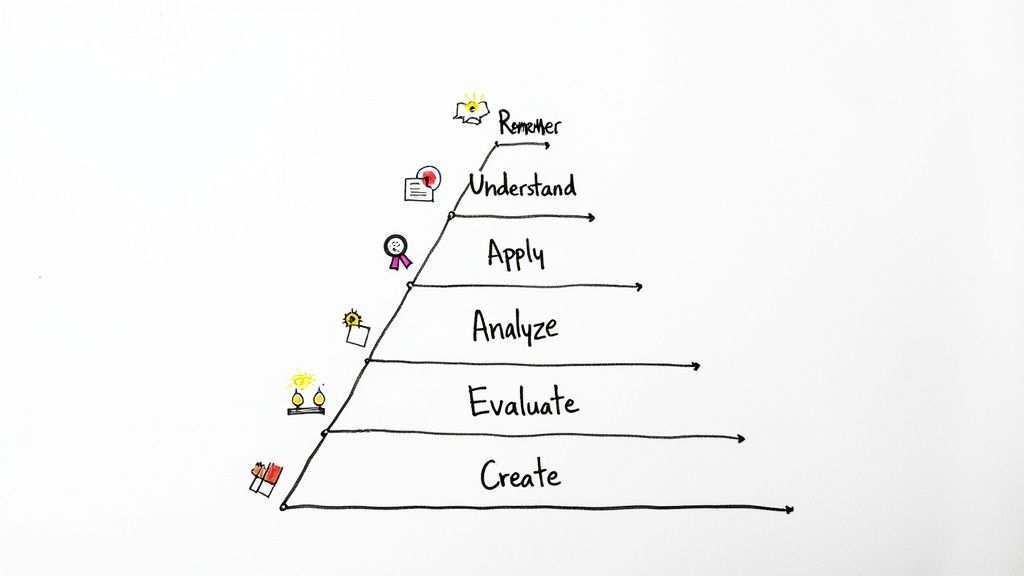
Often structured using frameworks like Bloom's Taxonomy, these objectives are built with strong, observable action verbs. The framework categorizes cognitive skills into six levels, from basic recall to complex creation, providing a clear roadmap for developing learner competencies.
Strategic Breakdown of a Learning Objective Example
Let's break down a typical corporate training goal and refine it into a clear example of a goal statement structured as a learning objective.
- Vague Goal: "Employees should understand the new project management software."
- Learning Objective: "By the end of this training module, participants will be able to apply the 'Gantt Chart' feature in the new project management software to create a project timeline with at least three interdependent tasks and assign one team member to each task."
This revised statement is effective because it is specific, measurable, and action-based. It replaces the vague verb "understand" with the observable action "apply," clearly defines the task (create a timeline), and includes specific criteria for successful completion (three tasks, team member assignments).
Actionable Takeaways and Implementation Tips
To apply this model in your own training or educational programs, focus on precision and alignment.
Key Insight: Well-crafted learning objectives serve as a contract between the instructor and the learner. They clarify expectations, guide the learner's focus, and provide a transparent basis for assessment.
Follow these tips for successful implementation:
- Use Strong Action Verbs: Start every objective with a verb from Bloom's Taxonomy (e.g., analyze, evaluate, create) that corresponds to the desired level of cognitive skill. Avoid ambiguous terms like know or understand.
- Align Assessment Directly: Ensure every quiz question, project, or evaluation task directly measures a stated learning objective. If an objective isn't assessed, it's not being reinforced.
- Keep it Learner-Centric: Frame objectives from the learner's perspective. They should complete the sentence, "Upon completion of this session, you will be able to…"
- Make Objectives Visible: Share learning objectives with participants at the beginning of any course, module, or training session. This helps them understand the purpose and focus their attention effectively.
4. Personal Development and Life Goals
Personal goal statements are the blueprints for individual growth, translating abstract aspirations into tangible life improvements. Unlike business goals, these are deeply personal and intrinsically motivated, focusing on well-being, skill acquisition, and overall life satisfaction. Popularized by thought leaders like James Clear and Tony Robbins, this approach frames self-improvement as a series of deliberate, actionable steps rather than wishful thinking.
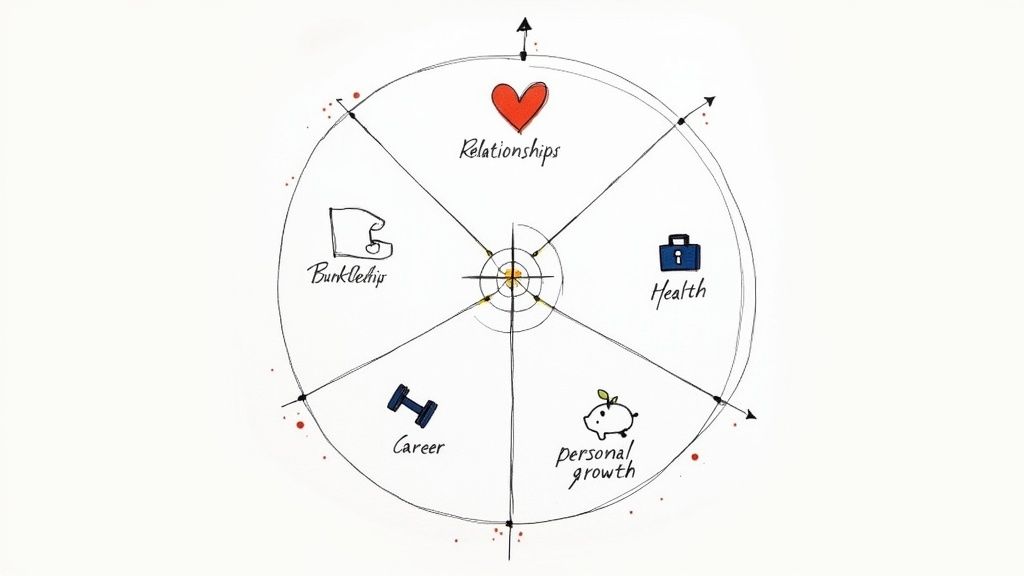
The core principle is to align your actions with your personal values across different life domains, such as health, career, and relationships. It’s about designing a life, not just reacting to it. This method is crucial for anyone feeling stuck or seeking to make meaningful changes, from freelancers planning their next skill to directors aiming for better work-life balance.
Strategic Breakdown of a Personal Goal Example
Let's apply a structured approach to a common personal development objective, turning it into a compelling example of a goal statement.
- Vague Goal: "I want to learn a new skill."
- Structured Goal: "I will become proficient in conversational Spanish by dedicating 30 minutes every weekday to language learning apps and completing one online module per week. I will test my progress by holding a 5-minute conversation with a native speaker through a language exchange platform by the end of six months."
This revised statement is effective because it creates a clear system for success. It specifies the desired outcome (conversational proficiency), defines measurable daily and weekly actions (30 mins/day, 1 module/week), makes it achievable by breaking it down, ensures relevance to personal growth, and sets a six-month deadline with a clear milestone.
Actionable Takeaways and Implementation Tips
To effectively set personal goals, the focus must be on building sustainable systems and habits.
Key Insight: The success of a personal goal is determined not by the ambition of the outcome but by the consistency of the process. Focus on designing small, repeatable actions that build momentum over time.
Follow these tips for successful implementation:
- Use Habit Stacking: Connect your new goal to an existing routine. For example, "After I finish my morning coffee, I will do my 30-minute Spanish lesson." This anchors the new behavior to an established one.
- Find an Accountability Partner: Share your goal with a trusted friend or mentor. Regular check-ins create external motivation and provide a support system when you feel your motivation wane.
- Schedule Monthly Reviews: Life happens. Dedicate time each month to review your progress, celebrate small wins, and adjust your plan as needed. This keeps the goal relevant and prevents discouragement.
- Break It Down into Milestones: A six-month goal can feel intimidating. Break it down into monthly targets, such as "Learn 50 new vocabulary words this month" or "Master present tense verb conjugations."
5. Nonprofit and Social Impact Goals
Social impact goal statements define how nonprofit organizations will create measurable change in their communities or for their chosen cause. These goals move beyond internal business metrics to focus on external, mission-driven outcomes. They must balance lofty aspirations with tangible accountability to donors, beneficiaries, and stakeholders, often incorporating frameworks like a Theory of Change or tracking a Social Return on Investment (SROI).
This approach is critical for organizations whose success is measured not in profit, but in positive societal change. It’s used by global bodies like the United Nations and the World Health Organization to guide large-scale initiatives. Key elements include:
- Mission-Alignment: Goals must directly serve the organization's core purpose.
- Stakeholder-Centricity: Objectives are defined by the needs of the community being served.
- Impact Measurement: Success is quantified through a mix of qualitative and quantitative data.
- Transparency: Progress and setbacks are reported openly to build trust and foster learning.
Strategic Breakdown of a Social Impact Goal Example
Let's examine a common nonprofit objective and refine it into a compelling example of a goal statement that drives and demonstrates impact.
- Vague Goal: "Help homeless individuals in our city."
- Impact-Oriented Goal: "By the end of the fiscal year, transition 75 individuals from chronic homelessness into stable housing by expanding our 'Housing First' program capacity by 30%. This will be measured by the number of individuals remaining housed for over six months, and success will be supported by securing two new community housing partnerships and increasing case manager staffing by one full-time employee."
This goal is effective because it links specific actions (program expansion, new partnerships) to a measurable human outcome (75 individuals housed). It defines what "stable" means (housed for over six months), identifies the resources needed, and sets a clear timeframe, making it both inspiring and accountable.
Actionable Takeaways and Implementation Tips
To apply this model effectively, focus on connecting activities directly to outcomes and involving the community you serve.
Key Insight: Unlike purely corporate goals, social impact goals must embed a feedback loop. The definition of success should be co-created with beneficiaries to ensure the intended impact is also the desired impact.
Follow these tips for successful implementation:
- Develop a Logic Model: Visually map how your inputs (funding, staff) and activities (workshops, outreach) lead to outputs (people served) and ultimately to desired outcomes (improved well-being, stable employment).
- Involve Community Members: Host focus groups or surveys with beneficiaries during the goal-setting process to ensure your objectives are relevant and respectful of their needs.
- Balance Quantitative and Qualitative Metrics: Track numbers (e.g., meals served) alongside stories and testimonials (qualitative data) to paint a complete picture of your impact.
- Embrace Adaptive Management: The path to social change is rarely linear. Build in regular review periods to assess what's working and pivot your strategy based on real-world results and community feedback.
6. Project Management and Delivery Goals
Effective project management hinges on clear, well-defined goals that guide every decision from kickoff to final delivery. These goals translate a project's vision into a tangible plan by integrating scope, schedule, budget, and quality standards. Popularized by frameworks from the Project Management Institute (PMI) and methodologies like PRINCE2 and Agile, these goals serve as the project charter's backbone, providing a universal standard for success.
Project goals must articulate exactly what will be delivered, by when, and to what quality. They are essential for:
- Scope: Defining the specific features, functions, and tasks that are part of the project.
- Cost: Outlining the budget and financial constraints.
- Hedule: Setting clear deadlines and milestone dates.
- Quality: Establishing the standards and criteria the final deliverable must meet.
Strategic Breakdown of a Project Goal Example
Let's break down a common project objective and refine it into a robust example of a goal statement that provides clarity for the entire project team and its stakeholders.
- Vague Goal: "Upgrade the company's internal server infrastructure."
- SMART Goal: "Complete the migration of all internal applications from the legacy server infrastructure to the new cloud-based environment by October 31st, with a total project budget of $75,000. The project's success will be measured by achieving 99.9% uptime in the first month post-migration and ensuring zero data loss, as verified by stakeholder sign-off on the final acceptance criteria."
This goal is effective because it quantifies every critical project constraint. It defines the scope (application migration), sets a hard deadline (October 31st), establishes a budget ($75,000), and specifies quality metrics (99.9% uptime, zero data loss).
Actionable Takeaways and Implementation Tips
To apply this to your projects, focus on documentation and proactive stakeholder communication.
Key Insight: A project goal isn't just a finish line; it's a comprehensive contract between the project team and its stakeholders. Documenting scope, constraints, and acceptance criteria upfront prevents scope creep and misalignment later.
Follow these tips for successful implementation:
- Define Success Criteria Explicitly: Work with stakeholders before the project starts to agree on what "done" looks like. Document these "acceptance criteria" in the project charter.
- Use a Work Breakdown Structure (WBS): Deconstruct the main project goal into smaller, manageable tasks and sub-goals. This helps in accurate estimation and progress tracking.
- Document Assumptions and Constraints: Clearly list all known assumptions (e.g., resource availability) and constraints (e.g., budget limits). This provides crucial context for decision-making.
- Monitor Progress Against Baselines: Establish baseline metrics for schedule and budget at the project's start. Conduct regular reviews (e.g., monthly or at key milestones) to track performance against this baseline and make necessary adjustments.
7. Healthcare and Clinical Practice Goals
Clinical goal statements are foundational to modern healthcare, defining treatment objectives, patient outcomes, and quality improvement targets. Popularized by organizations like the Institute for Healthcare Improvement (IHI) and the Joint Commission, these goals translate broad aims like "improve patient safety" into measurable, evidence-based actions. They are critical for hospital administrators, clinical directors, and care teams striving to enhance patient outcomes and operational efficiency.
The core principle is to align clinical activities with quantifiable health improvements. These goals often address:
- Patient Outcomes: Reducing mortality rates or improving recovery times.
- Process Efficiency: Streamlining patient admissions or reducing wait times.
- Safety and Quality: Lowering infection rates or preventing medical errors.
- Population Health: Increasing vaccination rates or managing chronic diseases across a community.
Strategic Breakdown of a Clinical Goal Example
Let's examine a common healthcare objective and refine it into a clear example of a goal statement for a clinical setting.
- Vague Goal: "Improve diabetes management for our patients."
- Clinical Goal: "Reduce the average HbA1c level for our empaneled adult patients with type 2 diabetes from 8.1% to 7.5% within 12 months. This will be achieved by implementing a patient education program on diet and exercise, increasing follow-up appointment frequency, and utilizing a new patient data dashboard for proactive outreach."
This statement is effective because it is patient-centered and clinically specific. It defines the target population (adults with type 2 diabetes), uses a standard clinical metric (HbA1c), sets a measurable target (8.1% to 7.5%), and outlines specific interventions (education, follow-ups, dashboard), all within a 12-month timeframe.
Actionable Takeaways and Implementation Tips
To effectively use clinical goals, focus on integrating evidence-based practices with rigorous data tracking.
Key Insight: The most impactful clinical goals are not set in a vacuum. They are developed collaboratively with frontline staff and are directly linked to established evidence-based practice guidelines, ensuring they are both ambitious and clinically sound.
Follow these tips for successful implementation:
- Use Evidence-Based Guidelines: Base your targets on recommendations from credible sources like the CDC or NICE. This ensures your goals align with the latest medical science.
- Engage Clinical Teams: Involve physicians, nurses, and support staff in the goal-setting process. Their hands-on experience is invaluable for determining what is achievable and how to best implement changes.
- Track Process and Outcome Metrics: Monitor both the outcome (e.g., HbA1c levels) and the process metrics (e.g., number of patients attending education sessions). This helps identify if the interventions are being implemented as planned.
- Conduct Quarterly Reviews: Hold regular meetings with care teams to review progress, discuss barriers, and adjust strategies. Healthcare is dynamic, and your goals must adapt to new information and patient needs.
8. Team and Departmental Collaboration Goals
Effective team goal statements define collective achievements that require coordinated effort across departments or functional areas. Inspired by frameworks from thought leaders like Patrick Lencioni and Google's Project Aristotle research, these goals translate high-level organizational strategy into actionable team-level commitments. They are essential for fostering collaboration, interdependence, and shared accountability in complex projects.
Key principles include:
- Shared Outcome: The goal is owned by the collective, not a single individual or department.
- Interdependence: Success requires active contribution and synchronized effort from all involved parties.
- Role Clarity: While the outcome is shared, individual responsibilities within the group are clearly defined.
- Alignment: The goal directly supports a larger strategic objective, ensuring cross-functional work has a clear purpose.
- Communication: A structured communication plan is built into the goal to ensure continuous alignment.
Strategic Breakdown of a Collaboration Goal Example
Let's examine a common cross-functional initiative and structure it as a compelling example of a goal statement.
- Vague Goal: "Launch the new mobile app."
- SMART Collaboration Goal: "Successfully launch the 'ConnectSphere' mobile app by the end of Q4, achieving 10,000 user sign-ups and a 4.5-star average app store rating within the first 30 days. This requires a coordinated effort from Engineering (feature completion), Marketing (go-to-market campaign execution), and Sales (enterprise client onboarding)."
This revised goal is effective because it establishes a single, measurable definition of success (sign-ups, rating) that all three departments must work together to achieve. It clarifies who is involved and implies interdependent tasks, making it a powerful tool for aligning distinct teams toward a common objective.
Actionable Takeaways and Implementation Tips
To implement collaboration goals effectively, you must build systems that support cross-functional work.
Key Insight: The primary function of a collaboration goal is to make interdependence explicit. It forces teams to map out their reliance on one another, shifting the focus from siloed tasks to a shared project victory.
Follow these tips for successful implementation:
- Establish a "Single Source of Truth": Use a shared project management tool or dashboard (like Asana, Jira, or a shared Notion page) where all teams can view progress, dependencies, and key milestones in real-time.
- Define Decision Rights Clearly: Create a simple RACI (Responsible, Accountable, Consulted, Informed) chart for key launch decisions to prevent bottlenecks and confusion. Who makes the final call on the marketing budget or a go-live date?
- Schedule Regular Synchronization Meetings: Institute a brief, weekly cross-functional sync meeting focused exclusively on identifying and resolving blockers between teams. Keep the agenda tight and action-oriented.
- Celebrate Milestone Achievements Collectively: When the beta is released or the first 1,000 users sign up, celebrate it as a collective win. This reinforces the sense of shared ownership and boosts morale across all contributing departments.
8-Example Goal Statement Comparison
| Approach | 🔄 Implementation complexity | ⚡ Resource requirements & time | 📊 Expected outcomes | 💡 Ideal use cases | ⭐ Key advantages |
|---|---|---|---|---|---|
| SMART Goals for Business Performance | Medium — structured but can be time‑consuming to craft | Low–Medium — stakeholder time, baseline data; weeks–months to operationalize | Clear, measurable targets and stronger accountability | Performance management, strategic planning, individual targets | Increases focus and measurability; aligns to strategy |
| OKR (Objectives and Key Results) Framework | High — requires cultural change and training | Medium–High — alignment tools, dashboards, org coaching; 3–6 months rollout | Ambitious outcome-driven results and organization-wide alignment | Rapid-growth companies, cross‑functional strategy execution, product teams | Drives stretch performance, transparency, and alignment |
| Educational Learning Objectives | Medium — needs instructional design and assessment mapping | Low–Medium — faculty time, assessment design; semester‑level implementation | Measurable learning behaviors and improved assessment validity | Course design, training modules, competency programs | Clarifies expectations; directly ties instruction to assessment |
| Personal Development and Life Goals | Low–Medium — flexible, less formal process | Low — individual time, habit tools; ongoing timelines | Increased motivation and well‑being; variable measurability | Personal growth, habit change, career transitions | Values‑aligned, flexible, supports self‑reflection and motivation |
| Nonprofit and Social Impact Goals | High — complex measurement and attribution challenges | Medium–High — program funding, community engagement; long horizons | Demonstrable social impact over time; mixed quantitative/qualitative results | NGOs, community programs, donor reporting, policy initiatives | Clarifies mission impact; strengthens donor/stakeholder trust |
| Project Management and Delivery Goals | Medium–High — integrates scope, schedule, budget and quality | Medium–High — project teams, tools, governance; project lifecycle timelines | Deliverables met on scope/time/budget; improved risk control | Construction, software releases, infrastructure and product launches | Prevents scope creep; provides clear success criteria and stakeholder alignment |
| Healthcare and Clinical Practice Goals | High — evidence, safety standards, regulatory requirements | High — clinical staff, data systems, compliance; outcomes may lag | Improved patient outcomes, safety metrics, regulatory compliance | Hospitals, quality improvement initiatives, clinical programs | Evidence‑based focus; improves patient safety and care quality |
| Team and Departmental Collaboration Goals | Medium — requires coordination and clear roles | Medium — meeting cadence, shared dashboards, cross‑team effort | Better cross‑functional outcomes, reduced silos, shared accountability | Product launches, retention initiatives, digital transformation | Breaks down silos; increases cohesion and shared ownership |
From Framework to Action: Your Next Steps in Goal Mastery
We've journeyed through a comprehensive landscape of goal-setting frameworks, deconstructing everything from business-focused SMART goals and ambitious OKRs to the nuanced objectives required in project management and personal development. You’ve seen a powerful example of goal statement for nearly every professional and personal scenario, but the true value lies not in the examples themselves, but in the principles they embody: clarity, specificity, and actionability.
The core lesson is this: a goal statement is not a static declaration. It's a dynamic tool, a compass that requires regular calibration. The most effective leaders, managers, and high-achievers don't just "set and forget" their goals. They integrate them into their daily workflows, review them in team meetings, and adjust them in response to new data and changing circumstances. The transition from a vague ambition like "increase revenue" to a sharp, tactical objective like "Increase MRR by 15% in Q3 by launching the 'Pro Tier' add-on and converting 25 existing 'Standard' clients through targeted email campaigns" is where strategy becomes reality.
Synthesizing Your Learnings into Action
To move from theory to execution, let's distill the most critical takeaways from the examples we've explored. Mastering these concepts is the key to crafting a goal statement that genuinely drives results.
- Context is King: The best framework depends entirely on your context. OKRs are fantastic for aligning a fast-growing agency around ambitious outcomes, while detailed SMART goals are indispensable for ensuring a critical project stays on schedule and within budget. Don't force a framework where it doesn't fit.
- Verbs Dictate Action: Pay close attention to the verb you use to start your goal. Words like "Launch," "Implement," "Reduce," "Increase," and "Achieve" are far more powerful than passive words like "Manage," "Oversee," or "Continue." An active verb creates an immediate sense of momentum.
- Quantify Everything Possible: Numbers remove ambiguity. Whether it's a percentage increase, a specific dollar amount, a reduction in support tickets, or a client satisfaction score, quantifiable metrics are the bedrock of a strong goal. They are the only way to know for sure if you have succeeded.
- The "Why" Is Your Fuel: As we saw in the personal development and social impact examples, connecting a goal to a deeper purpose or a larger vision creates resilience. When challenges arise, a powerful "why" provides the motivation to persevere. For your team, this means clearly communicating how their departmental goals contribute to the company's overall mission.
Your Immediate Next Steps
Knowledge without application is merely potential. To turn the insights from this article into tangible progress, here is your action plan. Don't try to do everything at once; pick one area and build from there.
- Choose One High-Priority Area: Select a single domain that needs immediate improvement. Is it a struggling project? Unclear team objectives? A personal ambition you've been procrastinating on?
- Draft Your First Statement: Using the templates and examples from this article, write your first goal statement for that chosen area. Don't aim for perfection on the first try. Just get a solid draft written down.
- Apply the SMART Litmus Test: Review your draft. Is it Specific? Measurable? Achievable? Relevant? Time-bound? Refine each component until you can confidently answer "yes" to all five.
- Schedule a Review Cadence: This is the step most people skip. Put a recurring event on your calendar to review this goal. For a project goal, it might be weekly. For a personal goal, it could be monthly. This act of scheduling accountability is often the difference between success and failure.
By consistently applying these principles, you transform goal setting from an annual administrative task into a powerful, ongoing strategic discipline. You create a culture of clarity, accountability, and achievement, where every team member understands not just what they are doing, but why it matters. This is how high-performing teams and individuals turn ambitious visions into measurable accomplishments.
Tired of goals living in spreadsheets, disconnected from the actual work? RGK centralizes your objectives, projects, and performance metrics into a single source of truth, ensuring every task is tied to a strategic outcome. See how you can bridge the gap between planning and execution by visiting RGK today.