How to Delegate Tasks Effectively and Scale Your Agency


Delegation isn't just about handing off a task you don't want to do. It's the art of strategically assigning the right work to the right people, with crystal-clear instructions and a shared understanding of what "done" looks like. It's a leadership muscle that requires trust—trust in your team to execute and trust in yourself to focus on the high-level work that actually grows the business.
When done right, delegation isn't offloading; it's a direct investment in your team's skills and your agency's future.
Why Mastering Delegation Is Your Agency's Ultimate Growth Hack
In the whirlwind of agency life, it's easy to wear "busy" as a badge of honor. You're the final eyes on every proposal, the first call for a client crisis, and the only one who really knows how to pull that one obscure report. This feels like quality control, but in reality, it's the single biggest bottleneck stunting your agency's growth. When you cling to tasks, you create a system that can't function without you at the center.
This hands-on-everything approach has real, damaging consequences. Projects grind to a halt waiting for your sign-off, your best senior talent gets stuck on low-level work, and team morale slowly erodes when capable people feel micromanaged and untrusted. That ripple effect inevitably reaches your clients, who start noticing slower response times and project delays.
Shifting Your Mindset from Cost to Investment
The biggest mental block to delegation? The classic "it's just faster if I do it myself" trap. And sure, for a one-off task, you might be right. But that thinking is dangerously short-sighted. Every time you do something a team member could have done, you're not just spending your time—you're stealing a growth opportunity from them and preventing your agency from building a scalable process.
The question isn't "Can I afford to delegate this?" It's "How can my agency afford not to?"
By not delegating, you are automatically choosing to do the lower-value work. You are choosing to be a bottleneck. You are choosing to stunt your team's growth.
This mindset shift is critical. The data paints a clear picture of what's at stake. An analysis of Inc. 500 CEOs revealed that leaders with strong delegation skills saw an average three-year growth rate of 1,751%—dwarfing their peers. Other reports show that managers who delegate effectively can generate 33% more revenue than those who struggle to let go. You can find more of the hard numbers on the financial impact of delegation from StaffConnect.
Before we dive deeper, let's look at the two very different realities for agencies, depending on how they handle delegation. The contrast is stark.
Delegation's Impact on Agency Performance
| Metric | Ineffective Delegation (The Bottleneck) | Effective Delegation (The Growth Engine) |
|---|---|---|
| Leadership Focus | Buried in daily tasks and firefighting | Strategic planning, client relationships, business development |
| Team Morale | Low; employees feel untrusted, micromanaged, and bored | High; team feels empowered, trusted, and has clear growth paths |
| Project Velocity | Slow; projects stall waiting for a single person's approval | Fast; multiple workstreams run in parallel with clear ownership |
| Scalability | Limited; growth is capped by the leader's personal capacity | High; systems and people are in place to handle more clients |
| Client Satisfaction | Inconsistent; prone to delays and communication gaps | Consistently high; responsive, efficient, and proactive service |
| Profitability | Stagnant; high-cost leaders are doing low-value work | Growing; operational efficiency drives higher margins |
The table makes it obvious: one path leads to burnout and stagnation, while the other leads to a thriving, scalable business.
Ultimately, learning to delegate is about building an agency that runs on strong systems, not just your personal heroics. It’s about empowering your team, cranking up your operational efficiency, and finally freeing yourself up to do the one thing only you can do: lead.
Deciding What to Delegate with the 4D Framework
Before you can get good at how to delegate, you’ve got to figure out what to delegate. Just throwing tasks at people without a plan is a classic mistake. It feels productive, but you end up creating more confusion than clarity. You need a system to audit what’s on your plate and be strategic about what you hand off.
The 4D Framework is a dead-simple but surprisingly effective way to sort through your to-do list. It forces you to put every single task into one of four buckets: Do, Delegate, Defer, or Delete. This isn't just about freeing up your calendar; it's about making sure your time—your most valuable asset—is spent on what actually moves the needle.
This decision tree helps visualize the process. It's a quick gut-check for whether something is a candidate for delegation or needs to stay with you.
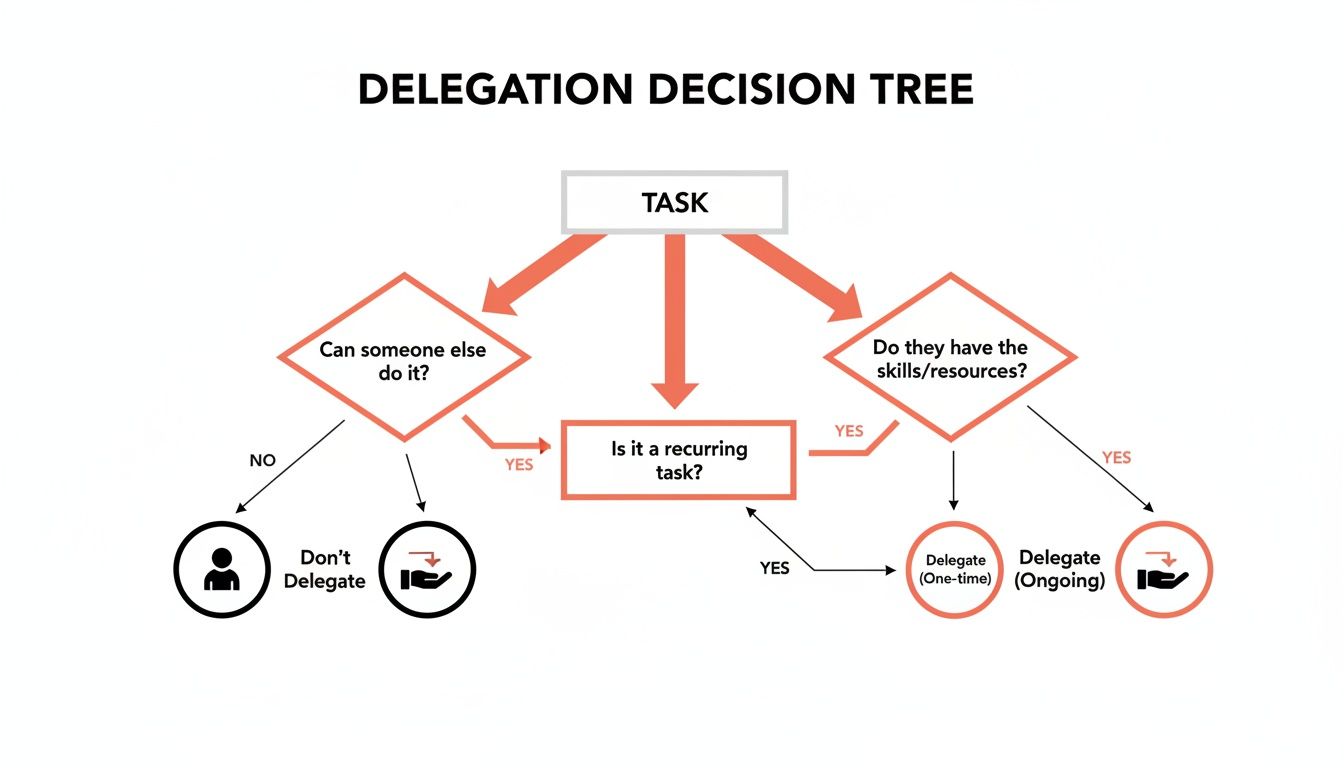
As you can see, the real question is whether a task requires your specific, unique expertise or if it's something that can be systemized and handed over to a capable team member.
Do It Yourself
These are the big ones—the tasks that absolutely require your unique skills, authority, or vision. They're often high-stakes, tied directly to the agency's future, or involve critical client relationships. Delegating these too early will backfire, big time.
Think about things like:
- Finalizing a massive proposal for a dream client.
- Navigating a tricky negotiation with a major partner.
- Setting the strategic roadmap for the next quarter.
The trick is being honest with yourself about what truly needs you. A lot of leaders hang onto tasks because they enjoy them or are just used to doing them, not because they are the only person who can.
Delegate It to Someone Else
This is where you create leverage. These tasks are important, but they don't depend on you personally doing them. They are often repeatable, follow a clear process, or fall right into a team member's zone of genius (or could, with a little training).
Delegation isn’t about offloading work you hate. It’s about empowering your team with responsibility that helps them grow, which in turn frees you up for the work only you can do.
If you can write down the steps to get it done, it’s almost always a prime candidate for delegation.
Some classic agency examples include:
- Weekly Reporting: Pulling analytics and putting them into the standard client report template.
- New Client Onboarding: Setting up projects in your PM tool, sending welcome kits, and scheduling the kickoff call.
- Social Media Scheduling: Loading approved content into the scheduler according to the content calendar.
Handing these off doesn’t just clear your to-do list; it builds skills and confidence across your team.
Defer It for Later
This bucket is for things that are important, but not right now. These are the "someday/maybe" items that can easily distract you from what's urgent. Deferring isn't just procrastinating—it's making a conscious choice to tackle something when the timing is better.
For instance, you might defer a project to overhaul the internal knowledge base until after you’ve wrapped up a massive client launch. Just make sure you actually schedule a time to revisit these deferred tasks so they don't fall into a black hole.
Delete It Entirely
This one is my favorite because it’s so liberating. We all do things out of habit that provide little to no value. The "Delete" bucket is for any task that, if it vanished, would have zero negative consequences. Think outdated reports nobody reads, pointless recurring meetings, or redundant internal processes.
Ask yourself one simple question for every task: "What would actually happen if I just stopped doing this?" If the honest answer is "nothing," you’ve found something you can strike from the list for good. Getting comfortable with this is one of the fastest ways to simplify your entire operation.
Matching the Right Task to the Right Person
Okay, so you've figured out what to delegate. Now comes the trickier part: who gets the task? Just tossing work at the first person with a free moment is a classic rookie mistake, and it almost always leads to frustration, shoddy work, and endless revisions.
Handing a complex task to the wrong person can actually create more work than if you'd just done it yourself. You'll end up with missed deadlines, a drop in quality, and a team member who feels completely out of their depth.
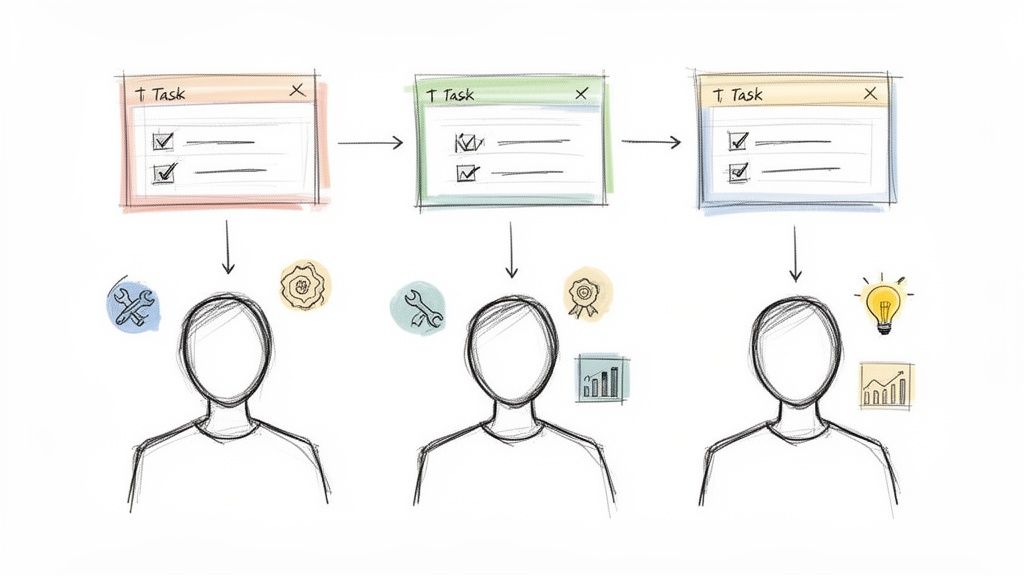
Think of it like casting for a role. You're not just filling a spot; you're looking for the perfect fit between the opportunity and the person. You need to find that sweet spot where their skills, current capacity, and personal growth goals all line up.
Look Beyond Your Go-To People
It’s so easy to fall into the trap of giving all the important stuff to your senior folks. They're your A-team—reliable, experienced, and you trust them to nail it every time. But this habit is a silent killer of team growth. It burns out your top performers and keeps your junior talent from ever getting the reps they need to level up.
Before you automatically assign that next big task, pause and scan your whole team. Who’s been asking to learn a new skill? Who has a hidden talent for something outside their job description? That quiet account coordinator might be a spreadsheet wizard, or a junior designer might have a surprising flair for client presentations.
Effective task delegation is not just about workload management; it's one of the most powerful professional development tools you have. Every delegated task is a chance to build someone’s skills and confidence.
Don't shy away from stretching people a bit. Giving someone a task that’s just a little beyond their current comfort zone (with your support, of course) is how you build a truly formidable team. It creates resilience and cross-functional skills, so you're not left scrambling when your key players are out of office.
The Skills, Workload, and Motivation Checklist
Making the right match comes down to quickly running through three critical factors. It’s a mental checklist that will save you a world of hurt later on.
-
Skills & Competence: Do they have the core skills to get this done? If not, do they have the aptitude to pick it up quickly with a bit of guidance? Think beyond just technical abilities—consider soft skills like problem-solving, attention to detail, and communication.
-
Current Workload & Capacity: Is their plate already overflowing? Dropping a new priority on someone who's already drowning is just setting them up to fail. Always do a quick gut check on their current bandwidth to make sure they can give the task the focus it needs.
-
Interest & Growth Potential: Is this something they want to do? Will it help them get where they want to go in their career? People produce their best work when they're genuinely engaged. Framing a task as a growth opportunity can be a massive motivator.
When you weigh these three things, delegation stops being a transaction and becomes a strategic tool for building a stronger, more capable team.
It's About Empowerment, Not Dumping
Once you've picked your person, the job isn't over. The handoff is crucial. Just dropping a task in their lap without context or authority isn't delegation; it's just dumping. True empowerment means setting them up for a win right from the start.
This boils down to providing three key things:
-
The "Why": They need to understand how this task fits into the bigger picture. When they know why it matters to the project or the client, they can make smarter decisions on their own.
-
The Authority: Give them the power to make the decisions needed to get the job done. If they need to coordinate with another team or spend a little money, make it clear they have your blessing. This prevents them from becoming a bottleneck.
-
The Resources: Make sure they have access to the right tools, documents, and institutional knowledge. A link to a solid Standard Operating Procedure (SOP) or a well-organized project folder can make all the difference.
This approach pays off in a big way. Workplace research has shown that when people are given more ownership through delegation, they report higher job satisfaction and feel more engaged. A study on workplace delegation and its benefits found a direct link between effective delegation and employees feeling a stronger sense of influence over their work.
When you give your team everything they need to succeed, you're building a culture where people don't just complete tasks—they own outcomes.
Crafting Bulletproof Briefs and Repeatable SOPs
You've picked the right task and found the perfect person for it. Great. But don't pop the champagne just yet. This next step is where delegation lives or dies—not in the handoff, but in the instructions you provide.
Handing someone a vague brief is like asking them to build a piece of IKEA furniture without the manual. They might get there eventually, but it’s going to be a painful, wobbly mess.
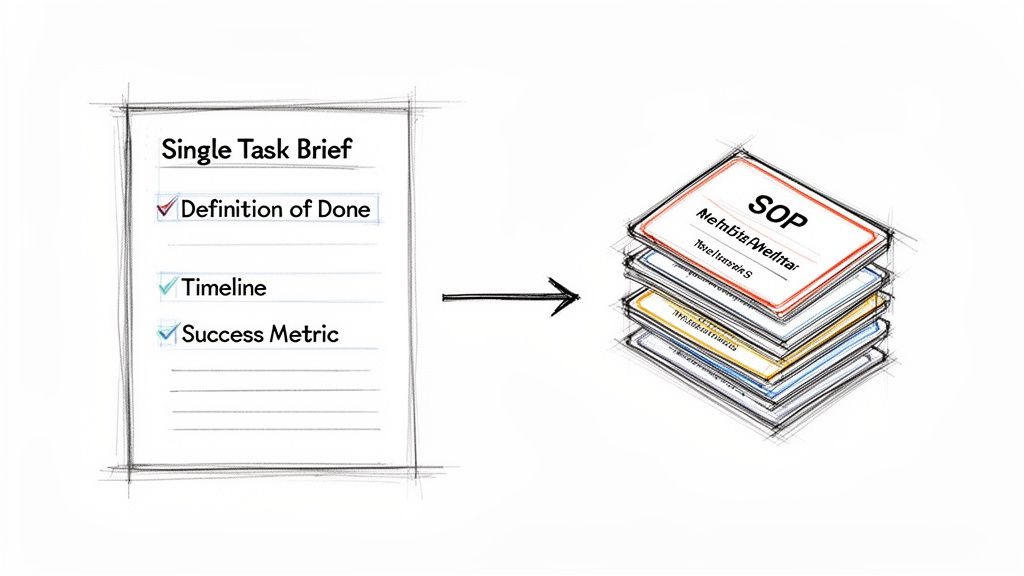
Ambiguity is the silent killer of effective delegation. To snuff it out, you need two core assets in your arsenal: the task brief for one-off projects and the Standard Operating Procedure (SOP) for everything else.
The Anatomy of a Perfect Task Brief
A solid task brief is more than just a to-do list; it’s a complete instruction manual for a specific outcome. The goal is to answer every question before it’s even asked, eliminating the endless back-and-forth that drains everyone’s time.
Here's what every bulletproof brief needs:
- The "Why" Behind the Work: Kick things off with a sentence or two connecting this task to the bigger picture. When your team knows why they're doing something, they can make smarter decisions without you.
- The "Definition of Done": This is non-negotiable. Be ruthlessly specific. Don't just say, "pull a social media report." Instead, try: "Create a PDF report for Client X using our standard template, covering reach, engagement rate, and the top three posts from the last 30 days."
- Success Metrics: How will you both know this was a home run? Define what success looks like. It could be as simple as, "The report is sent to the client by Friday at 5 PM with zero data errors."
- Timeline and Checkpoints: Give a firm final deadline. For bigger tasks, schedule a few key milestones or check-in points to make sure things are on track without having to hover.
- Budget and Resources: If there’s an ad spend, a budget for stock photos, or any other cost involved, spell it out. And for heaven's sake, link to everything they'll need—the template file, the analytics login, the project folder.
This isn't about micromanaging; it's about providing clarity.
A great task brief doesn't just give instructions; it transfers context. It’s the difference between saying "go get groceries" and handing someone a detailed list, a store map, and the credit card.
Turning One-Off Wins into Repeatable Systems
The moment a team member nails a task using one of your excellent briefs, you’ve struck gold. You now have the raw materials to turn that single successful execution into a repeatable process anyone can follow. This is how you stop reinventing the wheel and actually start scaling your agency.
An SOP is just a documented, step-by-step guide for a recurring task. Building one is simple.
- Document the Process: Right after the task is completed, sit down with the person who did it and have them walk you through the exact steps they took.
- Make it Visual: Words are good, but screenshots and short video recordings are better. Use a tool like Loom to record quick screen-shares. Visuals cut through confusion instantly.
- Centralize Everything: Don't let your SOPs die in a random Google Doc. Create a central knowledge base in a tool like Notion, Slab, or a well-organized Google Drive folder that everyone can access and search.
Building this library is an investment that pays you back, over and over again. The next time you need that weekly social media report, you don't write a new brief from scratch. You just assign the task and link to the SOP.
Despite how much sense this makes, a shocking number of agencies are still stuck in the dark ages. Recent surveys show that 81% of North American firms and 78% of UK firms are still delegating tasks manually. This old-school approach creates massive administrative drag and almost guarantees you’re not putting your best people on the right work. You can dig into more of these findings on profitable task delegation.
By systemizing your work with briefs and SOPs, you’re not just being more efficient. You’re building a resilient operation where anyone—from a brand-new hire to a seasoned pro—can execute key tasks to the same high standard, freeing you up to focus on growing the business.
Building Accountability Without Micromanaging
Once you’ve handed off a task with a killer brief, the real work starts. Delegation without accountability isn't empowerment; it's just dumping work on someone's plate and hoping for the best. This is exactly where so many agency leaders stumble. They either vanish completely, leaving their team to fend for themselves, or they swing to the other extreme and micromanage every last detail.
The sweet spot is building a system of shared ownership where everyone knows their role and feels empowered to deliver. You don’t need a complicated project management certification for this. All it takes is a simple framework to define who does what and a lightweight process to stay in the loop.
This isn’t about control—it’s about creating clarity. It’s how you prevent dropped balls, duplicated effort, and that classic "I thought they were handling that" moment that can completely derail a project.
Clarifying Roles with a RACI Matrix
One of the most effective tools I've ever used for this is the RACI matrix. It sounds more complicated than it is. RACI is just a simple way to map out who’s involved in a task and what their specific contribution is.
It’s an acronym for:
- Responsible: This is the person (or people) doing the actual work. They’re the ones with their hands on the keyboard, designing the creative, or writing the code.
- Accountable: The one person who ultimately owns the outcome. This is the individual whose head is on the line for the task's success or failure. Crucially, there can only be one "A."
- Consulted: These are the subject matter experts who provide input or feedback. Their opinions are valuable, and they need to be looped in before a decision is finalized.
- Informed: These folks just need to be kept up-to-date on progress. They aren't directly involved in the day-to-day work, so communication is often a one-way street.
A RACI chart forces you to have the conversation about roles before a project starts, not in the middle of a crisis when deadlines are slipping. It’s a five-minute exercise that can save you hours of confusion later on.
Let’s run through a common agency scenario. Imagine you're delegating the creation of a new client landing page. A quick RACI might look like this:
| Task/Decision | Project Manager | Copywriter | Designer | Developer | Client |
|---|---|---|---|---|---|
| Write Page Copy | A | R | I | I | C |
| Design Mockup | A | C | R | I | C |
| Develop Page | A | I | C | R | I |
| Final Approval | A | I | I | I | C |
In this simple chart, it’s instantly clear who’s doing what. The Project Manager is Accountable for the whole shebang, but different specialists are Responsible for each phase. The client is Consulted for feedback at key stages. This simple bit of clarity prevents the developer from getting conflicting feedback from both the designer and the copywriter.
Setting Up a Cadence for Check-Ins
With roles clearly defined, the next move is to establish a rhythm for monitoring progress that doesn't feel like you’re constantly looking over their shoulder. The trick is to schedule these touchpoints upfront. When they're on the calendar from day one, they feel like a natural part of the process, not a surprise "gotcha" meeting.
For a task spanning a single week, your cadence might look like this:
- Kickoff (Monday): The initial handoff where you walk through the brief and confirm the RACI.
- Mid-Point Check-In (Wednesday): A quick 10-minute huddle. The goal is to review progress against the plan and troubleshoot any blockers.
- Final Delivery (Friday): The completed work is submitted for review.
This structure gives your team members the autonomy to work independently between checkpoints. It also provides a safety net for them to raise issues and for you to course-correct if needed—all without hovering.
The goal of these check-ins isn't to critique every move. Instead, you should be asking questions that foster ownership and open dialogue:
- "How are we tracking against the timeline?"
- "Are there any roadblocks I can help clear for you?"
- "Do you have everything you need to get this over the finish line?"
This changes the entire dynamic from inspection to support. You’re building a psychologically safe environment where people feel comfortable admitting they're stuck before it becomes a crisis. This is how you transform delegation from a simple transaction into a positive feedback loop of trust and continuous improvement—the very engine that powers a truly effective and scalable team.
Your Toughest Delegation Questions, Answered
Even with the perfect framework, you're going to hit some bumps in the road. Learning to delegate well is a skill you sharpen over time, not something you master overnight. You’ll run into weird edge cases and frustrating roadblocks that make you question the whole system. That's normal.
Here are my unfiltered answers to the most common snags agency leaders run into when they get serious about delegation. This is your field guide for navigating the tricky parts and turning those problems into wins for you and your team.
"What Do I Do If My Team Member Messes Up?"
First, take a breath. Seriously. Your gut reaction will be to jump in and fix it yourself. Resist that urge with everything you have. Mistakes are going to happen, especially when someone is stretching into a new role. How you handle them will define your agency's culture.
This is the moment you decide if you're building a team that takes calculated risks or one that plays it safe and never grows.
Come at the situation with genuine curiosity, not blame. The goal isn't to critique the person; it's to figure out where the process broke down.
Try starting the conversation with open-ended questions like:
- "Hey, can you walk me through your process on this one?"
- "Was there a point in the brief where things got a bit fuzzy or unclear?"
- "What was the most challenging part of this task for you?"
Nine times out of ten, this kind of collaborative debrief points to a hole in your system, not a flaw in your team member. Maybe an SOP was missing a critical step, or the brief’s "definition of done" was too vague. Use that insight to patch the hole so the same mistake can't happen again.
A mistake is only a true failure if you refuse to learn from it. I always tell my team to treat errors as data points that help us build tougher systems and smarter people.
When you treat mistakes as learning opportunities, you create psychological safety. And when your team isn't terrified of failing, they start taking real ownership and honing their problem-solving skills—which is the entire point of delegating in the first place.
"How Can I Delegate Effectively to a Remote Team?"
When your team is distributed, the need for crystal-clear communication gets amplified by about 100x. You can't just swing by someone's desk to clarify a minor point, so your documentation has to do all the heavy lifting. This means your task briefs and SOPs need to be almost obsessively detailed, leaving zero room for guesswork.
Over-communication is your best friend here. Don't just explain the "what" and "how"—always explain the "why" behind a task. Giving that extra layer of context empowers remote team members to make smart, autonomous decisions when they can't get an instant answer from you.
A few non-negotiables for delegating to a remote team:
- One Source of Truth: All conversations, files, feedback, and updates for a task must live in one central place, like your project management tool. This stops critical info from getting buried in siloed email threads or private Slack DMs.
- Scheduled Face-to-Face Time: Relying only on async text is a recipe for misunderstanding. Short, regular video check-ins are essential for maintaining a human connection and making sure nothing gets lost in translation.
- Equal Access to Everything: Do a quick audit. Does your remote team have the exact same access to the tools, software, and information as your in-office folks? An accidental information gap can completely derail a delegated project.
"How Do I Get Over the Feeling That It's Just Faster to Do It Myself?"
Ah, the classic trap. This is single-handedly the most common and destructive mindset for any agency leader. And let's be honest, in the short term, you're probably right. It is faster to do that familiar task yourself… this one time. But that thinking puts a hard, immovable ceiling on your agency's growth.
Every time you give in to that impulse, you're making a trade. You're trading a tiny, short-term time-saver for a massive, long-term bottleneck. You become the bottleneck.
Think of delegation as an investment. The very first time you hand off a complex task, it will absolutely take you longer. You've got to write the brief, record the Loom, explain the context, and be on standby for questions. But the second time? It's much faster. By the third or fourth time, that task is completely off your plate, freeing up countless hours for the future.
You're not just getting a task done; you're building a scalable asset for your business. You're training a person, refining a process, and creating a system that no longer depends entirely on you. That initial time investment is precisely what buys you the freedom to finally focus on the high-value work that only you can do.
At RGK, we're building the unified operating system that agencies need to scale without the chaos. Our platform is designed to make delegation seamless, with integrated project management, SOPs, and an AI layer that gives your team the context they need to execute flawlessly. If you're tired of running your agency with a dozen disconnected tools, see how we can help.