How to Improve Operational Efficiency: how to improve operational efficiency

Before you can plug the leaks, you have to find them. Improving your agency's efficiency starts with a brutally honest look at where you're losing time, money, and momentum. This isn't about some abstract business theory; it's about getting crystal clear on what to fix so you can make changes that actually move the needle.
Diagnosing Your Operational Bottlenecks
Trying to boost efficiency without first finding your specific problems is like trying to fix a car that won't start by just washing it. It might look better, but you haven't touched the engine. Too many agency leaders jump straight to buying shiny new software or overhauling processes, only to realize they've solved a problem they didn't really have.
So, the first and most important step is to assess where you are right now. This means getting past gut feelings and digging into the real friction points in your daily workflows, from the second a lead hits your inbox to the moment you send that final invoice.
Map Your Current Reality
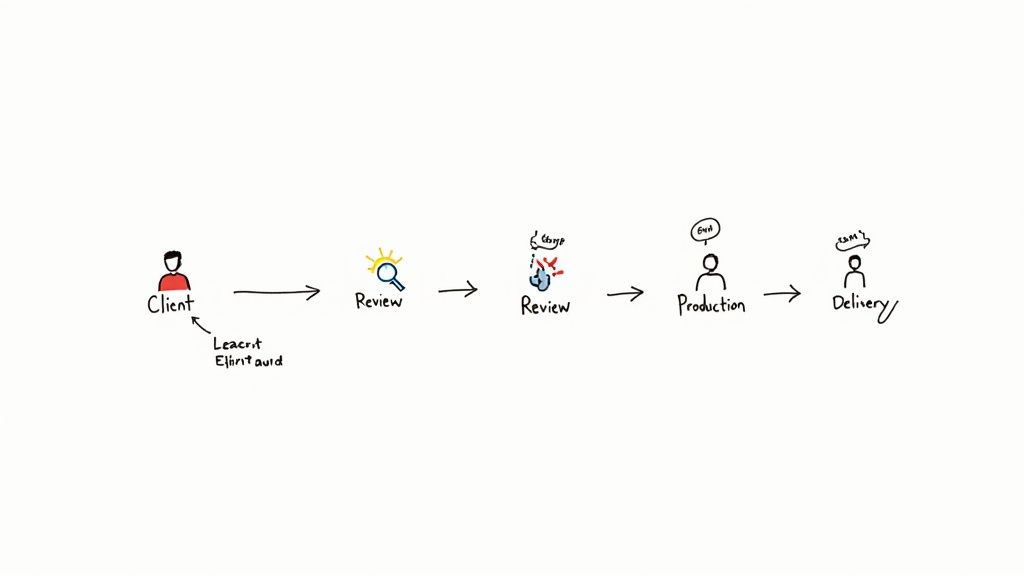
You can’t improve a process you don't fully understand. Start by mapping out your core workflows as they actually happen, not how they’re supposed to happen. Get in a room with a whiteboard or a simple tool like Miro and sketch out the journey.
For a standard client project, that might look something like this:
- Intake: A new lead fills out a form on your website.
- Assignment: The project gets handed off to a project manager.
- Kickoff: You schedule and hold a discovery call.
- Execution: Your team gets to work on the deliverables.
- Review: Drafts go to the client for their feedback.
- Revisions: You make changes based on that feedback.
- Final Delivery: The finished project is officially handed over.
Just getting this down on paper forces you to see every handoff, every decision, and every potential spot where things get stuck. It’s a simple exercise that gets the whole team on the same page.
Gather Ground-Level Intelligence
Your team knows where the bodies are buried. They live with the frustrating workarounds and the mind-numbing repetitive tasks every single day. If you want to know what's really broken, you have to talk to them.
The goal isn't to find fault; it's to find friction. When team members feel heard and know their insights are valued, they become active partners in building a more efficient system rather than passive participants.
Pull people aside for informal one-on-one chats or get small groups together. Ask open-ended questions like, "What's the most annoying part of your day?" or "If you had a magic wand, what's the one task you'd make disappear forever?" You’ll be amazed at the patterns that pop up.
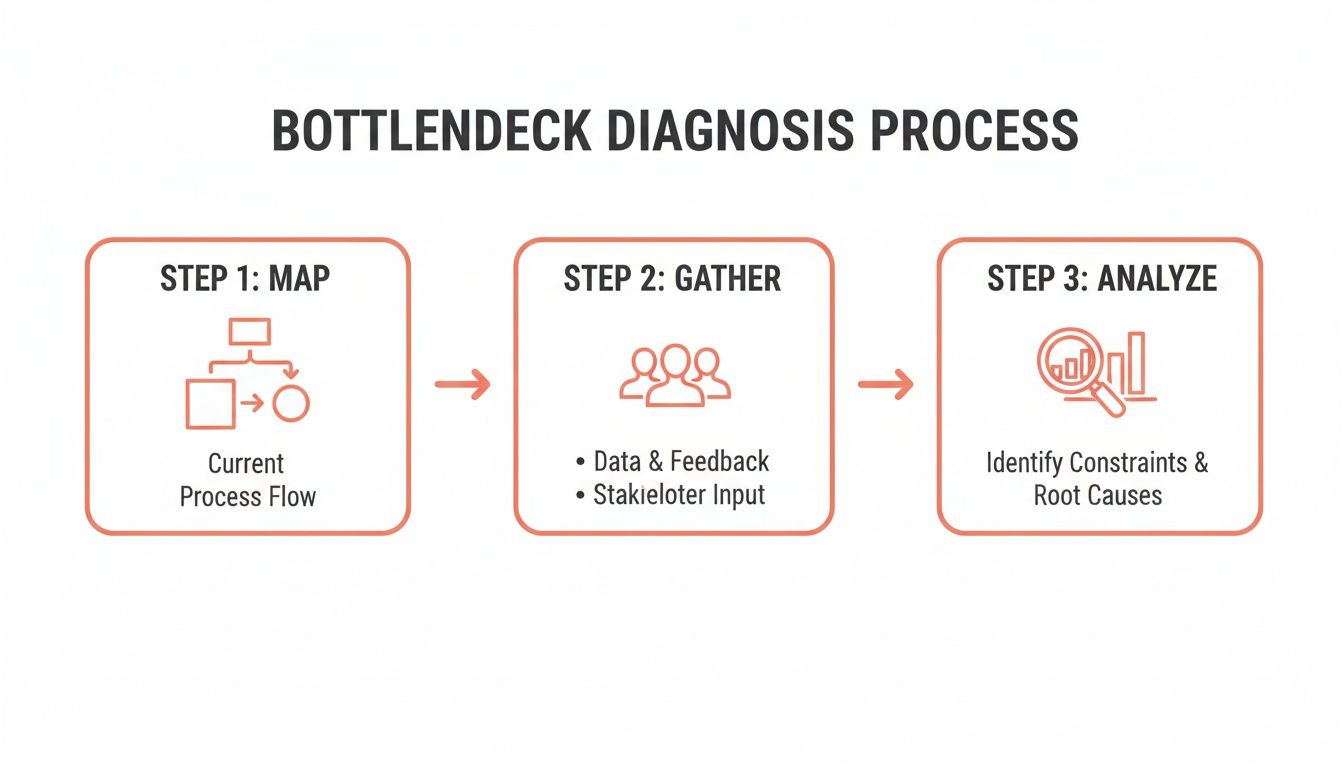
This process shows how a systematic approach—moving from a high-level map to human insights and finally to data-backed analysis—is the most effective way to figure out where to focus your energy.
Analyze Simple Data for Hidden Clues
Finally, back up what you've heard with some simple numbers. You don't need a fancy business intelligence dashboard for this. Just look at basic metrics that tell a story.
For example, you might look at your project management data and realize that 74% of your projects go through more than two rounds of client revisions. That's not just a hunch anymore; it’s a clear sign that something is off in your initial briefing or review process.
Or maybe you find that the average time from project completion to sending the final invoice is 12 days. That’s almost two weeks of cash just sitting there, pointing directly to a snag in your finance workflow.
These little data points are gold. They turn vague feelings into concrete, actionable problems. This whole diagnostic phase sets the foundation for everything else, making sure that when you do start making changes, you're fixing the things that will make the biggest difference.
Defining Success with Clear KPIs and Metrics
Once you’ve pinpointed the bottlenecks slowing your agency down, the next question is obvious: What does better actually look like? You can't improve what you don't measure. This is where Key Performance Indicators (KPIs) become your agency’s scoreboard, turning vague ambitions into tangible goals.
Without solid metrics, you're just guessing. You might feel like your team is busier than ever, but activity doesn't always equal progress. The real win is moving beyond vanity metrics (like the number of emails sent) and zeroing in on the data that truly reflects the health and profitability of your operations.
From Vague Goals to Specific Metrics
It's common for agency leaders to set goals that sound great but are impossible to track. Think "boost client happiness" or "make the team more productive." How do you put a number on that? The trick is to translate these broad objectives into specific, measurable figures.
For instance, "boost client happiness" is a fantastic goal, but it becomes actionable when you start tracking your Net Promoter Score (NPS) after each project wraps. Or, even simpler, track the number of revision cycles a project goes through. Fewer revisions almost always mean you nailed the brief, leading to happier clients.
In the same way, "make the team more productive" gets real when you measure your team utilization rate or the average project turnaround time. These numbers give you a crystal-clear picture of your team’s capacity and speed, showing you exactly where the improvement opportunities are.
KPIs That Truly Matter for Agencies
While your agency has its own unique rhythm, a few core KPIs offer a ton of insight for just about everyone in the service business. These are the metrics that cut through the noise.
Here’s a breakdown of some essential KPIs that we see the most successful agencies tracking.
| KPI | What It Measures | Operational Goal |
|---|---|---|
| Project Profitability | Revenue minus all direct costs, including billable hours. | Ensure every project contributes positively to the bottom line. |
| Team Utilization Rate | The percentage of an employee's time spent on billable work. | Maximize billable output without causing team burnout. |
| Average Billable Rate | The effective hourly rate you're actually earning on a project. | Identify if scope creep or inefficiencies are eroding your profits. |
| Process Cycle Time | The total time from project start to finish. | Shorten delivery timelines to increase capacity and cash flow. |
| Revision Cycles | The number of times a deliverable is sent back for changes. | Improve initial communication and the quality of first drafts. |
This isn't an exhaustive list, but it’s a powerful starting point for understanding where your time, money, and energy are really going.
A classic mistake is trying to track everything at once. Pick three to five KPIs that directly address the bottlenecks you’ve already identified. A cluttered dashboard quickly becomes an ignored one.
Building Your Efficiency Dashboard
You don’t need a fancy, expensive business intelligence tool right out of the gate. Honestly, a well-organized spreadsheet or a simple dashboard in your existing project management software like Asana or ClickUp is more than enough to get started. The important part is making the data visible and reviewing it regularly.
Make it a habit. Block off time in your weekly or monthly leadership huddles to go over the numbers. Ask the tough questions:
- What is this metric telling us?
- Why did it move up or down this week?
- What's one thing we can do next week based on this trend?
This simple routine turns your KPIs from a list of numbers into a powerful tool for driving real change. It builds a culture where decisions are backed by data, and every process tweak is measured by its impact on the metrics that matter most.
Time to Build Your Agency's Playbook
Once you’ve pinpointed your bottlenecks and have your KPIs dialed in, the next move is all about creating consistency. Running an agency without standard processes is like trying to run a professional kitchen where every chef makes the same dish their own way. The results are all over the place, quality is a guessing game, and training new cooks is a nightmare.
Real operational efficiency isn’t about luck; it’s built on a bedrock of clear, repeatable systems that take the guesswork out of daily work.
This is where your Standard Operating Procedures (SOPs) come into play. Forget the idea of rigid, bureaucratic manuals. Think of SOPs as your agency’s playbook—the best, most efficient way to get recurring tasks done right, every single time. It's how you empower everyone on the team to perform with the same confidence and quality.
From "Ask Steve" to a Documented Playbook
Let's be honest. In most agencies, the "process" for critical tasks lives inside the heads of a few key people. This “tribal knowledge” is a massive risk. What happens when that person goes on vacation, calls in sick, or worse, leaves the company? The whole system grinds to a halt, projects stall, and chaos takes over.
The goal here is to pull that invaluable knowledge out of people's heads and turn it into a simple, accessible guide that anyone can follow. Start by thinking about your core, repeatable workflows. Good candidates for your first few SOPs are usually things like:
- Client Onboarding: What are the exact steps from a signed contract to a successful project kickoff? Who’s responsible for gathering assets, setting up the project in Asana or ClickUp, and scheduling that first call?
- Project Kickoff Meetings: What's the standard agenda? What information do you absolutely need to collect from the client every single time to ensure the project starts smoothly?
- Content Creation & Review: How does a blog post or social media campaign move from a brief to a final, client-approved piece? Who needs to sign off at each stage? Map it out.
- Final Project Handoff: What does "done" actually look like? Detail exactly what files, reports, and access credentials the client gets at the end of an engagement.
Documenting these workflows instantly clarifies roles, sets clear expectations, and cuts down on the endless back-and-forth that kills productivity.
Creating Living Documents, Not Dusty Binders
The biggest mistake I see agencies make is treating SOPs as a one-and-done project. They create a beautiful document, save it to a shared drive, and it’s never seen again. An SOP is only valuable if it’s a living, breathing part of your daily operations.
To avoid creating a process graveyard, stick to these principles:
- Keep It Simple and Visual: Nobody wants to read a 20-page wall of text. Use checklists, annotated screenshots, and quick video recordings (a Loom walkthrough is perfect for this). Break it down into a simple, scannable list.
- Make Them Easy to Find: Don't bury your SOPs in a maze of folders. Put them where your team already works—a dedicated Slack channel, a Notion database, or right inside your project management tool.
- Assign an Owner: Every single SOP needs a designated owner who is responsible for keeping it current. When a tool gets an update or a process changes, their job is to update the documentation right away.
Your playbook does more than just reduce errors; it empowers your team. It frees up your senior talent from constantly answering the same basic questions, letting them focus on high-impact strategic work instead of being the process police.
But building a playbook is just one piece of the puzzle. Workforce and productivity metrics are just as critical. Recent survey data from 2024–2025 shows a bit of a disconnect; while 58% of tech leaders expected their budgets to increase in 2025, only 17% ranked improving processes as a top priority. This shows that many organizations are trying to balance new digital investments with cost pressures, when really, process improvements should be driving efficiency across the board. You can discover more insights about these technology leadership trends for a deeper dive.
By building this solid foundation of SOPs, you’re not just cleaning up your current workflows. You’re building the very structure you need to scale your agency effectively and profitably.
Get Your Systems Talking and Automate the Grunt Work
Once you’ve standardized your core processes, the next big win for your agency's efficiency is getting your tools to do the heavy lifting. This is where you claw back hours, slash human error, and rescue your team from the soul-crushing monotony of manual, repetitive tasks. Think of it as building a digital assembly line that handles the boring stuff, freeing up your people for strategy and creative work.
The modern agency runs on a whole stack of specialized software—a CRM for sales, a project management tool for delivery, maybe Slack or Teams for communication. When these systems don’t talk to each other, your team is forced to act as the human glue, constantly copying and pasting information between platforms. This isn't just slow; it’s a breeding ground for mistakes and a major source of frustration for your team.
Bridge the Gaps in Your Tech Stack
The goal here is to create a seamless flow of information. An action in one system should automatically trigger the next logical step in another.
Let's take client onboarding. When a deal is marked "won" in your CRM, a whole cascade of events should fire off without anyone lifting a finger:
- A new project pops up in Asana or ClickUp using your standard onboarding template.
- A private Slack channel is instantly created for the project team and the client.
- A welcome email sequence kicks off, sending the kickoff meeting scheduler and initial questionnaire.
That’s the real power of system integration. You’re not just saving a few minutes here and there; you're building a reliable, error-proof engine that runs your operations in the background.
Tools like Zapier and Make have become the central nervous system for thousands of agencies for this very reason. They let you connect different apps without having to write a single line of code.
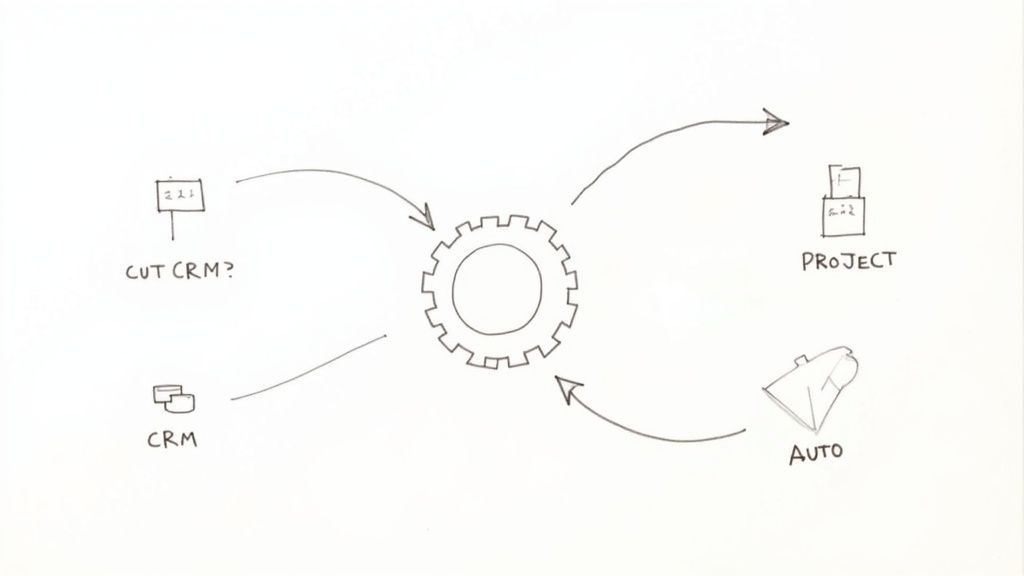
Here’s a classic example: a simple automation that connects a website form to your project management tool, instantly turning a new lead into a task for your team.
This visual setup shows how you can link a "trigger" (a new form submission) to an "action" (creating a task), completely removing the need for manual data entry.
Find the Best Candidates for Automation
You don't need to automate everything. The sweet spot is high-frequency, low-complexity work. Look for the recurring tasks that don’t require a ton of critical thinking but chew up a surprising amount of your team’s day.
Start by spotting the common "if-this-then-that" scenarios happening in your agency:
- If a project task is marked "Ready for Review," then ping the project manager in Slack.
- If a client support ticket sits unanswered for over 2 hours, then automatically escalate it to the support lead.
- If a project hits 75% of its budgeted hours, then send an alert to the account manager.
Automation isn't about replacing people. It's about augmenting them. When you let technology handle the tedious admin load, you free up your team to focus on the high-value work clients are actually paying for.
This focus isn't just an agency trend; it's a near-universal business priority. In a 2025 operations survey of 610 executives, a massive 93% of respondents said increasing operational efficiency was a top goal. What's more, 96% of tech and telecom leaders reported that digital tools gave them much better cost visibility. The same study also found that 62% of executives see AI as "very effective" at creating value through higher productivity. You can dive deeper into these findings in the PwC 2025 Digital Trends in Operations Survey.
By connecting your systems and putting these routine workflows on autopilot, you shift from being reactive—constantly chasing down information and fixing mistakes—to being proactive. Your processes just run themselves. That shift is absolutely fundamental if you want to scale your agency without just throwing more people at every problem.
Bring in AI and Assistants to Power Up Your Workflow
Once you’ve standardized your processes and connected your core systems, you have a solid operational engine. Now, it's time to add the high-octane fuel. This is where you bring in Artificial Intelligence (AI) and specialized assistants to create a workflow that’s not just efficient, but genuinely smart.
Let's be clear: this isn't about replacing your talented people. It's about giving them superpowers. Think of AI as the ultimate junior team member—one that can draft, research, and analyze at an incredible pace, freeing up your team for the strategic, high-value work that actually grows the business.
From First Drafts to Quick Insights
AI has moved beyond sci-fi and into the everyday toolkit of savvy agencies. We're seeing teams get immediate wins by using AI to bust through common bottlenecks in creative and strategic work.
For instance, that dreaded blank page is becoming a thing of the past. Instead, your team can use AI to:
- Generate initial content briefs: Plug in client goals and audience info to get a structured brief complete with key themes, headline ideas, and SEO keywords.
- Draft marketing copy: Get first drafts for social media updates, ad copy, or email campaigns that your team can then polish and perfect.
- Summarize research: Feed AI a lengthy report or a client interview transcript and get back a clean, bulleted summary in moments.
This approach massively shortens the "time to first draft," which means your team can jump straight to editing, strategizing, and adding that uniquely human creative spark.
Delegate the Administrative Drag
Besides content, the single biggest drain on any skilled team is administrative overhead. These are all the necessary evils that eat away at productive, billable hours. This is the perfect place to deploy a virtual assistant (VA) or other specialized support.
A good VA can take over the countless tasks that pull your senior people away from actual client work.
Here are some of the most common things we see agencies offload:
- Scheduling & Calendar Juggling: Coordinating meetings across different time zones is a classic time-sink.
- Data Entry & CRM Hygiene: Making sure client records are current and new leads are logged correctly.
- Basic Research: Pulling together lists of outreach targets or finding preliminary industry stats for a new project.
- Report Prep: Grabbing data from different platforms and dropping it into your standard weekly or monthly report template.
By handing off this work, you're not just saving time; you're protecting the focus and energy of your most critical thinkers. This is a direct line to improving operational efficiency.
Don't think of delegation as just offloading work. You're creating capacity. Every hour a senior strategist spends scheduling meetings is an hour they're not building a client's growth plan.
The financial upside here is real. Companies that have jumped on AI and automation are seeing serious gains. Industry data shows these technologies can drive logistics cost reductions of about 15%, cut inventory by roughly 35%, and boost service-level efficiency by nearly 65%. These figures aren't abstract; they show how smarter, AI-driven planning directly impacts the bottom line. You can read the full analysis of these supply chain statistics to dig deeper.
Building a Leaner, Smarter Agency
Bringing AI and assistants into the fold isn't a one-and-done project. It’s about developing a new instinct across your organization. The goal is to get everyone asking, "Could an AI or an assistant do this faster?"
My advice? Start small. Pinpoint one or two repetitive, high-friction tasks inside a single team. Pilot a new tool or hire a part-time VA to focus only on that workflow. Track the time saved and, just as importantly, ask the team how it feels.
Once you prove the value in one spot, you can start expanding the model across the rest of the agency. This deliberate, phased approach ensures you build a smarter, more resilient operation—one where technology truly empowers your people to do their absolute best work. The result is an agency that produces more, better work without just throwing more people at the problem.
Frequently Asked Questions
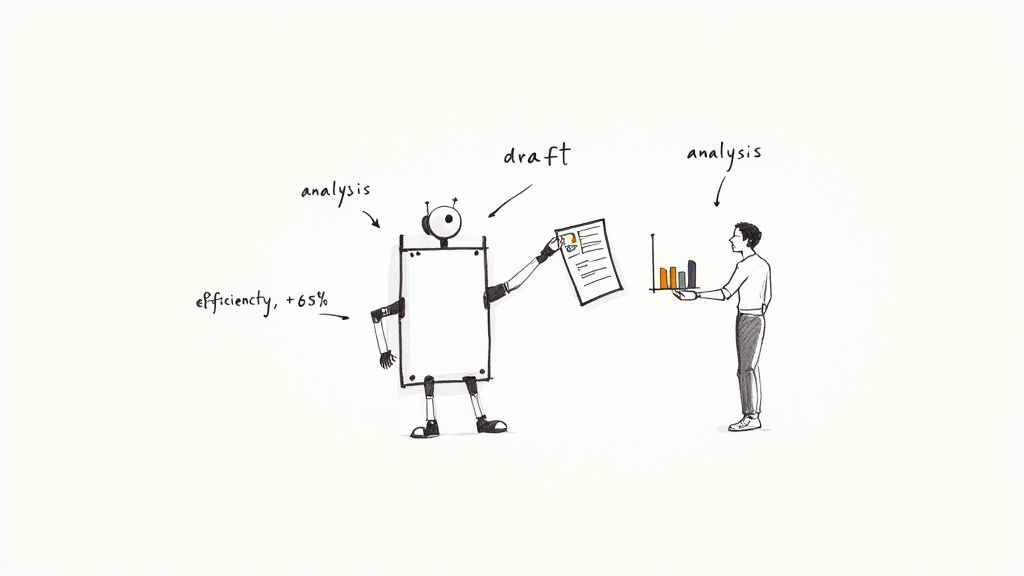
As you start pulling on these threads, you’re bound to have questions. This isn't about ticking boxes on a checklist; it's a living, breathing part of running your agency. I've gathered some of the most common questions and concerns that come up when leaders like you start putting these ideas into practice.
Let’s get into some of the real-world hurdles you're likely to face.
Where Should I Start Improving Operational Efficiency on a Tight Budget?
You don't need a huge budget to make a real difference. In fact, some of the highest-impact moves cost nothing more than your time and focus.
The best place to begin is almost always process mapping. Grab your team, pick one core process that feels like a mess—client onboarding is a classic culprit—and just map out every single step on a whiteboard. I guarantee you'll spot redundancies, communication breakdowns, or weird workarounds that can be fixed on the spot, no new software required.
Focus on these low-cost, high-return moves first:
- Create simple checklists: Make sure every project kickoff or creative handoff follows the same essential steps.
- Define communication channels: Establish a simple rule like, "Client feedback lives in the project tool, urgent questions go to Slack." This alone can save hours of confusion.
- Run a "gripe session": Seriously. Book an hour for the team to vent about their biggest daily frustrations. The solutions are often hiding in those complaints.
Nailing these fundamentals gets the human side of your operations sorted out. That creates a solid foundation for any tech you might decide to invest in later on.
How Do I Get My Team on Board with New Processes and Tools?
Here's a hard truth: without your team's buy-in, even the most brilliant new process is doomed. The secret is to make them partners in the change, not just recipients of it. Resistance isn't about stubbornness; it's about feeling like change is being done to them.
So, don't just drop a new SOP or tool on their desk. Bring them into the conversation from day one. Ask them what's broken. Ask them what would make their jobs easier. Frame the changes as the solution to their problems, not just another way for management to track things.
A pro tip: always start with a small pilot program. Find a few people on the team who are excited about the change and let them test the new process on a single project. Their success stories will do more to convince the skeptics than any memo you could ever write.
What Are the Most Common Mistakes Businesses Make When Trying to Improve Efficiency?
So many agencies try to get more efficient and end up spinning their wheels. It's almost always because they fall into one of a few classic, and completely avoidable, traps.
The biggest mistake, by far, is buying tech before understanding the process. A leader sees a shiny new tool, thinks it's a silver bullet, and buys it. But without a clear workflow to plug it into, the software just adds another layer of complexity. Always map out the process first, then find a tool that fits it—never the other way around.
Another common pitfall is the "set it and forget it" mentality. Improving your operations isn't a one-and-done project. It's a constant cycle of doing, measuring, and tweaking. Your SOPs should be living documents that evolve as your agency grows.
Finally, and this is a big one, don't neglect the human element. If a new process makes your team's life harder or they don't understand the "why" behind it, they'll just go back to the old way of doing things the second you turn your back. Communication and training aren't optional—they're how you make change actually stick.
Tired of duct-taping your agency's operations together with a dozen different tools that don't talk to each other? RGK is the unified operating system built for agencies, by an agency. Stop fighting your software and start scaling your business with a single source of truth for projects, clients, and billing. Discover how RGK can streamline your agency's workflow today.