Discover how to scale a service business with proven systems

To truly scale a service business, you have to break free from the "hours-for-dollars" trap. It all comes down to three things: systemization to make your processes repeatable, productization to standardize what you sell, and leverage to get more done with the same team. The real secret is shifting your role from doing all the work to architecting the system that does the work. That's what unlocks real, sustainable growth.
Why Most Service Businesses Get Stuck
If you're running a service business, this probably sounds familiar. You're stuck on an operational treadmill. Every time you land a new client, you're not just adding revenue—you're adding complexity and more hours to your own plate. You’re caught in a cycle where growth just means working harder, not smarter. This is exactly why so many talented founders hit a revenue ceiling and burn out.
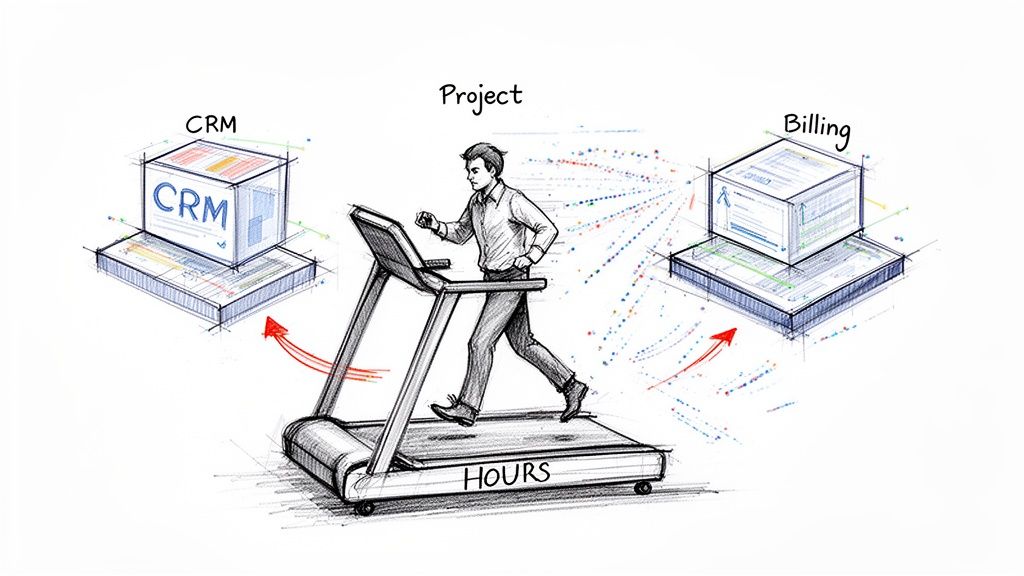
The roadblock isn't a lack of skill or talent. It's the operational drag created by a jumble of disconnected systems and a total lack of standardized processes.
The Chaos of Disconnected Systems
Most agencies and service providers I've seen are held together by a patchwork of software. The CRM has the client info, a project management tool tracks the actual work, and another system handles the billing. On their own, each tool is fine, but they don’t talk to each other. This creates a mess behind the scenes.
Think about the last time you onboarded a new client. Notes from the sales call had to be manually typed into your project tool. The scope of work lived in a completely separate document. And time tracking? That was probably happening somewhere else entirely. This constant, manual data entry isn't just slow—it's where mistakes happen, communication breaks down, and profits start to leak.
The core challenge of scaling isn't about getting more leads; it's about building a delivery machine that can handle them without breaking. Your focus must shift from just 'doing the work' to architecting a system that delivers consistent value, every single time.
Architecting Your Delivery Machine
To finally get off that treadmill, you need a different way of thinking. Stop looking at your business as a series of one-off client projects. Instead, start seeing it as a single, integrated delivery machine. This mindset is the key to figuring out how to scale a service business for the long haul.
This guide is your roadmap for making that shift. We'll focus on the three pillars that support real growth:
- Systemization: We're talking about documented, repeatable processes (SOPs) for everything that matters—from how you welcome a new client to how you deliver the final report.
- Productization: This is where you turn your custom services into standardized packages. Think clear deliverables, set pricing, and no more reinventing the wheel for every new project.
- Leverage: It's all about using technology and a smart team structure to amplify what each person can do. This allows you to serve more clients without you, the founder, being the bottleneck.
By dialing in these three areas, you can finally build a business that grows with you, not just because of you. Let's dive into the actionable steps to make it happen.
Laying the Groundwork to Scale Your Business
Before you even think about chasing more clients or hiring your next team member, you have to look under the hood. The truth is, most service businesses aren't built to handle rapid growth. Scaling on a shaky foundation is a recipe for disaster—it's like trying to build a skyscraper on sand. It will eventually come crashing down.
The first real step is to get a handle on what you sell and how you deliver it. This means you have to stop the madness of endless custom proposals and one-off projects. It's time to productize your services.
Package Your Services for Simplicity and Speed
Productizing simply means packaging your expertise into a handful of clear, repeatable offers. Each package has a defined scope and a set price. This is, without a doubt, the fastest way to simplify your sales process and bring consistency to your operations.
Let’s take a web design agency as an example. Instead of drafting a new proposal for every lead that comes in, they could offer three distinct packages:
- Launch Package: A five-page starter website using a proven template—perfect for a business just getting off the ground.
- Grow Package: A more robust ten-page site that includes foundational SEO and a content strategy session.
- Scale Package: A full-blown e-commerce build with all the bells and whistles for established brands ready to grow their online sales.
See how much clearer that is? This tiered model does the heavy lifting for you. Prospects can practically qualify themselves based on their budget and needs, which cuts your sales cycle down dramatically. You’re no longer reinventing the wheel on every sales call; you’re guiding people to the best solution you’ve already built.
When you shift from custom work to productized packages, you transform your business from a bespoke art project into a well-oiled machine. It’s the key to creating repeatable systems, training people effectively, and actually being able to forecast your revenue.
This isn't just a theoretical change. We've seen businesses boost their efficiency by 20-30% just by cutting out the wasted time on custom scoping and proposal writing. If you're serious about scaling, this is non-negotiable.
Get Brutally Honest with an Operational Audit
Okay, so you know what you’re selling. Now you need to take a hard, honest look at how you’re delivering it. An operational audit isn't about pointing fingers. It's about uncovering the hidden friction—the little things that slow you down, frustrate your team, and eat away at your profit margins.
The goal here is to map out your entire client journey, from the first "hello" to the final invoice.
Grab your team, a whiteboard (or a Miro board), and trace every single step. At each stage, you need to ask some tough questions:
- Onboarding: How does a new client’s information get from sales to the delivery team? Is someone manually copy-pasting data between systems?
- Kickoff: What are the exact steps to get a project started? Who owns each task? Is anything ambiguous?
- Execution: Where do handoffs happen? Are they seamless, or is that where projects go to die?
- Reporting & Delivery: How do we create client reports? Is it a standardized process, or does every project manager have their own "special" way of doing it?
- Offboarding: What’s the final checklist before we call a project "done"? How long does it take us to send that final invoice?
When you map it all out visually, the bottlenecks become glaringly obvious. Maybe you realize projects are always delayed because your initial asset request email is vague. Or perhaps the delivery team is constantly missing key details because the handoff from sales is just a verbal conversation. These tiny friction points multiply into huge problems as you add more clients.
I once worked with a marketing agency that discovered they were wasting an average of three hours per client just on email back-and-forth to get social media access. By creating a single, secure form for credentials during onboarding, they instantly reclaimed that time. That’s three hours back per client to spend on work that actually matters.
Fixing these small inefficiencies now is critical. If you don't, you'll just be scaling broken processes, which only leads to bigger, more expensive chaos down the line. This audit will give you your hit list—a clear, actionable set of problems to solve first.
Designing Your System for Repeatable Delivery
If you want to scale, consistent, high-quality delivery is non-negotiable. Without it, growth just means more chaos, more mistakes, and more fires to put out. Building a system for repeatable delivery is how you essentially clone your best work, empowering your team to execute flawlessly—even when you’re not in the room. This is where you build your operational engine.
This engine runs on two core components: documented processes and a central hub for all project and client information. This isn't about creating rigid, bureaucratic rules. It's about establishing clear, simple guardrails that reduce mental load and eliminate guesswork. The goal is to make the "right way" of doing things the easiest way.
This systematic approach is more critical than ever. Service-based businesses make up over 70% of U.S. small business GDP and employ millions. We're all under immense pressure to scale intelligently as client demands for faster delivery and seamless experiences skyrocket. A well-designed system is your secret weapon. For more on this, check out these insights on the latest service business trends.
Create Actionable Standard Operating Procedures
Forget the dusty, three-ring binder of procedures that no one ever reads. Modern Standard Operating Procedures (SOPs) need to be dynamic, living documents built directly into your team's daily workflow. Think of them as the tactical instruction manuals for every critical task your business performs.
You have to start somewhere, so begin by documenting your highest-impact processes. Don't try to boil the ocean. Just focus on the tasks that are either repeated constantly or carry the highest risk if done wrong.
Good candidates for your first few SOPs include things like:
- Client Onboarding Checklist: Every single step, from collecting brand assets to scheduling the kickoff call. Leave nothing to chance.
- Project Kickoff Process: The exact agenda and task sequence to get a new project off to a perfect start.
- Monthly Reporting Guide: A step-by-step on how to pull metrics, format the report, and add client-specific insights that show value.
- Quality Assurance Protocol: A final review checklist to ensure every deliverable is buttoned up and meets your quality standards before it hits the client's inbox.
For each SOP, I recommend a mix of simple checklists, short video tutorials (using tools like Loom), and clear, concise text. The key is to make them easy to follow in the heat of the moment.
Build Your Single Source of Truth
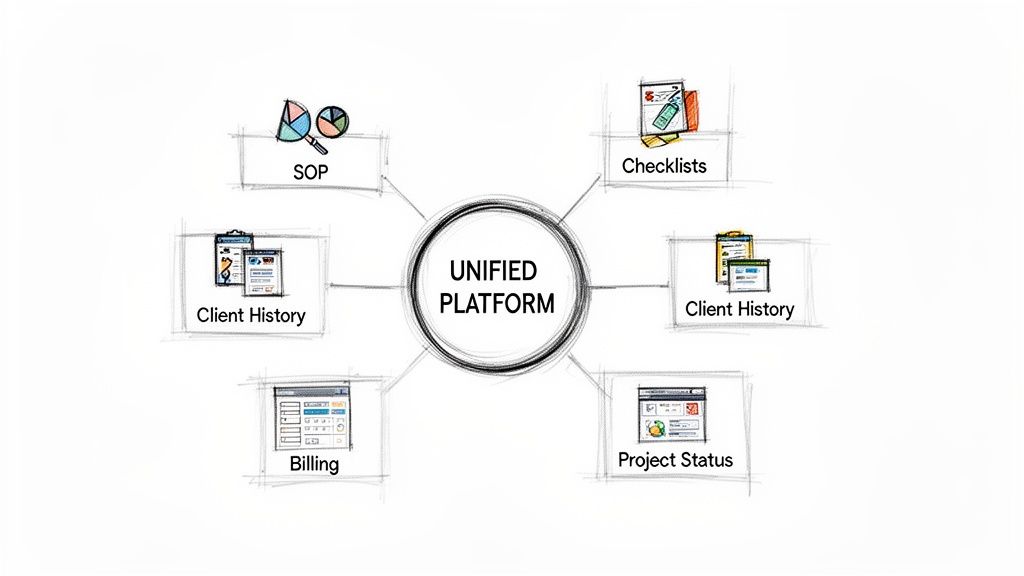
One of the biggest drags on a growing service business is scattered information. You know the drill: client history lives in the CRM, project tasks are in one tool, key conversations are buried in Slack, and billing is in another system entirely. This kind of fragmentation is a recipe for expensive errors and wasted time.
A single source of truth (SSoT) fixes this. It's a unified platform or a tightly integrated set of tools where all critical business information resides. When a team member needs to know a client's history, the status of a project, or the details of a support ticket, they know exactly where to look. No more hunting.
This concept is a game-changer. Instead of frantically searching through email chains or pinging colleagues for context, your team can operate with confidence and autonomy. Imagine a junior project manager being able to instantly access a client's entire project history, past invoices, and all support communications without having to interrupt a senior team member. That's the power of an SSoT.
A single source of truth isn't just a productivity hack; it's a foundational element for delegation. It gives you the peace of mind to hand off high-stakes work because you know your team is operating with the complete, correct information.
Choosing the Right Tools for Your System
The tools you choose will either support or undermine your entire system. It's tempting to chase the latest shiny object, but the best tech stack is the one your team will actually use consistently. My advice is to focus on platforms that prioritize integration and centralization.
Here’s a practical way to think about building your tech stack:
- Start with a Core Hub: Select a primary platform to act as your SSoT. This is often a robust project management tool or a specialized agency operating system like RGK.
- Integrate Crucial Spokes: Connect essential tools for communication (like your team chat app) and finance (like your accounting software) directly into that central hub.
- Document Tool Usage in Your SOPs: Your SOPs must specify which tool to use for which task. For example, an SOP might state, "All client-facing communication must be logged as a comment on the relevant project task in [Your PM Tool]."
This deliberate approach to tooling prevents the "wild west" of using random apps for critical functions. It reinforces your system, breaks down information silos, and ensures your single source of truth stays reliable as you grow. This operational clarity is what separates businesses that scale smoothly from those that crumble under their own success.
Hiring and Structuring Your Team for Scale
As you grow, the temptation is to just throw more people at the work. Don't do it. Simply adding to the payroll is the quickest way to kill your profit margins and create a management headache you’ll never escape.
Scaling your team is really about intelligent design. The goal is to hire for specific functions inside the systems you’ve already built, not just to fill a seat. Your SOPs become the blueprint, telling you exactly what roles you need. Instead of a generic "Project Manager," you can now hire a "Client Onboarding Specialist" whose job is mapped directly to your onboarding checklist.
This little shift makes your hiring process faster, more precise, and a whole lot more effective.
Building a Blended, Cost-Effective Team
You don't need a roster of expensive, senior-level experts to scale. In fact, that's one of the most common mistakes I see founders make. A much savvier approach is building a blended team that balances cost with skill, giving you the horsepower you need without the massive overhead.
Here’s what that looks like in practice:
- Junior Staff: Think of them as your executors. Their job is to follow your meticulously crafted SOPs and handle the day-to-day delivery. They're cost-effective and, when plugged into a great system, incredibly productive.
- Specialized Contractors: Need a top-tier copywriter for a specific campaign or a data analyst for a one-off project? Bring in a specialist on a contract basis. You get access to A-level talent without the long-term commitment of a full-time salary.
- Senior Mentors: The role of your experienced people needs to change. They should graduate from being "doers" to being mentors and strategists. Their job is to QA the work, solve the truly tough problems, and guide the junior team—not get bogged down in every single task.
This model keeps your fixed costs low and gives you the flexibility to handle a huge variety of client work. Your senior talent becomes a force multiplier, spreading their expertise across the entire portfolio instead of being trapped on one or two accounts.
To illustrate the difference this makes, let's compare the old way of scaling an agency with this more modern, system-led approach.
Scaling Models Comparison: Traditional vs System-Led
| Attribute | Traditional Scaling | System-Led Scaling |
|---|---|---|
| Hiring Focus | Adding senior-level "doers" to handle more work. | Hiring junior staff to execute proven systems. |
| Cost Structure | High fixed costs; payroll balloons with each new client. | Low fixed costs; flexible use of contractors keeps overhead down. |
| Owner's Role | Deeply involved in daily operations; becomes a bottleneck. | Focused on strategy and growth; removed from the day-to-day. |
| Efficiency | Relies on individual heroics; inconsistent and hard to predict. | Driven by systems and SOPs; highly consistent and predictable. |
| Profitability | Margins shrink as headcount and management complexity grow. | Margins increase as systems create more leverage. |
As you can see, the system-led model is built for sustainable growth, freeing you up to work on the business, not just in it.
Using AI as Your Ultimate Force Multiplier
This is where things get really powerful. Modern AI tools, like the ones we’ve built into our platform at RGK, can act as an incredible force multiplier for your team. When an AI has context on all your client history, SOPs, and project data, it gives your junior team members the institutional knowledge they would otherwise take years to develop.
Imagine a new support agent getting an instant, accurate answer by asking the system, "What was the fix for Client X's last billing issue?" They can suddenly perform at a level far beyond their experience.
By baking AI directly into your operations, you're giving your team the guardrails and context to make smart, independent decisions. This turns your senior people into strategic overseers, not firefighters, and lets you scale delivery without a linear increase in senior headcount.
Keeping Communication Clear with an Org Chart
As you grow beyond a handful of people, informal "tap on the shoulder" communication falls apart. You end up with a tangled mess of DMs and email threads. This is where a simple organizational chart becomes essential.
This isn't about stuffy corporate bureaucracy; it's a practical tool for clarity. It answers crucial questions like, "Who do I talk to about a billing problem?" or "Who has the final sign-off on creative?" A simple chart prevents crossed wires and makes sure everyone understands how information and decisions are supposed to flow.
This becomes especially critical as you add more services. In fact, a recent study found that 97% of MSPs plan to expand their offerings, adding an average of six new services. You can read more about these industry growth statistics to see the trend. Without a clear team structure, that kind of expansion is a recipe for chaos.
When you combine precise roles, a blended team, AI-powered support, and a clear org chart, you create a framework for hiring that truly supports profitable, sustainable growth.
Winning and Keeping the Right Clients
You've done the hard work of building a scalable delivery engine. Now, it's time to turn on the faucet. But scaling isn't just about chasing every possible lead; it's about attracting the right clients and making sure they stick around for the long haul. Your new productized services are the key, giving your sales team a clear, consistent playbook for closing deals.
The real magic, though, isn't in the initial sale. It's in retention and expansion. We've all heard it a thousand times: it costs way more to land a new customer than to keep an existing one. Great, systemized service is your best retention tool, turning what could have been a one-off project into a predictable, long-term revenue stream.
Building a Sales Machine That Runs Itself
Your standardized packages are the fuel for this machine. You can finally stop reinventing the wheel with every custom proposal. The conversation completely changes from a vague, "So, what can we build for you?" to a confident, "Which of our proven solutions is the best fit for your goals?"
This shift makes your sales process something you can actually teach and scale. You can bring on a junior salesperson, train them on the value of each package, and arm them with case studies and clear deliverables. They don't have to be a senior strategist to sell, because the strategy is already baked right into your offers.
Getting this operational alignment right is a massive challenge for most agency owners. While a recent report found that 78% of small business owners plan to grow and 69% are optimistic about their finances, they're often held back by disconnected tech and clunky manual processes. It’s a classic case of growth being limited by a lack of smart systems. If you want to dive deeper into these challenges, you can check out the full small business growth report.
Look Beyond Acquisition: Retention is King
Winning a new logo feels fantastic, but the agencies that truly print money are masters of retention. The metric you need to become obsessed with is Net Revenue Retention (NRR). This number tells you how much your revenue from existing customers grew or shrank over a period, factoring in both upsells and churn.
An NRR over 100% is the holy grail. It means your existing clients are spending more with you over time, even after you lose a few. You're literally growing your business without signing a single new client. That's the sign of an incredibly healthy, scalable service.
Getting to a high NRR doesn't happen by accident. You can't just do good work and cross your fingers, hoping clients will stay. You need to build systems that actively create opportunities for them to buy more from you.
Systematize Your Upsells and Cross-Sells
This is where your integrated platform becomes your secret weapon. With all your client communication, project data, and support tickets living in one place, you can set up automated triggers that practically hand-deliver expansion opportunities to your team.
Here’s what this looks like in the real world:
- Post-Project Plays: Imagine a client's "Website Launch" project is marked complete. The system can automatically create a task for their account manager to schedule a 60-day check-in. The goal of that meeting? To introduce the "SEO Foundation" package and show them how to get traffic to their shiny new site.
- Service Usage Alerts: Let's say a client on your "Basic" support plan blows past their ticket limit for the month. Instead of just dealing with the overload, the system flags it for the account manager. This is the perfect, data-backed reason to have a conversation about upgrading to the "Pro" plan.
- Smart Cross-Sell Nudges: When a new client signs on for your content marketing service, your system could automatically tag them as an ideal fit for your paid ads management package. The account manager gets a heads-up to bring it up in their next quarterly business review.
This isn't about being a pushy salesperson. It's about using the data you're already collecting to anticipate what your clients need next and genuinely help them. When you embed these kinds of triggers into your day-to-day operations, you turn expansion from a hopeful "maybe" into a predictable, proactive process. This is how you build true partnerships, lock in recurring revenue, and prove that exceptional service is the most powerful growth strategy you have.
Your 90–180 Day Roadmap to a Scalable Business
Alright, let's turn all this theory into reality. The biggest hurdle I see when people try to scale is getting lost in the "how." It's easy to feel overwhelmed and try to fix everything at once. That's a recipe for burnout.
Instead, we're going to break this down into a manageable 90-day plan. Think of it as three focused sprints, each building on the last. This creates momentum and gives you tangible wins along the way, turning a mountain into a series of small, climbable hills.
Month 1: The Audit and Productize Sprint
The first 30 days are all about discovery and focus. Before you start building anything new, you need a crystal-clear picture of what’s actually happening in your business right now. We're looking for the good, the bad, and the ugly.
Your mission this month is twofold:
- Run a Full Operational Audit: Get a whiteboard (physical or digital) and map out your entire client lifecycle. I mean everything—from the first "hello" to the final payment and offboarding. Where are the bottlenecks? What tasks are you doing over and over again manually? Pinpoint every single friction point that's costing you time or creating headaches.
- Productize Your Core Service: Armed with insights from your audit and real client feedback, it's time to simplify. Define one to three core service packages. No more custom-quoting every single project. Standardize the scope, nail down the deliverables, set a clear timeline, and establish fixed pricing. This is the single most important step toward creating a service that can be delivered repeatably.
Month 2: The Document and Build Sprint
Now that you have a streamlined, productized offer, it's time to build the operational machine that will deliver it. This month is all about getting the processes out of your head and into a system your team can follow.
This is where you build the foundation for a consistent client experience—one that not only helps you land new business but keeps clients happy and grows their accounts over time.
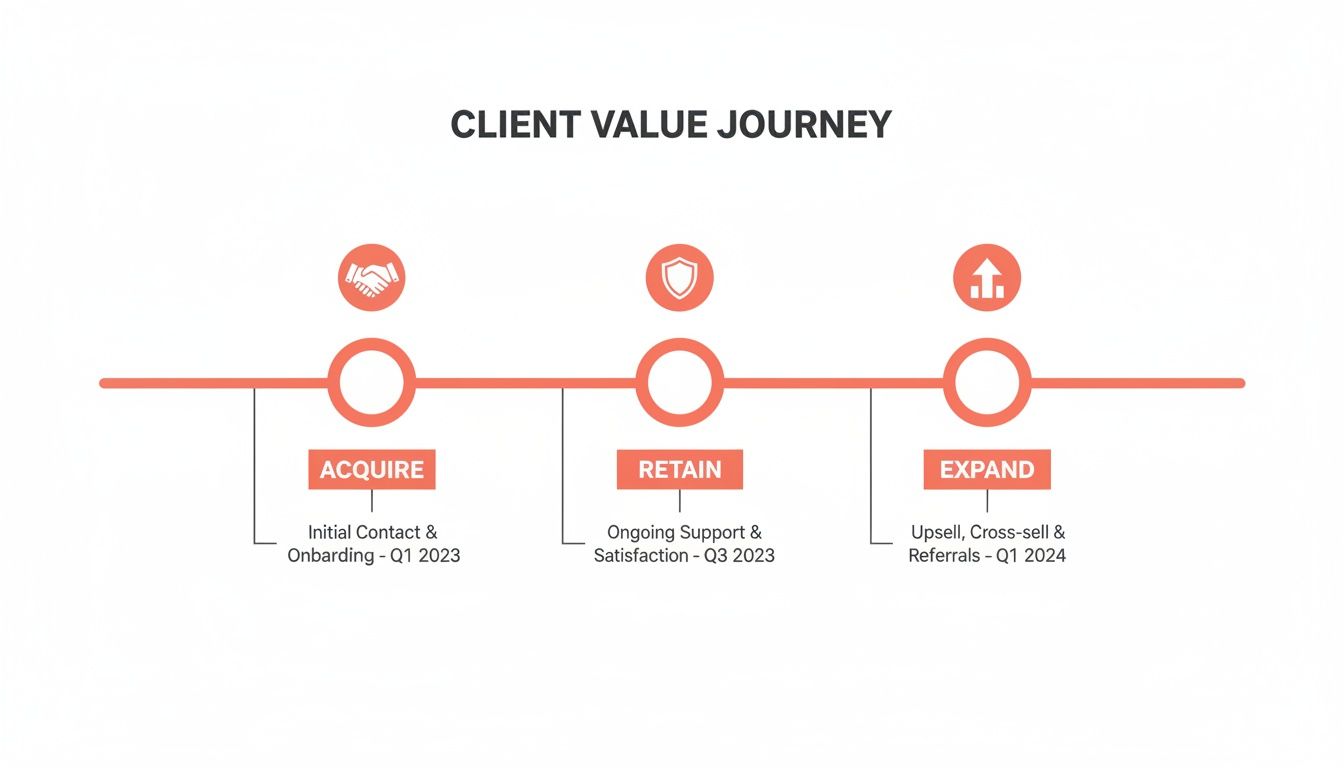
The goal here isn't just efficiency; it's about creating a predictable, high-quality experience that turns one-off projects into long-term partnerships.
By the end of this month, you should have the first version of your company "playbook." This isn't just a document; it's the key to empowering your team and freeing yourself from the day-to-day grind.
Month 3: The Train and Refine Sprint
Your final 30-day sprint is all about putting your new systems into action. A perfectly documented process is useless if nobody on the team knows how to use it—or worse, if it doesn't actually work in the real world. This is where the rubber meets the road.
Here's how you'll close out the 90 days:
- Train the Team: Don't just send a memo. Hold dedicated training sessions. Walk everyone through the new standard operating procedures (SOPs) and tools. Let them ask questions, push back, and really understand the "why" behind the changes.
- Run a Pilot Project: Pick one new or trusted client and run their project through your new system from start to finish. This is a live-fire exercise to see how everything holds up under pressure.
- Gather Feedback and Iterate: After the pilot, bring everyone together. What worked? What felt clunky? Get honest feedback from your team and even the client. Use these insights to make a final round of tweaks and polish your process.
Common Questions About Scaling a Service Business
Moving from a do-it-all founder to the leader of a scalable business is a huge shift, and it naturally comes with a lot of questions. Let's tackle some of the most common hurdles I see service business owners face when they start this journey.
When Is the Right Time to Start Building Systems?
Honestly, the best time to start was yesterday. The second-best time is right now.
A clear sign you've waited too long is when you, the owner, have become the bottleneck for every decision, every approval, every single thing. If the business can't function for a week without you checking your phone on vacation, it's past time to systemize.
Start documenting your core processes when you have a handful of clients—maybe five or so. Don't wait until you're drowning with 50 clients and the whole operation feels like it's on fire. Being proactive here prevents you from making rushed, sloppy decisions under pressure.
How Do You "Productize" a Creative Service Without Killing the Magic?
This is a big one for designers, writers, and strategists. Productizing a creative service isn't about churning out cookie-cutter work; it's about standardizing the process that leads to great outcomes.
Think about it in terms of a repeatable workflow. You can map out distinct phases that every project moves through:
- Discovery & Kickoff
- Strategy & Concepting
- Execution & Revisions
- Final Delivery & Handoff
From there, you bundle these phases into clear packages with defined deliverables, timelines, and a fixed price. For example, a "Brand Identity Package" gives the client a predictable result and gives your team a predictable workload. It takes the "how much will this cost?" guesswork completely off the table.
Solid SOPs aren't about micromanaging. They automate the 80% of routine work—like how to name files, onboard a new client, or format a report. This frees up your team's brainpower to focus on the 20% of the work that actually requires their creative genius.
Won't Standard Operating Procedures (SOPs) Stifle My Team's Creativity?
It’s a fair question, but in my experience, it’s the exact opposite. Good SOPs don't restrict creativity; they enable it. They provide the guardrails and a solid foundation, giving your team the confidence and autonomy to do their best work.
When your team isn't bogged down trying to remember a dozen administrative details or reinventing the wheel on every project, they have more mental energy to spare. That energy gets channeled directly into solving tough client problems and delivering amazing results—the very stuff you hired them for.
When client history, project details, and billing information are scattered everywhere, your team spends more time hunting for info than doing great work. RGK brings it all together into a unified platform, eliminating the frantic search and empowering your team to operate with confidence. Discover how RGK can become your single source of truth.