Unlocking Knowledge Management System Benefits for Your Agency


The benefits of a knowledge management system really boil down to one thing: turning your agency's chaotic, scattered information into an asset you can actually use. This simple shift stops the endless cycle of wasted time, leads to better client results, and builds a more efficient, profitable business. How? By giving your team a single source of truth.
The Hidden Costs of Disorganized Agency Knowledge
Think of your agency as a world-class orchestra. Now imagine every musician has a different sheet of music. The sound would be a mess—dissonant, chaotic, and frustrating for everyone, especially the client paying for the performance. This is what it’s like to run an agency without a central knowledge hub.

The costs of this disorganization are very real, and they go way beyond simple annoyance. Your team members lose countless hours just trying to find the right document, Slack message, or email thread. This constant context-switching absolutely kills productivity and is a fast track to burnout.
The Ripple Effect of Information Chaos
When information lives in silos, every new project feels like you're reinventing the wheel. Account managers draft new proposal templates, designers try to rebuild brand guidelines from memory, and developers solve the same coding problem for the third time this quarter. This constant churn eats directly into your profit margins.
This friction shows up in painful ways that slowly chip away at your agency's performance:
- Duplicated Work: Your team wastes billable hours recreating assets and re-documenting processes that already exist somewhere in the digital clutter.
- Inconsistent Deliverables: Without a central playbook, the quality of your client work can swing wildly from one person to the next.
- Slow Onboarding: New hires get stuck in a frustrating loop, forced to interrupt busy colleagues with the same questions instead of finding answers in a structured knowledge base.
The operational drag is no small thing. In high-performing organizations, only 36% of their agents are stuck juggling multiple screens for information. Compare that to 58% in underperforming companies. The data shows a direct link between organized knowledge and the speed of your operation.
This inefficiency isn't just an internal headache; it directly impacts your client relationships and your bottom line. An agency’s most valuable asset is its collective expertise. When that expertise is disorganized, its value drops with every missed deadline and inconsistent deliverable.
You can dig deeper into these knowledge management trends and statistics yourself, but the conclusion is clear. The need for a better way to manage your agency's knowledge becomes impossible to ignore.
Alright, let's get into what a knowledge management system actually is.
After wading through the chaos of scattered information, it's clear agencies need a better way. A Knowledge Management System (KMS) isn't just another tool you add to your tech stack; it’s the central nervous system for your entire agency. Think of it as the dedicated space where you capture, organize, and share your team's collective wisdom.
I like to use the analogy of a messy garage versus a well-organized workshop. In the messy garage, tools are everywhere, old project notes are stuffed in random boxes, and finding a simple wrench can turn into an hour-long archeological dig. Sound familiar?
A KMS is like taking the time to install a custom pegboard, label every drawer, and create a system where everything has a home. Suddenly, anyone on the team can walk in, find the exact tool they need, understand how to use it, and know precisely where to put it back. This is the core idea: turning scattered data into accessible, valuable assets.
From Clutter to Clarity
Without a system, your agency's most valuable knowledge is fragmented. It's buried in old Slack threads, locked away in individual email inboxes, or spread thin across a hundred different Google Docs with titles like "Final_Client_Report_v3_final_final." A KMS acts like a powerful magnet, pulling all that critical information into one searchable, reliable place.
It captures everything—from your formal, documented processes to the informal "tribal knowledge" that your experts share in passing conversations. It’s about turning those random bits of information into structured, useful content that anyone can find.
The real goal here is to build a single source of truth. This means when someone on your team needs an answer, they find the most current, approved version. It's the only way to kill the confusion and costly mistakes that come from using outdated information.
So, a KMS is much more than a digital filing cabinet. It's a living, breathing ecosystem that helps your team not just store, but actually use its intellectual capital. It’s built to answer questions, guide decisions, and give every single person the context they need to do their best work.
The Four Pillars of Your Agency's Knowledge
Most of the information a KMS wrangles falls into four key buckets. I call them knowledge assets. Understanding them helps you see what you're actually trying to organize.
- Experiential Knowledge: This is the gut-feel stuff, the "know-how" your veterans have picked up over years. Think of a senior developer's uncanny ability to spot a bug, or a strategist's intuition for a winning campaign angle.
- Routine Knowledge: These are the unwritten rules and embedded processes that define how your agency operates. It’s the subtle art of running a client meeting that ends with a "yes," not just a "we'll think about it."
- Conceptual Knowledge: This is the hard data and research. We're talking about market research reports, detailed customer personas, and the brand style guides that keep your creative consistent.
- Systemic Knowledge: This is your explicit, documented information. It’s the official playbook: company policies, step-by-step Standard Operating Procedures (SOPs), and the training materials you use for new hires.
By systematically capturing all four types, a KMS builds a complete, 360-degree view of your agency's collective intelligence. It's not just a nice-to-have; it's the foundation for real growth and efficiency.
The Real-World Payoffs of a Knowledge Management System
Putting a knowledge management system in place is that pivotal moment when the idea of being organized becomes a real, tangible advantage you feel every single day. It’s about finally turning that messy digital garage—you know the one—into a high-performance workshop. This shift unlocks a whole suite of benefits that tackle the biggest headaches of agency life.
This image perfectly captures that transformation from chaos to clarity. It's the difference between a cluttered space where you can never find the right tool and a workshop where everything is exactly where it needs to be.
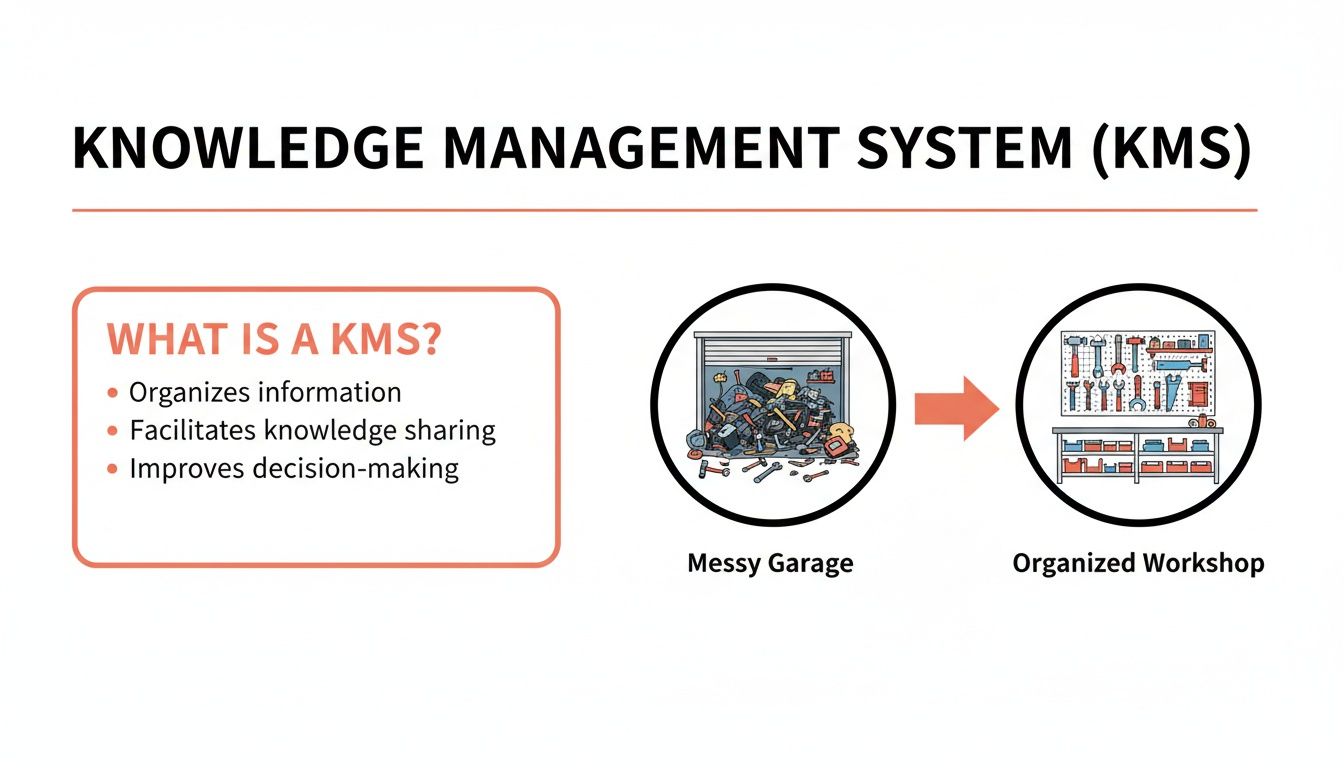
When you move from that cluttered "before" to the streamlined "after," you start to see the real magic happen, impacting everything from your team’s sanity to your bottom line.
Drastically Cut Down Onboarding Time
Let’s be honest, getting new hires up to speed is a huge time sink. A KMS acts like a living playbook for your agency, giving new team members a self-serve resource to find answers from day one.
Instead of tapping a senior strategist on the shoulder to ask where the client’s brand guidelines are again, they can just look it up. This empowers them to learn the ropes quickly and, more importantly, frees up your veterans to focus on strategic work, not basic questions.
Think of it this way: a good KMS is like giving a new hire a guided tour of the city's most important landmarks, instead of just handing them a map and wishing them luck.
The result? New people become productive, contributing members of the team in a fraction of the time.
Send Operational Efficiency Through the Roof
Probably the most immediate and satisfying benefit you’ll see is how much more efficient your day-to-day operations become. When everyone knows where to find the single source of truth, the endless scavenger hunts for information finally stop. No more frantic searching through old emails, Slack DMs, or that one Google Drive folder nobody can find.
This is a direct assault on context-switching. In fact, some research shows that teams using a KMS switch between screens up to 58% less, which completely slashes the time wasted just looking for stuff. That reclaimed time means faster project turnarounds and serious cost savings. You can dig into more data on how KMS boosts efficiency over at Straits Research.
Elevate the Quality of Your Client Work
Consistency is everything when it comes to keeping clients happy. A KMS ensures every project is built on the foundation of your agency's collective experience and best practices. It captures what works and turns those winning strategies into repeatable, easy-to-follow processes.
This means a junior designer can produce work that meets the same high standards as your creative director. This leads to some powerful outcomes:
- Fewer Mistakes: With standardized templates and checklists, the risk of costly errors plummets.
- Better Deliverables: Everyone is working from the same playbook, ensuring your output is consistently polished and professional.
- Happier Clients: Clients get a reliable, high-quality experience every single time, which is how you build trust and earn those long-term retainers.
See a Clear, Measurable Return on Your Investment
At the end of the day, any new system has to make financial sense. A KMS delivers a very real ROI by plugging the leaks in your operations—less wasted time, less duplicated work, and a higher quality of output.
It’s simple math. When your team spends less time searching, they spend more billable time working. When new hires get up to speed faster, they start contributing to revenue sooner. And when your processes are airtight, your project profit margins improve.
These gains aren’t just about feeling more organized. They're about building an agency that's more resilient, scalable, and ultimately, more profitable. The right system pays for itself by turning your internal knowledge from a hidden liability into your most powerful competitive edge.
The table below breaks down just how stark the difference is.
Impact of a KMS on Key Agency Metrics
This chart summarizes the direct improvements you can expect, contrasting the common agency chaos with the clarity and efficiency a KMS provides.
| Metric | Without a KMS (The Problem) | With a KMS (The Solution) |
|---|---|---|
| Onboarding Time | Weeks or months of hand-holding and repetitive questions. | New hires are self-sufficient and contributing within days. |
| Information Retrieval | Team members spend ~20% of their day searching for information. | Answers are found in seconds, maximizing billable hours. |
| Project Consistency | Quality varies wildly depending on who is working on the project. | Standardized processes and templates ensure consistently high-quality work. |
| Employee Turnover | Frustration and burnout from inefficient workflows lead to higher churn. | Empowered, efficient teams report higher job satisfaction. |
| Client Satisfaction | Inconsistent results and missed deadlines erode client trust. | Reliable, predictable outcomes build long-term client loyalty. |
As you can see, the shift isn't just incremental; it’s a fundamental change in how your agency operates, turning pain points into strengths.
How AI Transforms Your Knowledge Management System
Think of a traditional Knowledge Management System (KMS) as a well-organized library. It’s useful, but you still have to know what you're looking for. Now, imagine that library has an expert librarian who not only knows where everything is but also understands what you actually need, sometimes before you even ask. That's the difference AI makes.
Artificial intelligence doesn't just store information; it understands it, connects the dots, and anticipates what your team needs next. It turns a static database into an active, intelligent partner in your agency's work. This shift is a huge reason why the global knowledge management market is absolutely booming.

The market itself, valued at $773.6 billion in 2024, is expected to skyrocket to an incredible $3.5 trillion by 2034. The real story here is the AI-powered segment, which is projected to grow from $9.6 billion in 2025 to $251.2 billion by 2034. These numbers aren't just noise; they signal a massive move toward smarter, more intuitive knowledge platforms. You can dig deeper into these booming knowledge management market statistics if you're curious.
From Simple Search to Intelligent Discovery
The most immediate upgrade AI brings is to the search bar. A standard KMS is stuck on keywords. If you type in "client onboarding checklist," it will only find documents that contain that exact phrase. It’s a rigid system that can easily miss what you’re looking for.
AI, on the other hand, uses technologies like natural language processing (NLP) to grasp context and intent. You can ask a real question, like, "What are the first steps for a new social media client?" The system will pull up the relevant checklist, sure, but also project templates and even examples from past client communications—all without you having to guess the precise file names. It changes search from a frustrating guessing game into a productive conversation.
An AI-powered KMS doesn't just find documents; it surfaces answers. It pulls together information from multiple places—SOPs, project notes, old support tickets—to give you the full picture, saving hours of digging.
Proactive Knowledge Delivery
Where AI really starts to feel like magic is in its ability to deliver information proactively. Instead of just sitting there waiting for you to search, it starts anticipating what you need based on what you're doing.
For instance:
- Contextual Assistance: A project manager starts setting up a new project in a system like RGK. The AI assistant, Greta, could automatically pop up the correct project setup SOP and a list of similar, successful projects for reference.
- Automated Summaries: AI can scan a long, messy client email thread and spit out a clean summary of the key decisions and action items. No more re-reading dozens of messages to find that one detail.
- Identifying Knowledge Gaps: The system can track search queries that come up empty. This is a goldmine—it flags exactly where your agency needs to create new documentation or update what you already have.
This kind of proactive support cuts down on the mental friction that drains your team's energy, letting them stay focused on valuable, client-facing work. The system works quietly in the background, making sure everyone has the right information at the right time. In the end, AI takes all the benefits of a KMS and puts them on steroids, making your agency's collective knowledge not just available, but genuinely intelligent.
Implementing a KMS in Your Agency
Knowing the benefits of a knowledge management system is great, but putting one in place is where the rubber meets the road. It’s easy to get intimidated by the thought of a massive system overhaul, but it doesn't have to be a painful, all-at-once project.
Think of it less like building a skyscraper from scratch and more like a strategic renovation. You start with one room, get it just right, and let the success of that small project build momentum for the rest. This approach gets your team on board by showing them real, tangible improvements right away.
The trick is to focus on practical steps and score some early wins. Before you even start demoing software, you need to map out where your agency's knowledge actually lives. Rushing this step is how you end up with a prettier, more organized version of the same old chaos.
Start with a Knowledge Audit
Think of a knowledge audit as your diagnostic phase. It’s all about figuring out what your agency knows, where that information is stashed, and who desperately needs access to it. This isn't about cataloging every single file; it's about identifying your most valuable—and most scattered—assets.
Get started by asking a few simple questions:
- What are our most critical processes? Think client onboarding, campaign reporting, or building new proposals.
- Where do people waste time searching for information? Ask your team what their biggest daily frustrations are. You'll get some very honest answers.
- What knowledge would we be toast without if a key person left tomorrow? Pinpoint your experts and the "tribal knowledge" locked in their heads.
The audit gives you a concrete starting point. If everyone is constantly scrambling to find the latest approved client brand assets, you’ve just found the perfect problem to solve for your pilot project.
The goal of an audit isn't to boil the ocean. It's to find the most significant leak in the boat and fix that first. Solving a single, high-impact problem is the fastest way to demonstrate the value of a KMS and earn early buy-in from your team.
Choose the Right Platform and Pilot Project
Once you’ve identified your biggest pain point, you can pick a tool and a small, manageable pilot project to test it out. Whatever you do, don't try to roll out a system for the entire agency at once. That's a recipe for failure.
Instead, pick a single team or a specific workflow.
For example, your pilot could be as simple as: "Create a single source of truth for all client brand guidelines for the design team."
This focused approach lets you work out the kinks on a small scale. You’ll learn the best way to structure information, get direct feedback from a handful of users, and build a success story you can use to champion the system across the rest of the agency.
Cultivate Adoption and Appoint Champions
A new tool is only half the solution. The other half—the more important half—is getting people to actually use it. You can't just launch a KMS and expect everyone to jump on board. You have to actively encourage adoption.
A fantastic strategy here is to identify and empower knowledge champions. These are the enthusiastic people on your team—not necessarily managers—who get the vision and are excited to lead by example. They can help train their peers, answer questions, and get the ball rolling by adding the first pieces of high-value content.
By following this step-by-step roadmap, you can bring a system into your agency that starts delivering value from day one, truly changing how your team operates without overwhelming the very people it’s supposed to help.
Measuring Your Knowledge Management Success
So, you’ve set up a knowledge management system. How do you know if it's actually working? It’s not just about feeling more organized. The real proof is in the numbers—the tangible impact on your agency's bottom line. When you can show stakeholders exactly how this system is making the business stronger, that’s when you’ve truly succeeded.
You need to move beyond anecdotes like "things feel smoother." Agency leaders want to see the data. This means zeroing in on Key Performance Indicators (KPIs) that directly tie back to operational health and, most importantly, profitability. This is how you build an undeniable, data-backed case for your agency's collective brain.
Key Metrics to Track
To get a real sense of the ROI, focus on tracking improvements in a few critical areas:
- Reduced Onboarding Time: How long does it take a new hire to get up to speed and start contributing meaningfully? A great KMS can slash this time from months down to just a few weeks, which is a massive cost saving right off the bat.
- Faster Project Delivery: Clock the average time from project kickoff to final delivery. When your team isn't constantly hunting for information, they can execute much faster, which frees up capacity for more client work.
- Fewer Internal Support Requests: Keep an eye on the number of repetitive questions flying around in Slack or email. A noticeable drop here is a great sign that people are finding answers themselves in the knowledge base.
Capturing this kind of data is a game-changer. It shifts the conversation from "I think we're more efficient" to "We are completing projects 15% faster." That's the language that proves the system’s worth and its direct contribution to growth.
This focus on turning internal data into a strategic asset is exactly why the knowledge management market is booming. It's projected to climb from USD 23.2 billion in 2025 to a staggering USD 74.22 billion by 2034. That kind of growth only happens when companies see a serious return on their investment. You can find more details about this growing market on Fact.MR.
Got Questions? We've Got Answers
Even when the benefits seem clear, it's natural to have a few lingering questions. Let's tackle some of the most common things we hear from agencies who are on the fence about building a knowledge hub.
We’re a Small Agency. Do We Really Need This?
Absolutely. In fact, it might be more important for a small team. When you're small, all your best processes, client insights, and creative sparks often live inside the heads of one or two key people. That's a huge risk.
A KMS lets you get that crucial knowledge down on paper (so to speak) from the very beginning. It builds a solid foundation you can scale on, rather than having to untangle everything later when you're growing fast. Think of it less as a complex system for a big company and more as your agency's playbook for future success.
How Do We Get the Team to Actually Use It?
This is the million-dollar question, isn't it? Team adoption hinges on two simple things: make it incredibly easy and show them what's in it for them.
The best approach is to pick a system that plugs right into the tools your team already lives in every day, like your project management or communication software. Don't add another island; build a bridge.
A great way to kick things off is with a small pilot project. Target one major, universally annoying problem—like tracking down client brand guidelines or onboarding new freelancers. Once the team sees how a KMS solves that headache for them, they'll start using it for everything else without you having to ask.
Isn't This Just a Glorified Google Drive?
That's a fair question, but no, it's a completely different beast. While Google Drive is a fantastic digital filing cabinet for storing documents, a true KMS is more like an intelligent library.
A KMS doesn't just store files; it creates connections between them. It understands context, links a project brief to the final deliverables and the client feedback, and makes every bit of it searchable in seconds. An AI-powered system takes it even further by proactively surfacing the exact information you need, right when you need it. It’s the difference between a messy storage locker and having a world-class researcher on your team.
Ready to build a smarter, more efficient agency? RGK is the unified operating system designed to eliminate chaos and give you a single source of truth, powered by AI that works like a second you. See how RGK works for agencies like yours.