Creating a Bulletproof Scope Management Plan


Ever had a project spiral out of control? It starts with a small, "Can we just add…" request. Then another. Soon, the finish line keeps moving further away, the budget is shot, and the team is completely burnt out. This is scope creep, and it’s a project killer.
The best defense against this chaos is a scope management plan. Think of it as the project's official rulebook—the single source of truth that defines what you're building, how you'll get it done, and how you’ll handle changes along the way. It’s the blueprint that ensures everyone agrees on what "done" actually looks like before you even start.
Why Your Project Needs a Scope Management Plan
Without a scope management plan, a project is basically a ship without a rudder. It might feel like it's moving forward, but it's at the mercy of every new idea or stakeholder whim. The plan is your navigation system, keeping everyone pointed in the same direction and focused on the real destination.
This isn’t just another document to create and file away. A good scope management plan is a living, breathing guide that brings clarity to your team and protects your project from its biggest threats.
To understand its role better, let's look at what a scope management plan really does for your project.
Core Functions of a Scope Management Plan
| Function | What It Does | Why It Matters |
|---|---|---|
| Boundary Setting | Clearly defines what is in scope and what is out of scope. | Eliminates ambiguity and prevents "assumed" tasks from being added later. |
| Change Control | Establishes a formal process for handling change requests. | Turns chaotic requests into structured, strategic decisions. |
| Expectation Alignment | Creates a shared understanding of deliverables among all stakeholders. | Reduces friction, rework, and the risk of delivering the wrong thing. |
| Accountability | Assigns roles and responsibilities for managing and approving scope. | Ensures decisions are made by the right people at the right time. |
Ultimately, these functions work together to give you control over the project's direction and outcome.
Preventing the Dreaded Scope Creep
Let's be honest, the biggest reason to have a plan is to fight scope creep. This is when small, unapproved additions slowly bloat the project, draining your budget and timeline. A solid plan gives you a formal process for evaluating every new request.
Instead of derailing progress, a change request gets properly assessed. You can analyze its impact on the schedule, resources, and budget. This turns a frantic "yes or no" into a thoughtful business decision, keeping the project focused on its core objectives.
Aligning Stakeholder Expectations
Misaligned expectations are silent project killers. A scope management plan forces you to have those critical conversations upfront, ensuring everyone—from the client to your internal team—shares the same vision.
A scope management plan is your project's constitution. It lays down the laws of what's in, what's out, and how changes are handled, creating a system of governance that prevents project anarchy.
This alignment process is crucial because it:
- Defines Boundaries Clearly: It explicitly states what the project will deliver and, just as importantly, what it will not deliver.
- Establishes Acceptance Criteria: It sets clear, measurable standards that a deliverable must meet to be considered finished and approved.
- Creates Accountability: It clarifies who has the authority to request, review, and approve changes to the scope.
The Surprising Reality of Scope Planning
Given how critical this is, you'd think every project would start with a solid scope plan. But the data tells a different story.
A shocking 52% of organizations don't even create a scoping document during project planning. Think about that—it’s a coin toss whether a project has its most basic guardrails in place. The research also shows that while 55% of project managers create a scope document, nearly half of their organizations fail to baseline their schedules, making it impossible to track if they're on or off track.
You can explore more eye-opening project management statistics to see how common these issues are. This gap in foundational planning is a massive contributor to blown budgets and missed deadlines. In this context, simply having a solid scope management plan becomes a real competitive advantage.
The 5 Essential Components of Your Plan
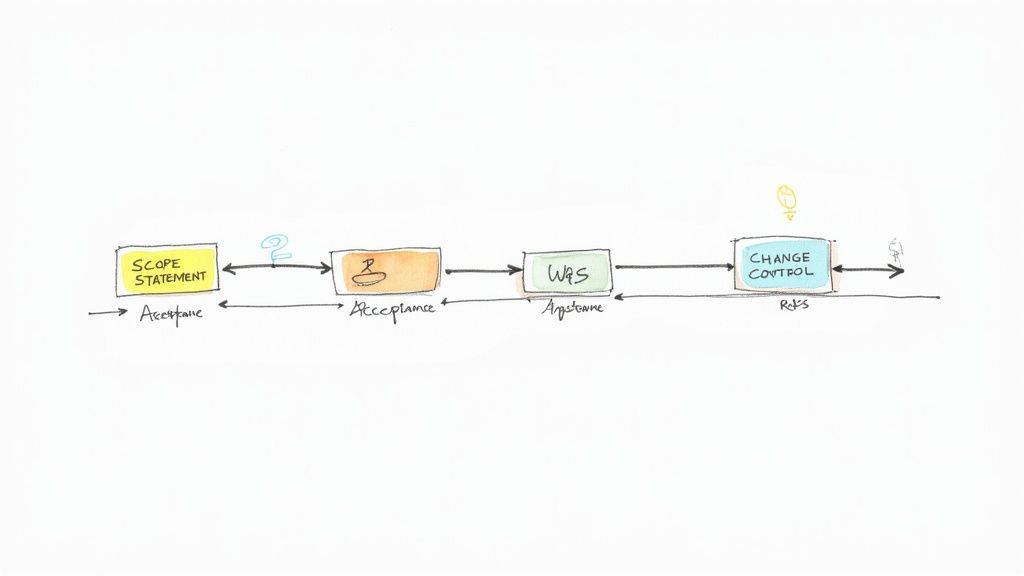
A solid scope management plan isn't just a document; it's a project's constitution. It’s built on five distinct, interconnected parts that work in harmony to keep everything from going off the rails.
Think of them as the five pillars holding up your project. If one of them is shaky, the whole structure becomes unstable and is just one surprise away from collapsing. Let’s dig into what these non-negotiable elements are and how they function in the real world.
1. The Project Scope Statement
First up is the project scope statement. This is your project's story, not just a to-do list. It’s a clear, descriptive document that lays out the project's goals, what you’ll be delivering, and—most importantly—where the lines are drawn. This is where you declare what’s in and what’s out.
This statement becomes the single source of truth for everyone involved. It needs to be written in plain English, free of jargon, so that the client, the designer, and the developer are all on the same page. The whole point is to forge a shared understanding.
A strong scope statement always covers:
- Project Justification: The "why" that’s driving this whole effort.
- Key Objectives: The specific, measurable goals the project will hit.
- Deliverables: The actual, tangible things you will produce.
- Exclusions: A crystal-clear list of what is not included. Honestly, this is often the most critical part for avoiding arguments down the road.
2. The Work Breakdown Structure (WBS)
Once you know what you’re building, the Work Breakdown Structure (WBS) tells you how you'll get it done. It’s a simple but powerful tool that breaks down the massive, intimidating scope of a project into smaller, bite-sized pieces.
Think of it like planning a big event. The main deliverable, "Successful Conference," is way too broad to act on. A WBS would deconstruct it into manageable chunks:
- Venue Management: Researching, negotiating, booking, and setup.
- Speaker Coordination: Finding speakers, scheduling them, and handling logistics.
- Marketing & Promotion: Building a website, running email campaigns, and posting on social media.
- Attendee Registration: Setting up the platform, processing payments, and providing support.
Each of those can be broken down even further until you have a detailed map of every single task. This process makes planning, scheduling, and assigning resources a whole lot more accurate.
3. Clear Acceptance Criteria
How will you know when a deliverable is actually "done"? Acceptance criteria are the answer. These are the specific, black-and-white conditions that a deliverable must meet to be officially signed off on by the client. It’s all about removing subjectivity.
Acceptance criteria turn the fuzzy idea of "done" into a simple, testable checklist. It's the proof that what you've built meets the standards everyone agreed upon.
For example, a new website homepage might have acceptance criteria like this:
- The page must load in under 2 seconds on a standard internet connection.
- All contact forms must send data to the CRM without any errors.
- The design must render perfectly on the latest versions of Chrome, Firefox, and Safari on both desktop and mobile.
Without these specifics, a stakeholder could push back on work because of a gut feeling or a minor personal preference, throwing your whole timeline into chaos.
4. A Formal Change Control Process
Look, change happens. It's a fact of project life. But chaos is a choice. A formal change control process is your system for handling any requests to alter the project's scope. It makes sure every change is properly evaluated, costed, and approved before anyone starts working on it.
This process is your best defense against scope creep. It transforms those casual "hey, can you just…" requests into structured business decisions. When a stakeholder asks for "one small tweak," this system forces everyone to pause and assess its true impact on the budget, timeline, and resources.
A good change control process typically follows these steps:
- Submission: The person with the idea fills out a formal change request form.
- Analysis: The project manager investigates the request's impact.
- Review: A designated person or committee (like a change control board) reviews the analysis.
- Decision: The change is either approved, rejected, or put on hold.
- Implementation: If approved, the project plan is officially updated to reflect the new reality.
5. Defined Roles and Responsibilities
Finally, every scope management plan must spell out who is responsible for what. This simple step heads off a world of confusion and finger-pointing. Who has the final say on the WBS? Who is allowed to submit a change request? Who signs off on the final deliverables?
Defining these roles from the get-go prevents power struggles and bottlenecks. This is where a RACI (Responsible, Accountable, Consulted, Informed) chart can be a lifesaver. You map out key tasks and decisions, then assign a role to each stakeholder so there's no question about who does what.
Don't underestimate this step. A staggering 37% of projects fail due to a lack of clear objectives and leadership—a problem that defined responsibilities solve directly. You can learn more about how poor scope definition sinks projects by reviewing key project management statistics.
How to Build Your Scope Management Plan
Building a solid scope management plan isn't a job you do in isolation. It’s a team sport, one where the project manager acts as the coach, bringing everyone together to lay a strong foundation for the entire project. Think of it as creating a detailed blueprint before the first shovel hits the ground.
This step-by-step process is all about making sure nothing is left to chance. It’s how you turn fuzzy ideas into a concrete, actionable roadmap that your team and stakeholders can actually follow. Get this right, and this document becomes the project's unwavering North Star.
Start by Gathering Requirements
First things first: you need to understand what success actually looks like to your stakeholders. This is more than just firing off a quick email; it means getting in the trenches with them to dig out their real needs, expectations, and priorities. If you skip this, you’re just flying blind.
To pull this off, you need to get people talking. The goal is to walk away with a complete list of everything the project has to deliver to be called a success.
Here are a few tried-and-true ways to get it done:
- Stakeholder Interviews: Sit down one-on-one. These conversations are invaluable for digging deep into individual needs and concerns.
- Workshops and Brainstorming Sessions: Get your key players in a room together. It’s amazing what ideas pop up when people can bounce ideas off each other.
- Surveys and Questionnaires: When you need specific data from a wider group, well-designed surveys can gather it efficiently.
- Document Analysis: Don't forget to review what you already have. Existing business plans, contracts, or process docs can give you crucial context and constraints.
Translate Needs into a Formal Scope Statement
Once you have a handle on all the requirements, it's time to distill that information into a formal project scope statement. This is where you translate all those "wants" and "needs" into an official statement of work, drawing a clear line in the sand around the project's boundaries.
Your scope statement needs to be specific, measurable, and crystal clear. It has to spell out the project's objectives and key deliverables. But just as critically, it needs to detail any exclusions. Stating what’s out of scope is just as important as defining what’s in, because it heads off so many arguments down the road.
A well-crafted scope statement is your contract with the stakeholders. It sets expectations and gives you a stable baseline to measure every future decision against.
This document is what you’ll come back to again and again. Anytime someone asks, "Hey, should we add this feature?" the scope statement should have the answer.
Develop a Clear Work Breakdown Structure
Okay, so you've nailed down the "what" and the "why." Now it's time to figure out the "how." This is where the Work Breakdown Structure (WBS) comes in. The WBS takes the major deliverables from your scope statement and smashes them into smaller, more manageable pieces. This hierarchical breakdown makes the work feel less overwhelming and much easier to plan.
Imagine you're building a house. The top level of your WBS is "New House Construction." The next level down might include "Foundation," "Framing," "Electrical," and "Plumbing." You can then break each of those down even further into specific tasks. Suddenly, you have a clear, logical map of all the work.
This structure is absolutely essential for a few key reasons:
- Accurate Estimating: It’s way easier to estimate the time and cost for small, well-defined tasks than for one giant project.
- Resource Allocation: You can see exactly what skills you'll need for each part of the project.
- Progress Tracking: It gives you a clear way to measure what’s done and keep an eye on the project's health.
Establish a Change Control Board and Validate
Change happens. It’s a fact of project life. But that doesn’t mean it has to be chaotic. The final piece of the puzzle is setting up the rules of engagement for handling those changes. This means creating a formal change control process and, in many cases, a Change Control Board (CCB).
The CCB is simply a designated group of stakeholders who are responsible for reviewing, evaluating, and either approving or rejecting proposed changes. This takes the emotion out of it. The board ensures decisions are made based on the change’s real impact on the budget, timeline, and resources—not just on who shouted the loudest.
Finally, you have to validate the scope with all your key stakeholders. Get their formal sign-off on the scope statement, the WBS, and the change control process. This simple act secures buy-in and confirms that everyone is starting from the same page, with a shared understanding of the goals and the rules of the game.
Common Scope Management Pitfalls to Avoid
Even the best scope management plan will get tested by reality. The real secret isn't creating a perfect plan, but anticipating the common tripwires so you can build defenses right into it. This turns potential project-killers into risks you can actually manage.
Most projects don't fail because of one big explosion. They die by a thousand tiny cuts—a series of small, unmanaged issues that pile up. The connection between fuzzy scope and project failure is crystal clear. Studies on major infrastructure projects show that solid scope planning, budgeting, and control directly and significantly impact whether a project succeeds or fails. You can dig deeper into the impact of scope management on project implementation if you're interested in the data.
Let's walk through the three most common traps and, more importantly, how to sidestep them.
The Danger of Gold Plating
You’ve probably seen this before. Gold plating is when a team member adds extra features or bells and whistles to a project that nobody actually asked for. It almost always starts with good intentions—a designer wants to wow the client, or a developer thinks a "cool" new feature would be a great addition.
But these unrequested extras are a huge problem. They burn through time, money, and resources without any formal sign-off or clear connection to the project's goals. What looks like a harmless little upgrade can add unexpected bugs, push back deadlines, and create a bad habit of going off-script.
For example: A team is tasked with building a simple internal dashboard for tracking weekly metrics. A developer, on their own initiative, spends an extra week adding fancy, animated data visualization tools that weren't in the plan. The project ends up late, and the client is frustrated because the "cool" feature wasn't a priority and didn't solve their core problem.
The fix? Be a stickler for your change control process. Make it known that every single task must trace back directly to the agreed-upon scope and WBS. No exceptions.
The Problem with Ambiguous Requirements
Vague requirements are where scope creep is born. Phrases like "make it user-friendly" or "build a robust backend" are basically meaningless because they can be interpreted in a dozen different ways. Without concrete, measurable definitions, you’re gambling with the project's success.
This kind of ambiguity creates a huge gap between what the client thinks they're getting and what your team is building. It's a recipe for endless revision cycles as the team tries to hit a moving target that was never properly defined.
Here's how you nail down requirements from day one:
- Write Clear User Stories: Frame every requirement from the user's point of view. For instance, "As a site administrator, I need to export a CSV of all new users so I can add them to our mailing list." It's specific and testable.
- Define Acceptance Criteria: For every major deliverable, create a simple checklist. What conditions must be met for this task to be officially "done"?
- Use Prototypes and Mockups: A picture is worth a thousand meetings. Visuals get everyone on the same page about the end product long before a single line of code is written.
The Challenge of Stakeholder Disagreement
When your key stakeholders aren't on the same page, your project gets pulled in ten different directions. The head of marketing might be pushing for a quick launch, while the head of engineering is demanding a flawless, bug-free product. These competing priorities can paralyze a team.
This kind of conflict usually boils over in the middle of the project, leading to frantic, last-minute changes and arguments over which direction to take. If you don't get it under control, it will crush team morale and send your timeline into a tailspin. A solid scope management plan is your best tool for getting everyone aligned early.
To get ahead of stakeholder conflicts:
- Create a RACI Chart: This simple matrix clearly defines who is Responsible, Accountable, Consulted, and Informed for every key decision. It eliminates confusion about who has the final say.
- Get Formal Sign-Off: Before any work kicks off, make sure every key stakeholder has formally signed off on the project scope statement and WBS. That document then becomes the single source of truth everyone has agreed to.
Integrating Scope Control Into Your Workflow
A brilliant scope management plan is only as good as its execution. If it just sits in a shared drive gathering digital dust, it’s not really a plan—it’s an artifact. The goal is to weave scope management into the very fabric of your daily work, making it an active, living process that guides your team's day-to-day decisions.
This means embedding scope control directly into the tools and workflows your team already uses. When your project management platform becomes the gatekeeper for scope, everything changes. Instead of relying on manual checks and hazy memories, the system itself enforces the rules. This is how you bridge the gap between a theoretical plan and the practical reality of getting work done, ensuring no change slips through the cracks.
Centralize and Automate for Real-Time Visibility
The first step is to bring all your project information into one central hub. When tasks, change requests, stakeholder comments, and progress updates all live in the same place, you create a single source of truth. This real-time visibility is absolutely essential for comparing what you planned to do against what’s actually happening.
Modern project management systems, especially an integrated OS like RGK, are built for this kind of control. They help you:
- Automate Change Request Workflows: Imagine a stakeholder submitting a request through a simple form. That action can automatically trigger an approval process, log the request, notify the right people, and pause any action until its impact is fully assessed.
- Link Tasks Directly to Deliverables: Every single task in your project plan should clearly map back to a specific item in your Work Breakdown Structure (WBS). This simple discipline makes it incredibly easy to spot "orphan" tasks that might represent out-of-scope work.
- Generate Real-Time Reports: Dashboards can give you an instant health check on the project, highlighting potential scope deviations long before they escalate into serious problems.
It's about stopping those small, seemingly harmless additions that can derail a project. This is often called "gold plating," and it's a classic scope creep culprit.
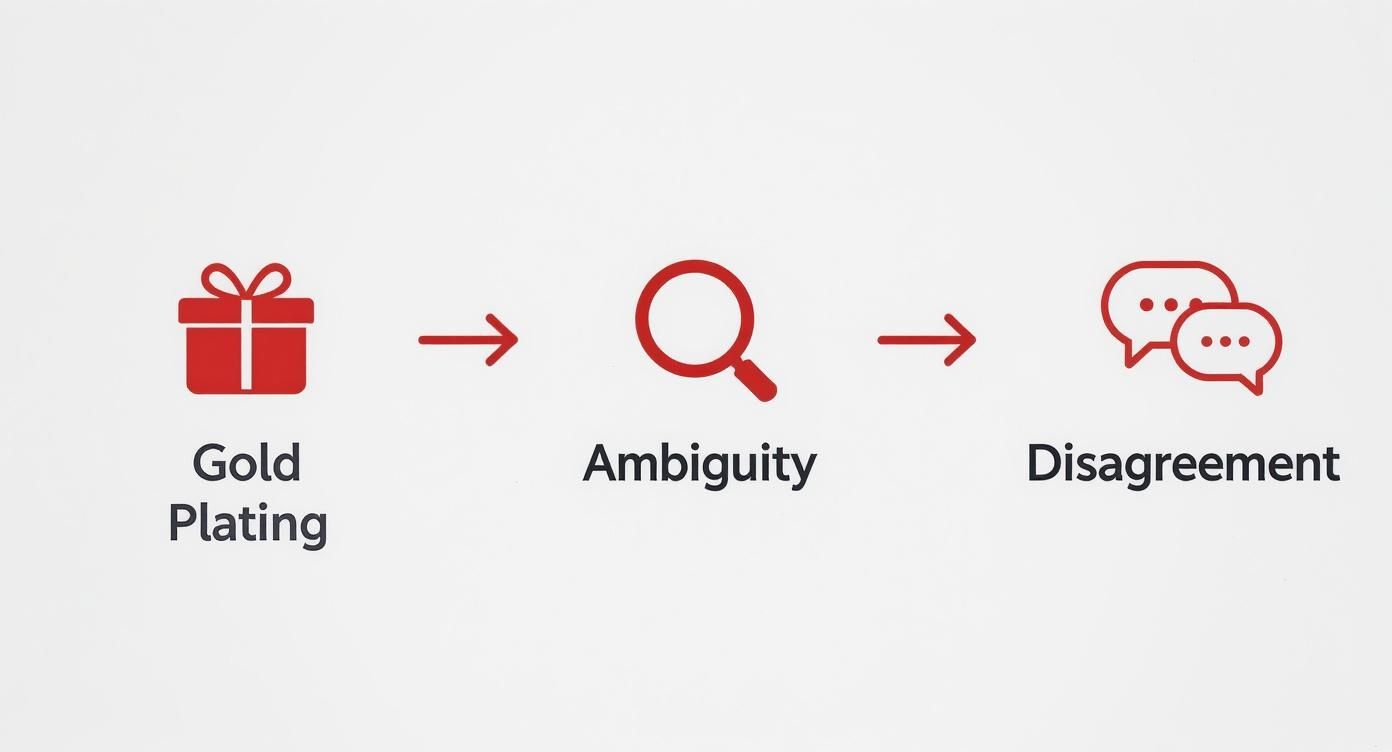
As you can see, adding unrequested features creates ambiguity. That ambiguity almost always leads to stakeholder disagreement down the line.
A Sample Change Request Workflow in Action
Let's make this more concrete. Here’s how a simple, automated change control process might look inside your project management tool. This kind of workflow turns a potentially chaotic request into a structured, predictable series of steps.
The point of an integrated workflow isn’t to prevent change entirely, but to ensure every change is a conscious, strategic decision. It forces a conversation about trade-offs, protecting the project’s core objectives from impulsive additions.
Here’s a typical process that enforces proper scope control.
Sample Change Request Workflow
| Step | Action | Key Responsibility |
|---|---|---|
| 1. Submission | A stakeholder submits a formal change request via a digital form, detailing the what and why. | Requesting Stakeholder |
| 2. Initial Review | The project manager assesses the request's impact on scope, budget, timeline, and resources. | Project Manager |
| 3. CCB Evaluation | The Change Control Board (or project sponsor) reviews the PM's analysis and decides to approve, reject, or defer the request. | Change Control Board |
| 4. Implementation | If approved, the project manager officially updates the scope statement, WBS, and project schedule to reflect the change. | Project Manager |
| 5. Communication | The decision and its impact are communicated to all relevant team members and stakeholders. | Project Manager |
By building this exact process directly into your operational tools, you create guardrails. These guardrails make it easy for your team to do the right thing and incredibly difficult to accidentally introduce scope creep. This integration is where a scope management plan transforms from a static document into your project’s most powerful operational control.
Real-World Examples and Templates
It’s one thing to talk about a scope management plan in theory, but seeing how one actually works in the wild is what makes it all click. The amount of detail you need will always change with the size of the project—a massive software build is going to have a much thicker plan than a quick marketing campaign—but the core building blocks are always the same.
Let's look at how these core elements flex to fit two very different kinds of projects. Think of these as condensed blueprints that show how to put the principles we've discussed into practice.
Example 1: Mobile App Development
For a new mobile app, the scope is all about features, functionality, and the tech behind it all. Here, the plan needs to be incredibly detailed to keep feature creep at bay and avoid any technical stumbles.
- Scope Statement: We’re building a minimum viable product (MVP) for a food delivery app on both iOS and Android. It needs to handle user registration, browsing restaurants, placing orders, and processing payments. Exclusions: To be crystal clear, this launch will not include a separate app for drivers or any kind of customer loyalty program.
- WBS Snapshot: You’d likely organize the Work Breakdown Structure around features and development sprints. The big buckets would be things like User Authentication, Restaurant Listing Module, and Checkout Process. From there, you'd break it down into tiny, tangible tasks like "Build login screen UI," "Develop password reset API," and "Integrate Stripe payment gateway."
- Change Control: If someone wants a feature that isn't in the original MVP scope, it requires a formal change request. The project manager and lead developer review every request, but the product owner has the final say. No exceptions.
Example 2: Marketing Campaign Launch
Now, let's switch gears to a marketing campaign. Here, the scope is all about creative assets, distribution channels, and hitting deadlines. The plan’s main job is to keep the creative vision locked down and make sure every ad, email, and social post is on-brand and on time.
- Scope Statement: Our goal is to run a three-month digital marketing campaign for a new product launch. The deliverables are social media creative, email marketing copy, and a set of paid search ads. Exclusions: This campaign won't involve any in-person events or print advertising.
- WBS Snapshot: The WBS for this would probably be organized by channel. You'd see top-level items like Social Media, Email Marketing, and Paid Ads. These would then drill down into specific tasks like "Design Instagram story graphics," "Write three-part email nurture sequence," and "Develop ad copy for Google Ads."
- Change Control: Want a new creative asset or want to add a new marketing channel? That request has to go straight to the marketing director for approval before any work begins.
A Simple Template to Get You Started
Ready to create your own? You don’t have to stare at a blank document. Use this simple outline as a launchpad for your next scope management plan. Just fill in the blanks for each section, and you’ll have a solid foundation to keep your project on track.
Simple Scope Management Plan Template
- Introduction & Project Goals: A quick summary of the project and the business problem it’s meant to solve.
- Project Scope Statement:
- Objectives: What are the specific, measurable goals we're aiming for?
- Deliverables: What are the tangible things we'll produce?
- Exclusions: What are we explicitly not doing? (This is crucial!)
- Work Breakdown Structure (WBS): Attach or link out to the detailed WBS that breaks down all the deliverables into manageable chunks of work.
- Roles and Responsibilities: Who’s the project sponsor? Who sits on the Change Control Board? List the key people and what they're responsible for when it comes to scope.
- Change Control Process: How does someone request a change? Who reviews it? Who gives the final green light?
- Scope Acceptance Process: How will the stakeholders formally review and sign off on the deliverables?
Frequently Asked Questions
Even with the best plan in hand, questions always come up once the rubber meets the road. Let's tackle a few of the most common ones that project managers run into when putting scope management into practice.
What’s the Difference Between Project Scope and Product Scope?
It's easy to get these two mixed up, but the distinction is crucial.
Think of product scope as the "what"—it’s all the features and functions that make up the final thing you’re delivering. If you're building a mobile app, the product scope includes things like the user login, the dashboard, and the notification system.
Project scope, on the other hand, is the "how." It's all the work that needs to happen to create and deliver the product. This includes everything from initial research and design to coding, testing, and deployment. A solid scope management plan needs to account for both to succeed.
How Often Should I Review the Scope Management Plan?
Your scope management plan isn't a "set it and forget it" document. It’s a living guide for your project.
You should definitely revisit it at major project milestones—say, after you wrap up the design phase or right before a big launch. It’s also smart to pull it out anytime a significant change request is approved, just to make sure everything still aligns.
For teams running agile projects, this review happens more organically and frequently, often during sprint planning and review meetings.
The plan is a living document. Regular reviews keep it relevant and effective, preventing it from becoming an outdated artifact that no longer reflects the project's reality.
Who Is Responsible for Approving the Scope Management Plan?
The project manager typically owns the creation and day-to-day management of the plan. However, the final sign-off comes from the project sponsor and key stakeholders.
Getting their official approval is more than just a formality. It signifies that everyone agrees on the project’s boundaries, what will be delivered, and how changes will be handled. This sign-off gives the project manager the authority they need to protect the scope and hold everyone accountable.
Running an agency is chaotic enough without your tools working against you. RGK is the integrated operating system designed to unify your projects, team, and finances, giving you a single source of truth. Stop fighting disconnected software and see how a purpose-built platform can help you run, grow, and keep your business. Explore RGK today.