How to Reduce Operational Costs: how to reduce operational costs for 2025

Cutting your operational costs isn't just about trimming the fat—it's a deliberate strategy for building a more resilient and profitable agency. The real magic happens when you move beyond random expense cuts and adopt a systematic approach. This means auditing your real cost drivers, making smart moves with your tech stack, leaning into automation, and rethinking how you deploy your team. When you do this, your operations stop being a cost center and become your biggest competitive advantage.
Beyond Revenue The Untapped Power of Efficiency

Most agency leaders are wired to chase the next big client. It’s understandable. The thrill of landing a huge contract often overshadows the less glamorous, internal work of fine-tuning the engine. But what if the secret to sustainable growth isn't just about what you bring in, but what you get to keep?
This guide is about flipping that perspective. We're going to treat operational efficiency not as a defensive measure, but as your most powerful tool for boosting profitability and setting the stage for scalable growth. We'll walk through a data-driven playbook that moves you from guesswork to measurable results, building a leaner, more agile agency that can weather any storm.
Why Cutting Costs Is Harder Than It Looks
Every executive wants to reduce costs, but there's often a massive gap between intention and execution. Too many initiatives fizzle out because they lack a clear framework, and the promised savings never appear. It’s a common story. One BCG study found that companies, on average, hit only 48% of their cost-saving targets. This highlights a widespread struggle to turn a strategic goal into a real financial outcome.
For agencies, this challenge is even more pronounced. Inefficiencies are often subtle, quietly eating away at profit margins until a small leak becomes a major flood.
"Operational drag is the silent killer of agency profitability. It's not the big, obvious expenses that sink you; it's the death by a thousand cuts from redundant software, manual processes, and inefficient workflows."
The Real Sources of Agency Inefficiency
Before you can fix the leaks, you have to know where they are. In my experience with agencies, the financial drain almost always comes from a few familiar culprits:
- Technology Sprawl: You’ve got multiple, overlapping tools for project management, another set for comms, and yet another for client reporting. It’s confusing, expensive, and a massive waste.
- Fragmented Processes: When there’s no single, documented way to handle core tasks—like onboarding a client or kicking off a project—your team is forced to reinvent the wheel every single time. It's chaos.
- Administrative Overhead: Think about all the time spent on manual, repetitive tasks. Generating reports, chasing invoices, or scheduling meetings. These are hours that could have been spent on billable client work.
- Reactive Staffing: Sticking to a rigid model of only full-time hires creates fixed costs that don't scale up or down with your project pipeline. This leads to expensive downtime and underutilized talent.
This guide gives you a clear roadmap to tackle each of these problems head-on. We'll turn your operations from a source of frustration into a well-oiled machine that fuels your bottom line.
To get started, it's often best to focus on changes that deliver visible results without a massive upfront investment of time or money. These "quick wins" can build momentum and get your team excited about the bigger changes to come.
Quick Wins for Operational Cost Reduction
| Strategy Area | Quick Win Action | Potential Impact |
|---|---|---|
| Tooling Rationalization | Cancel redundant software subscriptions. Audit your tech stack and remove tools with overlapping features. | Immediate reduction in monthly overhead. |
| Process Consolidation | Create a simple checklist or template for a single, high-frequency task (e.g., new client onboarding). | Reduces errors, saves time, and improves consistency right away. |
| Vendor Renegotiation | Review your top 3 vendor contracts. Ask for a discount or better terms—especially for long-term partners. | Can lower fixed costs by 5-15% with just a few phone calls. |
| Automation | Set up simple email automations or automated reminders for recurring tasks like invoicing or report deadlines. | Frees up hours of administrative time each week per team member. |
Tackling even one or two of these actions in the next month can start making a tangible difference, paving the way for the more comprehensive strategies we'll cover next.
Getting a Real-World Map of Your Agency's Costs
Before you can start trimming the fat, you need an honest look at where every single dollar is actually going. A standard P&L is fine, but it only gives you the "what," not the "why" or the "how efficiently." The real breakthroughs happen when you dig in and create a detailed financial map of your agency's guts.
This isn’t just an accounting exercise. Think of it more like financial forensics—you’re on the hunt for hidden expenses, duplicate efforts, and all the little inefficiencies that quietly bleed your profit margins dry, month after month. The idea is to get past the surface-level numbers and build a solid, data-backed foundation that will guide every cost-cutting move you make.
Tackling the SaaS Sprawl Problem
For just about every modern agency I know, the biggest and sneakiest source of financial leakage is "SaaS sprawl." It's that slow, creeping accumulation of software subscriptions that flies completely under the radar. It starts with a free trial here, a new social media scheduler there, and before you know it, you're paying for three different platforms that all do basically the same thing.
A full-on software audit is your first and most powerful move. And I mean everything. Don't just glance at the big-ticket items.
- Build your master list: Get a spreadsheet going and document every single subscription. Note its cost (monthly or annual), when it renews, and who on the team "owns" it.
- Spot the overlaps: Does your project management tool have task features that your CRM also has? Are you shelling out for a premium video conferencing plan when the one baked into your office suite is perfectly fine for 90% of your calls?
- Question every tool: Be ruthless. For each subscription, ask the hard questions. Is this absolutely critical for delivering client work? Does it genuinely save more time than it costs? Could we get the same result from a tool we already have?
I promise you, this process always uncovers quick wins. You’ll find forgotten subscriptions for team members who left ages ago or expensive "per-seat" licenses for people who barely even log in.
Taking a Hard Look at Team Utilization
Your people are your biggest asset, but their time is also, by far, your largest expense. Figuring out how that time is actually spent is the key to profitability. At a glance, everyone might look busy, but you have to learn to see the difference between productive, billable work and costly internal friction.
Start by tracking time with a bit more detail. This isn't about micromanaging your team; it's about spotting patterns that point to operational weaknesses. You’re searching for the hidden "time sinks" that drag your best people away from doing great work for clients.
If your billable team members have a utilization rate dipping below 75-85%, that’s usually a red flag signaling a deeper problem. It could mean your processes are a mess, you're buried in administrative overhead, or your project scoping is way off, leading to endless rounds of unbillable rework.
Look for trends in all that non-billable time. Are your PMs wasting hours every week manually pulling numbers for client reports? Is your creative team stuck in a death cycle of internal meetings? Each of these patterns points directly to a process that’s broken—a perfect candidate for the consolidation or automation tactics we’ll get into next.
Scrutinizing Vendor and Freelancer Deals
Finally, it's time to put your external partners under the microscope. Vendor contracts and freelancer agreements have a bad habit of getting signed, filed away, and left to auto-renew without a second thought. This is an area where you can find some serious savings with just a few phone calls.
- Review all your contracts: Pull every single active agreement. Look closely at auto-renewal clauses, sneaky price hikes, and the original scope of services. Are you even using everything you’re still paying for?
- Benchmark your rates: Do some quick research. What are other agencies paying for similar services? Are your web hosting fees competitive with today’s market rates? Could you get a better deal on that freelance copywriter by negotiating a retainer instead of paying by the hour?
- Renegotiate before you have to: Don't just wait for the renewal notice to land in your inbox. Get on the phone with your long-term partners and ask for a better deal. Offering to bundle services or sign a longer contract can often get you an immediate discount of 10-20%.
By mapping these three core areas—software, team time, and vendors—you turn a vague list of expenses into a clear, actionable battle plan. You'll see exactly where the waste is, giving you a precise roadmap to cut costs smartly and build a much more resilient agency.
Unifying Your Processes and Technology
Fragmented workflows and a sprawling tech stack are two of the biggest silent killers of agency profitability. When your project management platform doesn't talk to your CRM, and your team is manually bridging the gap, you're not just losing time—you're hemorrhaging money.
This isn't about finding one mythical piece of software to rule them all. It's about being intentional. You need to map out how your agency actually works and then choose a lean, integrated set of tools that supports that reality, not fights against it.
Let's be honest, most operational spending falls into three main buckets.
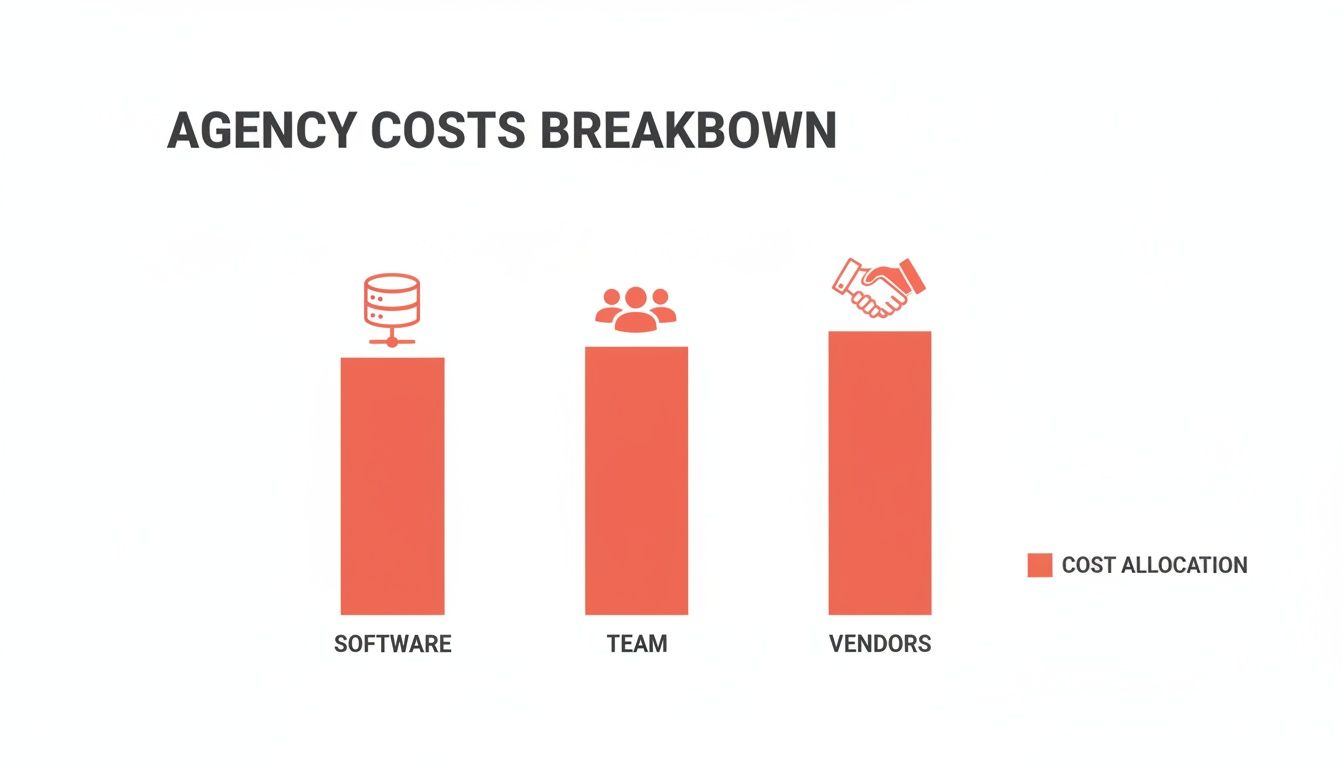
As you can see, software, team, and vendor costs are where the money goes. The real magic happens when you get these three to work together seamlessly.
Mapping Your Core Delivery Pipeline
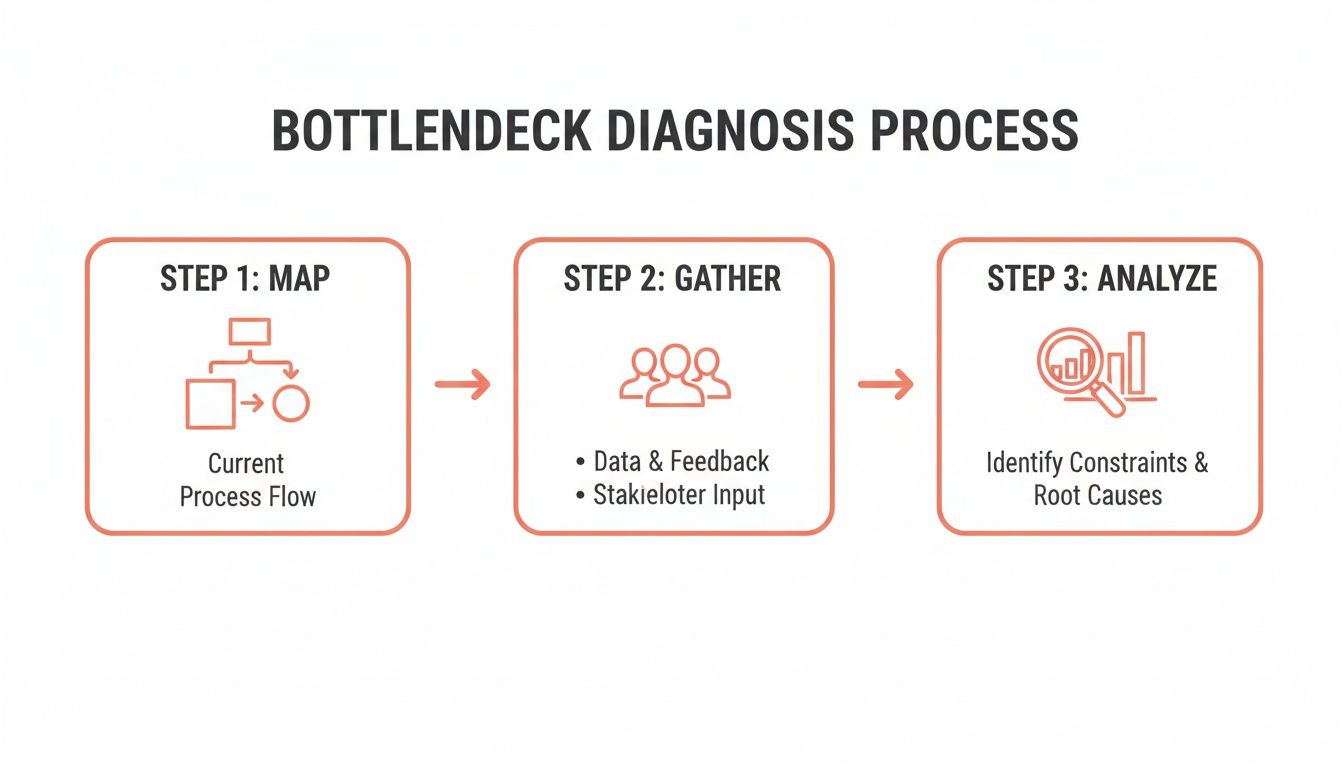
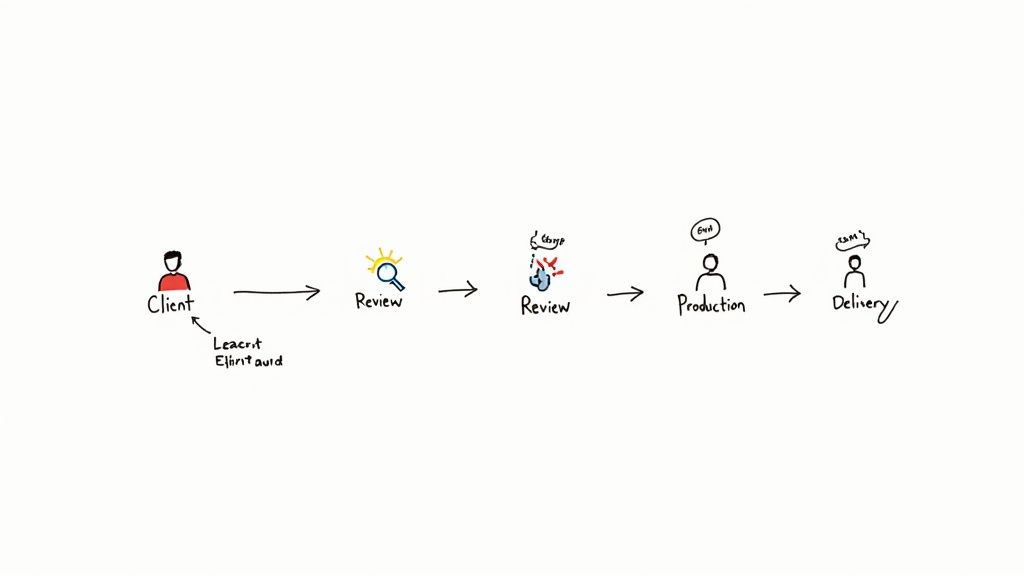
You can't fix a process you don't fully understand. The first, and most crucial, step is to map your entire client delivery pipeline. I mean every single step—from the moment a client signs on the dotted line to the final invoice and offboarding.
Get a whiteboard out and get granular. Where are the handoffs? What requires an approval? Which software is used at each stage?
Think through the key phases:
- Client Intake: How do you collect client info? Where does it live? Who needs it?
- Project Kickoff: How are tasks actually assigned? How does the team know what to build or create?
- Execution & Revisions: What's the real process for review and approval? Where does client feedback get logged so it doesn't get lost?
- Reporting & Invoicing: Where is the data for reports pulled from? Is it manual? Who is responsible for getting paid?
This exercise is incredibly revealing. You’ll almost certainly find redundancies, like an account manager typing up a brief in a Google Doc only for a project manager to re-enter the same information into Asana. That's a classic, and costly, time-waster.
The goal here is to create a 'single source of truth.' When everyone on your team is working from the same playbook and the same data, you eliminate the costly confusion and rework that kills margins.
The Power of Tool Rationalization
With your process map in hand, you can now conduct a proper tool rationalization. This isn't just about finding unused software licenses; it's about spotting functional overlaps where you can consolidate.
You’re looking for places where you’re paying for three tools to do the job of one. For instance, are you using one app for time tracking, another for task management, and a third for resource planning? Many modern agency platforms, like ClickUp or Teamwork, roll all of that into one system.
To make this tangible, lay it out in a simple table. This framework helps you see exactly where the redundancies and savings opportunities are.
Tool Consolidation Analysis
| Tool Category | Current Tools Used | Annual Cost | Consolidation Opportunity | Potential Savings |
|---|---|---|---|---|
| Project Management | Asana, Trello, Basecamp | $7,500 | Consolidate all projects onto one platform (e.g., ClickUp) | $4,500 |
| Communication | Slack, MS Teams | $3,200 | Standardize on a single platform with PM integration | $1,600 |
| File Storage | Dropbox, Google Drive, WeTransfer | $1,800 | Use the storage included with Google Workspace subscription | $1,800 |
| Time Tracking | Harvest, Toggl | $2,400 | Use the native time tracking in the new consolidated PM tool | $2,400 |
| CRM | HubSpot (Free), Pipedrive (Sales) | $4,800 | Upgrade HubSpot to a paid plan to cover all sales/service needs | $1,200 |
By forcing yourself to list out the tools and their costs side-by-side, the path forward becomes much clearer.
This kind of consolidation pays off in several ways:
- Direct Cost Savings: Fewer subscriptions mean lower monthly overhead. It's the quickest win you'll get.
- Reduced Training Time: Onboarding is a breeze when a new hire only has to learn one or two core systems instead of a dozen.
- Better Data Integrity: When project data lives in one place, your reports are suddenly far more accurate. You can finally get a real, reliable view of project profitability.
Creating an Integrated Agency Operating System
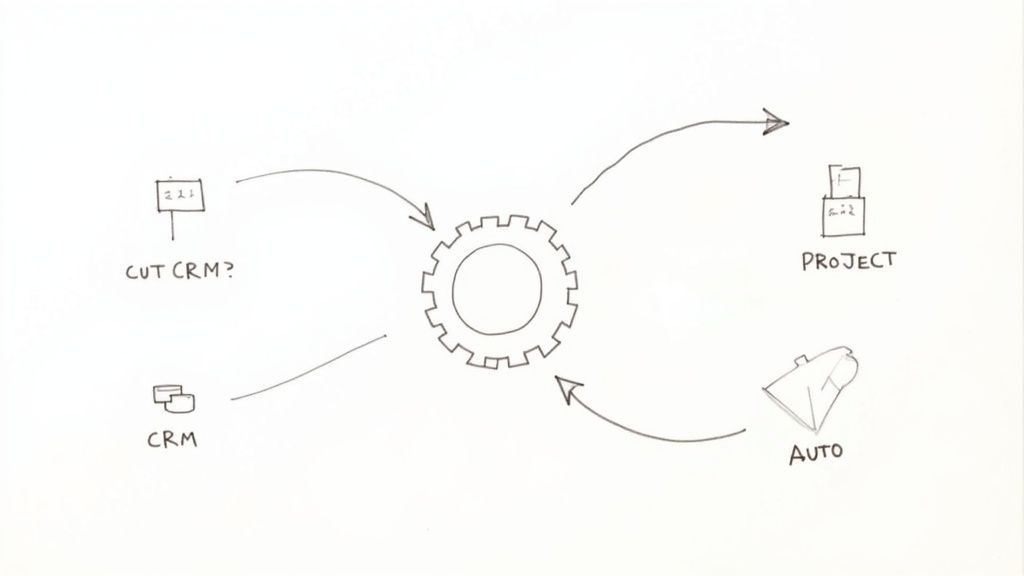
The final piece of the puzzle is connecting your newly streamlined processes with your rationalized tool stack. This is where you can start automating the grunt work. For example, you can build a workflow where closing a deal in your CRM automatically creates a new project, applies a standard task template, and notifies the project manager.
Don't underestimate the impact of this. Case studies have shown that firms embracing this kind of digital automation have seen cost reductions of up to 40% in certain operational areas. By eliminating duplicate data entry and automating routine tasks, you free up your team for what they were hired to do: high-value client work. To see more data on this, check out these insights on how automation drives savings.
When you intentionally connect your workflows and technology, you’re building an operational foundation that is not just cheaper to run but also more efficient, scalable, and a whole lot less frustrating for your team.
Driving Efficiency with Smart Automation and AI

Once you’ve tightened up your processes and consolidated your tech stack, it’s time to add some real firepower. Automation and AI aren't just buzzwords for Fortune 500s anymore; they are practical, everyday tools that can systematically eliminate administrative headaches and give your team their creative time back. This is where your cost-reduction efforts really start to pay dividends.
Let's cut through the hype. This isn't about replacing your talented team with bots. It’s about supercharging them—freeing them from the repetitive, soul-crushing tasks that eat up their day and keep them from doing high-value, billable work. The right automation strategy is less about technology and more about reclaiming your agency's most valuable resource: your team's brainpower.
Identifying High-Impact Automation Opportunities
Before you even think about buying new software, you need to pinpoint the right targets. What are the best candidates for automation? Simple: any task that is repetitive, rules-based, and time-consuming.
Think about all the little chores that happen every day, every week. The stuff that makes your team’s eyes glaze over but has to get done.
Most agencies have the same culprits hiding in plain sight:
- Client Reporting: The monthly scramble to pull data from Google Analytics, various ad accounts, and social media platforms just to paste it into a slide deck is a classic time sink.
- Initial Proposal Drafts: The core strategy needs a human touch, of course. But the boilerplate—company info, service descriptions, case studies—can be assembled in seconds.
- Social Media Scheduling: Manually logging into five different platforms to push out approved content is a perfect example of a low-value task just begging to be automated.
- Invoice Generation and Reminders: The process of creating and sending invoices, then chasing down late payments, can and should be completely hands-off.
Tackling just these few administrative burdens can give your team back a shocking number of hours each week. In fact, one report found that 73% of IT leaders saw automation slash the time spent on manual tasks by 50%. That's a massive efficiency gain that flows directly to your bottom line.
The goal isn’t just to do things faster. It’s to free up human intellect for the problems that only humans can solve—like creativity, strategy, and building incredible client relationships.
Starting with Low-Investment Wins
You don't need a huge budget or a dedicated dev team to get started. The smartest way to begin is with small, low-investment wins that provide an immediate, tangible return. This builds momentum and helps your team see automation as a helpful tool, not a threat.
A fantastic starting point is using AI-powered writing assistants. These tools have become incredibly sophisticated and can dramatically speed up all sorts of content and communication tasks.
Agency Use Case: AI-Powered Content Generation
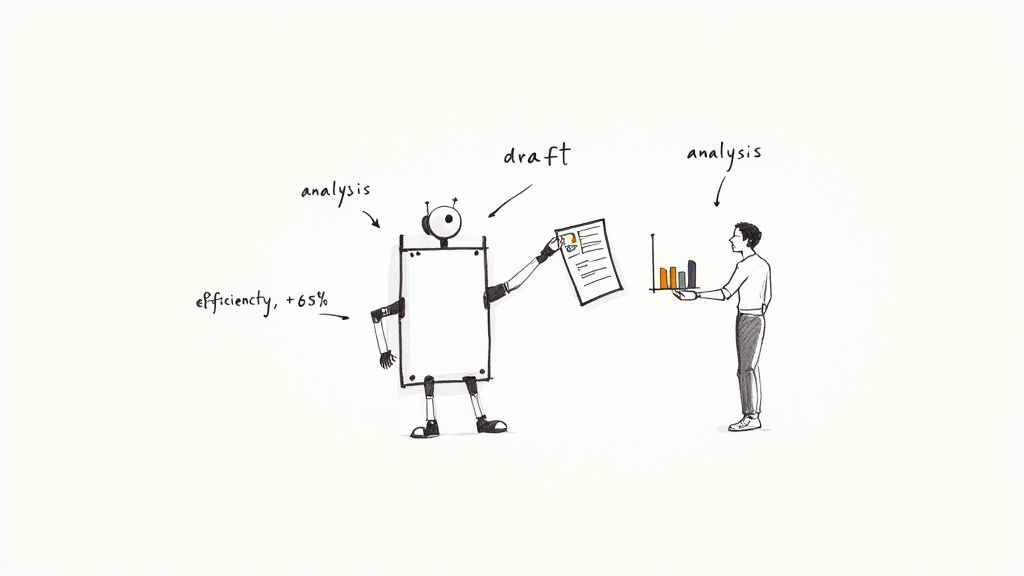
Think about drafting an initial social media calendar. A junior account coordinator might spend a whole day brainstorming and writing dozens of post variations for a single client. It's necessary work, but it's a grind.
With an AI writing tool, they can generate a month's worth of solid first drafts in minutes using a few well-crafted prompts. The coordinator’s job instantly shifts from tedious creator to strategic curator. They now spend their time editing, refining, and ensuring the AI-generated content perfectly matches the client's brand voice. This simple switch can easily cut the time for this task by over 60%, freeing them up for more impactful work like community engagement or performance analysis.
Creating an Automated Future for Your Agency
Don’t try to boil the ocean. Just pick one repetitive process from your list to start.
It could be as simple as setting up a workflow in your CRM. The moment a new client is marked as "won," an automated email goes out with a welcome packet and a link to your onboarding questionnaire. No manual steps, no chance of it being forgotten.
Once you see the time and mental energy saved from that single automation, you'll be eager to find the next one. This incremental approach is how you build a more efficient and resilient agency, one automated task at a time. Each step you take helps you reduce operational costs and build a business that can scale without buckling under the weight of its own administrative overhead.
Getting Smart About Your Talent and Vendor Spend
Your team and your vendors are your agency's biggest investments. It's easy to see them as fixed costs—just lines on a spreadsheet—but that's a missed opportunity. The real magic happens when you start treating them as flexible assets, which is a key part of building a more profitable and resilient agency.
This isn't about taking a machete to your headcount or squeezing every last penny out of your partners. It's about building a smarter, more agile operation that can expand and contract right along with your project pipeline. The goal is to make sure every dollar you spend on people and external help is directly fueling incredible work and padding your bottom line.
Rethink Your Staffing Model for a More Flexible Future
The old-school agency model—a big roster of full-time staff—works great when you're slammed with work. But what happens during the slow months? Suddenly, that massive payroll starts to eat away at your profits while you're paying for talent that isn't fully utilized.
A far more sustainable approach is a blended staffing model. This means you keep a core team of full-time employees for the essential, day-to-day work, and you build a trusted network of specialized freelancers and contractors to pull in for specific projects.
This hybrid approach gives you some serious advantages:
- Costs Become Variable: Instead of a huge fixed salary expense, a big chunk of your talent cost becomes variable. Your spending ebbs and flows with your revenue, which is a game-changer for financial stability.
- Access to A-List Talent: Need a world-class motion graphics artist or an SEO genius for a three-month gig? A blended model lets you tap into incredible expertise without the hefty price tag and commitment of a full-time hire.
- Move Faster: When a new project lands that needs a unique skill set, you can staff up in days, not the months it takes to hire someone. This agility means you can say "yes" to more opportunities without the fear of over-hiring.
The trick is finding that perfect balance. Your core team is your foundation—they hold the institutional knowledge and culture. Your freelance network provides the flex and specialized firepower you need to adapt to whatever clients throw at you.
Turn Your Vendors into True Partners
Just like you're re-evaluating your internal team, it's time to put your vendor relationships under the microscope. We've all done it: signed a contract, set it to auto-renew, and forgotten all about it. It’s time to shift those relationships from just another transaction to a strategic partnership.
Start by pulling up every single vendor contract you have, from your hosting provider to your accounting software. For each one, ask yourself some tough questions. Are we actually using all the features we're paying for? What's the going market rate for this service now? Is there a way to get more bang for our buck?
Smart vendor management is one of the quickest ways to trim operational fat. Here's a simple playbook to get started:
- Benchmark Everything. Before you even think about negotiating, do your homework. Find out what other agencies are paying for similar services. Walking into a conversation armed with market data gives you incredible leverage.
- Look for Bundles. Many vendors will cut you a deal if you bundle multiple services. Ask your current partners what else they offer. You might be surprised by the savings you can unlock by consolidating your spend with a few key vendors.
- Negotiate for Value, Not Just Price. A lower price is great, but it's not the only way to win. Try asking for more value instead. Could they give you better payment terms, a few extra user seats for free, or access to their premium support team?
- Embrace Modern Procurement. This is a massive opportunity that most agencies miss. Systematically managing your spending and using AI-powered contract tools can lead to double-digit savings. In fact, solid category management can deliver 10–15% in procurement cost savings, and AI has been shown to cut contract cycle times by a whopping 39%. You can learn more about how modern procurement strategies reduce costs on Concord.app.
By taking active control of your talent and vendor spend, you’re not just cutting costs. You’re building a more adaptable, financially sound agency that's ready for whatever comes next.
Answering Your Toughest Questions About Cutting Costs
Taking a hard look at your agency's spending can feel overwhelming. It brings up a lot of questions about where to start, how it will affect your team, and whether you're even making the right moves. Let's get into the most common concerns agency leaders have and give you some straight answers.
How Often Should We Really Be Looking at Our Costs?
A full-blown, line-by-line audit of every single expense? That's something you need to do once a year. But if you wait 12 months between check-ins, you're leaving money on the table. Smart cost management is an ongoing process, not a once-a-year fire drill.
Here’s a rhythm that works. We recommend a lighter quarterly review that focuses on your big-ticket items—think software subscriptions, major vendor contracts, and freelancer spending. That's frequent enough to spot things like sneaky price hikes or auto-renewals for services you forgot you were even using.
Then, on a monthly basis, your team should already be tracking core metrics like team utilization and project-level profitability. This constant, low-level monitoring makes cost control a proactive habit instead of a reactive headache, keeping your agency financially healthy day in and day out.
Will Cutting Costs Tank Our Agency's Culture?
It absolutely can, but only if you handle it like a clueless amateur. The difference between a morale-booster and a resume-polishing event is all in the framing.
If you announce it like a desperate, last-ditch effort to stay afloat, people will panic. Your best talent will start taking calls from recruiters.
Instead, you have to position this as a strategic move to build a smarter, stronger, and more resilient agency. Frame the mission around eliminating waste, killing frustrating manual work, and getting rid of clunky software—all the stuff your team probably complains about already.
When your team sees that the goal is to work smarter, not just cheaper, and that the changes actually make their jobs less of a grind, you can actually boost morale. You're not just trimming fat; you're removing friction and building a culture of efficiency where everybody wins.
It’s a simple shift, but it turns a potentially negative project into a positive one focused on genuine improvement.
Where’s the Best Place to Look for Quick Savings?
For almost every agency I've seen, the lowest-hanging fruit is the software stack. "SaaS sprawl" is a real thing, and it's almost always a goldmine for immediate savings. It’s that slow creep of redundant tools, forgotten trial accounts that are now billing you, and old-school software that nobody on your current team has ever even logged into.
Here’s a simple but powerful place to start:
- Make a master list: Seriously, just open a spreadsheet and log every single software subscription your agency pays for.
- Add the details: For each one, note the cost (monthly or annual), what it does, and who on the team "owns" it.
- Ask the hard questions: Is this tool truly critical? Do we have another tool that does the same thing? Is anyone even using this?
This simple audit will almost certainly uncover some quick wins. You can immediately cancel what's not being used, consolidate overlapping tools, or downgrade plans that are way more powerful than you actually need. It’s a high-impact first step that can generate savings without touching your core client work.
How Do We Know if Any of This Is Actually Working?
Measuring the ROI of your cost-saving efforts means you need to track both direct and indirect savings. Getting this right is how you know you're making a real difference.
- Direct Savings: This is the easy part. You cancel a $300/month software subscription? That’s a direct saving of $3,600 a year. Simple.
- Indirect Savings: This is all about the value of reclaimed time. Let's say a new workflow automation saves a project manager four hours a month. You can calculate the value of that time based on their fully loaded cost. That’s four hours they can now spend on high-value work, like client strategy or pitching new business, instead of administrative nonsense.
To see the big picture, you have to track a few key metrics before and after you make changes. Keep a close eye on your Operating Expense Ratio (OER), your overall Profit Margin, and your Employee Utilization Rate. A steady improvement in these numbers is the ultimate proof that your efforts are delivering a powerful return.
Ready to stop wrestling with disconnected tools and build a truly efficient agency? RGK is the unified operating system designed to eliminate operational chaos. It integrates your projects, clients, billing, and team into a single source of truth, supercharged with an AI layer that gives your team the context and support they need to operate at a higher level. Learn how RGK can help you scale profitably at https://rgk.app.