Your Guide to a Flawless Project Implementation Plan

Starting a new project can feel like staring up at a mountain. You know the summit is up there, but the path is full of unknowns. The hard truth? A surprisingly small number of projects ever actually make it to the top. Most get derailed by the same predictable issues, time and time again.

A solid project implementation plan is the map and compass that guides your team through that uncertainty, helping you sidestep those common pitfalls right from the get-go.

Why Projects Fail and How Your Plan Prevents It
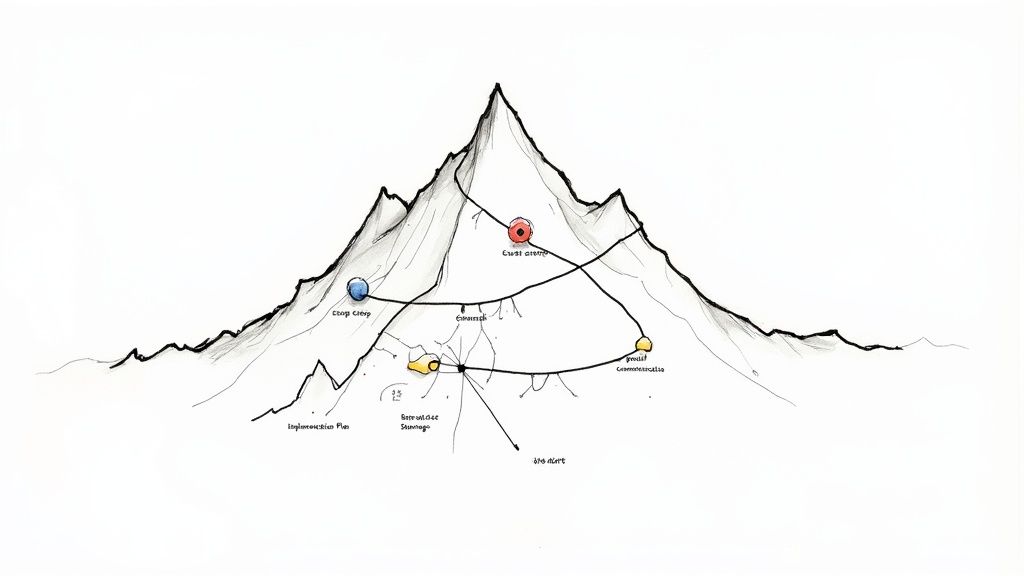
A hand-drawn mountain illustration depicting a project implementation plan with various labeled stages and paths.

So many agencies dive into new projects headfirst, running on pure enthusiasm. It’s a gamble, and the stats show just how badly that can go. Without a clear, structured plan, teams are wide open to the classic mistakes that cause projects to completely break down.

This isn't about being negative; it's about being prepared. Truly understanding why projects fail is the first step toward making sure yours doesn't.

The Sobering Reality of Project Success Rates

The numbers don't lie. Research from respected sources like Harvard Business Review and the Project Management Institute (PMI) consistently shows that only about 35% of projects are successfully completed on a global scale. Think about that. The majority either miss their deadlines, blow their budgets, or fail to deliver on the original promise.

But here’s the good news: the data also points to a powerful solution. Projects that use formal management practices are 2.5 times more likely to succeed. You can explore more project management statistics on Ravetree.com to see the full picture.

A well-crafted project implementation plan is the very foundation of that formal practice. It’s what turns abstract goals into a concrete, step-by-step guide your team can actually follow.

Common Failure Points a Strong Plan Solves

Projects rarely fail because of one single, catastrophic event. Instead, they die a death of a thousand cuts—a series of small, unmanaged issues that pile up over time. A strong implementation plan is your best defense, acting as a preventative measure against these all-too-common threats.

Here's a look at the most frequent culprits and how a good plan stops them in their tracks.

Common Failure Point How Your Implementation Plan Solves It
Scope Creep Clearly defines and locks in project boundaries from day one, preventing endless "can we just add…" requests.
Poor Communication Establishes a communication protocol—who gets what updates, when, and how—so everyone stays on the same page.
Unclear Roles & Responsibilities Explicitly assigns tasks and ownership, eliminating confusion and ensuring accountability.
Inaccurate Timelines Breaks the project into manageable tasks with realistic deadlines, creating an achievable schedule.
Resource Shortages Allocates people, budget, and tools in advance so you know you have what you need, when you need it.
Unidentified Risks Forces you to proactively identify potential problems and create contingency plans before they become emergencies.

By building a plan that accounts for these common failure points, you're not just creating a document; you're building a system for success.

By addressing these issues before they arise, your project implementation plan shifts your team from a reactive, firefighting mode to a proactive, strategic one. It's not just a document—it's your agency's best defense against chaos.

Defining Your Project Scope and Deliverables

Before your team even thinks about writing a line of code or mocking up a design, the fate of your project is already being sealed. This is the moment that matters most: defining what you will and will not do. Get this wrong, and you're practically inviting scope creep, blown budgets, and a very unhappy client.

Think of a well-defined scope as the guardrails for your project. It's the documented handshake between your agency and the client, clearly mapping out the project's boundaries, its goals, and every piece of work needed to get there. This isn’t just a friendly suggestion; it’s the single source of truth that shields your team from those dreaded "can you just add…" requests that torpedo timelines and kill profitability.

Mastering the Art of Scope Definition

Defining the scope is all about translating a client's big-picture vision into a detailed, actionable blueprint. This takes more than just listening; it requires asking the right questions to dig into what the client really needs, which is often different from what they initially think they want. Vague goals like "we need a new website" are the natural enemy of a successful project.

Your job is to break that down. What does "new" actually mean? Does it need an e-commerce platform? A blog? How many pages are we talking about? Who's responsible for writing the copy? Nailing down these answers upfront saves you from making incredibly expensive assumptions down the road. It’s no surprise that a failure to manage scope is consistently cited as a top reason projects fail, with a direct and painful impact on budgets and deadlines.

To get this right, you have to separate what’s essential from what’s extra. I've found one of the best ways to do this is to categorize every feature and request into three simple buckets:

  • Must-Haves: These are the absolute non-negotiables. The project is a failure without them. For a website launch, this would be things like a homepage, a working contact form, and full mobile responsiveness.
  • Should-Haves: These are important and add a ton of value, but the project can still launch without them. They're prime candidates for a "Phase 2" if time or budget gets tight. Think of an integrated blog or advanced SEO features.
  • Nice-to-Haves: These are the bells and whistles. We're talking slick animations or a niche feature that only a small slice of users might appreciate.

Going through this exercise with your client forces a strategic conversation right from the get-go. It gets everyone on the same page and manages expectations from day one, giving you a clear framework for making tough calls if priorities have to shift later on.

A project without a tightly defined scope is like a ship without a rudder. You might be moving, but you're definitely not in control of where you're going. Documenting everything gives you that control.

From Vague Goals to Tangible Deliverables

Once you’ve locked in the scope, the next move is to translate it into project deliverables. A deliverable is simply a tangible, measurable thing you will hand over. It’s the physical proof that work got done. Being almost painfully specific here is your best friend—ambiguity is the breeding ground for misunderstandings.

Don't just say "social media assets." A proper deliverables list gets into the weeds: "Five unique Instagram post graphics (1080x1080px) in JPG format" and "Three animated Instagram Story videos (1080x1920px), 15 seconds each, in MP4 format." See the difference? There's absolutely no room for misinterpretation.

Let’s walk through a classic agency scenario to see how this plays out in a real project implementation plan.


Agency Example: A New Client Onboarding Campaign

Imagine your digital marketing agency just landed a new software client. The task is to create an onboarding email sequence to welcome new users. Here’s how you’d break down the scope and deliverables.

Project Goal: Build an automated 7-day email sequence that educates new users and pushes them to activate a key feature in the software.

Scope Inclusions Scope Exclusions
Strategy and concept development A/B testing different subject lines
Copywriting for four distinct emails Designing custom graphics for each email
Basic, reusable email template design (HTML/CSS) Integration with a brand new email service provider
Setting up the automation in Mailchimp List segmentation beyond the "new user" category

Deliverables List:

  1. Project Brief Document: A final brief covering campaign goals, target audience, and key messaging, signed off by the client.
  2. Email Copy Document: A Google Doc with the final, approved copy for all four emails.
  3. Email Template: One responsive HTML email template, tested and confirmed to be compatible with Mailchimp.
  4. Live Automation: A fully configured and activated 7-day email sequence inside the client's own Mailchimp account.
  5. Final Report: A short summary doc with screenshots to prove the setup is live, plus a quick guide on how the client can monitor its performance.

By detailing precisely what’s in, what’s out, and what the client will actually get, the agency protects its time and budget. More importantly, it ensures the client knows exactly what’s coming. That kind of clarity is the foundation of every great project and every lasting client relationship.

Mapping Your Project Timeline and Resources

So, you've nailed down the scope and have a neat list of deliverables. It's tempting to dive right in and start creating, but hold on. A list of deliverables without a timeline is just a wish list. And a timeline without the right people and tools assigned is pure fantasy.

This is the part of your implementation plan where the rubber really meets the road. It’s where we connect the what to the how and the when. We’re about to create a realistic, interconnected map that turns big-picture goals into day-to-day actions. By breaking things down now, you'll avoid the classic agency pitfall: over-optimism leading to a last-minute scramble.
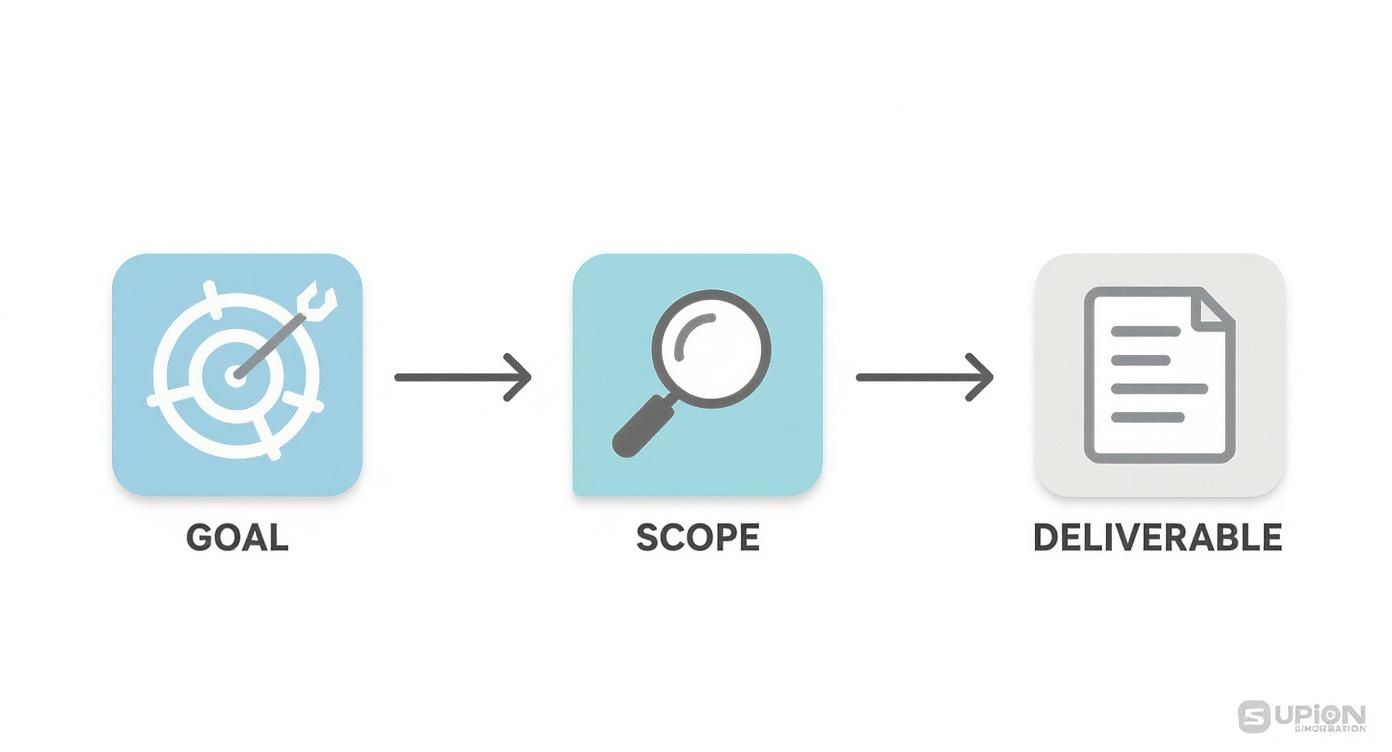
A three-step project implementation process: defining the goal, determining the scope, and creating a deliverable.

This simple flow gets to the heart of project planning. You start with the big goal, define the boundaries with your scope, and then identify the tangible things you'll create. Following this logic ensures every single task on your timeline directly serves an agreed-upon output, which means no more wasted effort on "busy work."

Breaking Down Work into Actionable Tasks

First up: deconstruction. Take each deliverable and break it down into the smallest possible actions. Think of it this way: a deliverable like an "Email Template" isn't a single task. It’s a mini-project.

It actually looks more like this:

  • Wireframe the email template design.
  • Write placeholder copy and headlines.
  • Develop the template with HTML/CSS.
  • Run tests across major email clients (Gmail, Outlook, etc.).
  • Get final client sign-off on the design and functionality.

Once you have this granular list, you can start putting real time estimates against each item. Be honest here. A task that takes a developer four hours of pure, focused work might need a full day blocked out on the calendar to account for meetings, questions, and other daily interruptions.

A rookie mistake is building a timeline based on a perfect, uninterrupted world. Always plan for reality. I’ve learned to pad estimates slightly and, most importantly, identify dependencies—those tasks that can't kick off until another is complete. This builds a resilient timeline that won't shatter at the first minor delay.

This detailed view is also the key to allocating resources properly. Now you know you need a designer for a few hours at the start, a developer for a day in the middle, and a project manager to oversee testing and manage client feedback throughout.

Aligning Resources with Your Timeline

With a task list and a draft schedule in hand, you can start building your resource map. This is all about assigning the right people, technology, and budget to each phase. It's not just about who's free; it’s about matching the right skills to the job. A junior designer can probably handle the wireframe, but you’ll want a senior developer for any complex coding.

Don't forget about the non-human resources, either.

  • Software and Tools: Will you need a subscription to a specific stock photo service? A license for a particular testing tool?
  • Budgetary Needs: Make sure to account for any contractor fees, software costs, or even ad spend if it's baked into the project.

This kind of careful planning is exactly why skilled project managers are so in-demand. The global need for this expertise is exploding, with roughly 40 million project management professionals already out there. The Project Management Institute even predicts a major talent gap, with demand expected to surge by 2035. You can discover more insights about project management trends on monday.com if you want to dive deeper into the data. It really highlights how valuable a well-resourced plan is.

Choosing the Right Visualization Tool

How you actually see all of this information—the tasks, the deadlines, the people—makes a huge difference in how manageable it feels. For agencies, the two most common tools are Gantt charts and Kanban boards. Each has its own strengths, and the right choice really depends on your project's rhythm and your team's workflow.

A Gantt chart is your best friend for showing task dependencies and the project's overall duration from start to finish. It’s perfect for projects with a hard deadline and a clear, step-by-step process. A Kanban board, on the other hand, is all about flexibility and visualizing your workflow, making it great for managing continuous delivery and adapting on the fly.

To help you decide, here’s a quick comparison of what each brings to the table.

Choosing Your Timeline Tool Gantt Charts vs Kanban Boards

Feature Gantt Chart Kanban Board
Primary Focus Scheduling and Dependencies Workflow and Process
Best For Projects with fixed deadlines and a clear, sequential path (e.g., a website launch). Continuous improvement projects or tasks with variable priorities (e.g., ongoing content creation).
Visual Style Horizontal bar chart showing tasks against a calendar. Vertical columns representing stages (e.g., To Do, In Progress, Done).
Flexibility Less flexible; changes can be complex due to cascading dependencies. Highly flexible; tasks (cards) can be easily moved and re-prioritized.
Complexity Can become cluttered and overwhelming on very large, complex projects. Simple and intuitive, providing a clear snapshot of current work in progress.

Ultimately, the best tool is the one your team will actually use and keep updated. For a big, multi-phase website build, a Gantt chart provides the structure you need to keep everything on track. But for a nimble, fast-moving marketing campaign, a Kanban board might offer the agility you need to react to real-time feedback.

Assembling Your Team and Defining Roles

A brilliant plan is just a document until you have the right people to make it happen. Now we get to the heart of it—the human element. It's not enough to just list names on a roster; you need to map out exactly who's doing what. This single step can be the difference between a smooth-running project and a chaotic mess of missed deadlines and duplicated work.

I’ve seen too many projects derail because of one simple, toxic phrase: "I thought you were doing that." That's the red flag signaling that roles were never clearly defined from the start. To avoid that pitfall, you have to get granular and assign specific responsibilities for every single part of the project.
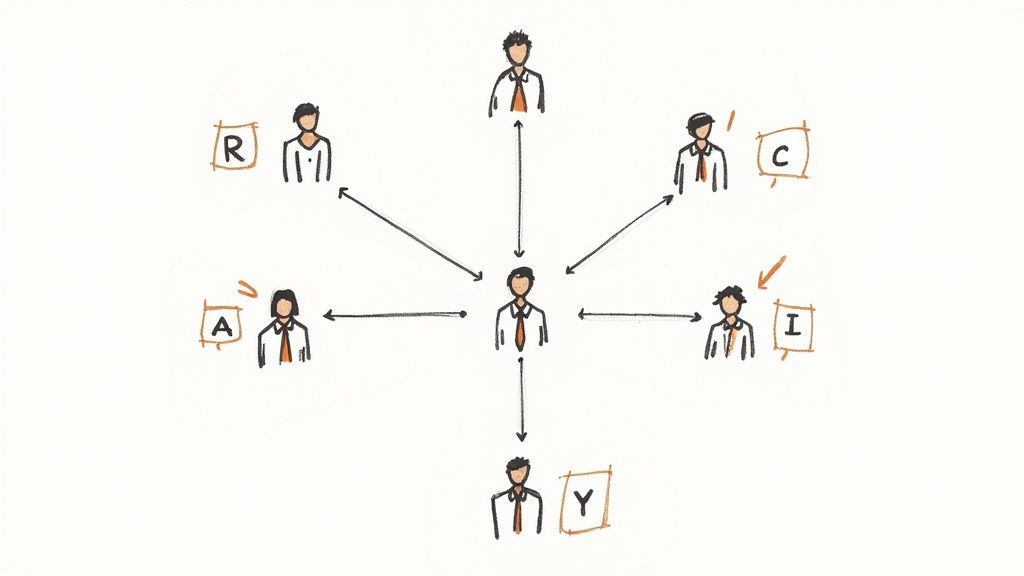
A hand-drawn organizational diagram with a central person connected to team members representing R, A, C, I roles.

This structure is what turns a group of talented individuals into a high-functioning team. Everyone knows who owns each task, and stakeholders know exactly who to go to for decisions. It transforms potential chaos into organized, collaborative energy.

Building Your RACI Chart

One of the most powerful tools I've used to bring this clarity is the RACI chart. It’s a simple matrix, but it’s a game-changer for agencies because it visualizes who does what. RACI is an acronym that stands for:

  • Responsible: This is the doer. The person with their hands on the keyboard, actually creating the deliverable—think the designer building the wireframes or the copywriter drafting the ad copy.
  • Accountable: This is the owner. The single person whose neck is on the line for the task's success. Critically, there should only ever be one "A" per task to avoid confusion.
  • Consulted: These are the experts you bring into the loop for their feedback. It could be the SEO strategist weighing in on a site map or the legal team reviewing compliance language.
  • Informed: These are the people who just need a heads-up on progress. They aren't directly involved, but the outcome affects them. Think clients, department heads, or the executive sponsor.

The act of building this chart forces crucial conversations early on. It uncovers assumptions and clarifies ownership before any work even begins, empowering everyone by showing them exactly where they fit.

A Web Development Project in Action

Let’s make this real. Imagine your agency is building a new e-commerce site. Your core team is a Project Manager (PM), a Lead Developer, a UI/UX Designer, a Content Strategist, and, of course, the Client.

For a task like "Design Homepage Mockup," the RACI chart might look like this:

Task Project Manager Lead Developer UI/UX Designer Content Strategist Client
Design Homepage Mockup A C R C I

Here's the breakdown:

  • The UI/UX Designer is Responsible (R) for the hands-on design work.
  • The Project Manager is Accountable (A) for making sure it gets done on time and meets the brief.
  • The Lead Developer and Content Strategist are Consulted (C) for feasibility and to ensure the design supports the content strategy.
  • The Client is kept Informed (I) of progress and will review the final mockup.

This simple chart prevents so many future headaches. The designer knows who to talk to, the PM knows the final sign-off is on them, and the developer doesn't get blindsided by a design that’s impossible to build.

Setting Up Communication Channels

Defining roles is step one; making sure those people can actually talk to each other effectively is step two. Your plan needs to spell out the how and when of communication. This isn't about scheduling more meetings—it's about making every interaction count.

Set up specific channels for different needs:

  • Daily Huddles: A quick 15-minute stand-up or a dedicated Slack channel works perfectly for quick blockers and progress updates.
  • Weekly Status Reports: A more formal email digest for stakeholders (your "Informed" group) summarizing wins, progress, and next steps.
  • Technical Problem-Solving: A separate channel or scheduled session for developers and designers to hash out technical issues without derailing the main project conversation.

By baking these communication protocols directly into your plan, you build a system that keeps information flowing. It ensures the right people get the right information at the right time, preventing those frustrating delays where a key decision is just sitting, unread, in someone's inbox.

Anticipating Roadblocks with a Risk and Communication Plan

Let's be honest—no project plan, no matter how detailed, survives contact with reality completely unscathed. Things happen. The real difference between a project that succeeds and one that goes off the rails is how you handle those inevitable bumps in the road.

This is where you shift from being just a planner to a prepared realist. By thinking through what could go wrong and setting up clear lines of communication from the start, you build resilience right into the project's DNA. It’s not about having a crystal ball; it’s about creating a framework that can absorb shocks without collapsing.

Conducting a Practical Risk Assessment

Your first move is to get the team in a room (or on a call) and brainstorm all the ways this project could get derailed. Seriously, no idea is too paranoid at this stage. To keep things organized, try thinking in categories.

What kind of gremlins usually pop up for agency projects?

  • People Problems: What's the plan if your lead designer quits to join a silent retreat mid-project? Or if the main client contact goes on an unexpected month-long vacation?
  • Tech Headaches: What happens if that critical third-party software goes down for a day? What if the "simple" API integration turns out to be a nightmare?
  • Client Curveballs: What if the stakeholder who needs to sign off on everything suddenly goes silent? Or worse, they come back with scope-creeping feedback two weeks before launch?
  • Outside Forces: What if a platform you depend on changes its terms of service overnight, breaking a key feature?

Once you have a healthy list of potential disasters, it's time to prioritize. A simple likelihood vs. impact matrix works wonders here. How likely is this to happen, and how bad will it be if it does? Focus your attention on the stuff that's both likely and damaging.

For each major risk, you need a game plan. These usually fall into two buckets:

  1. Mitigation: These are the proactive moves you make before the problem hits. Worried about your lead developer being a single point of failure? Schedule regular knowledge-sharing sessions to get another team member up to speed.
  2. Contingency: This is your "break glass in case of emergency" plan. What will you do if the risk becomes reality? For example, having a trusted freelance developer on standby who can jump in if needed.

Your risk register isn't a "set it and forget it" document. It's a living, breathing part of your plan. Revisit it in team meetings to see if new threats have appeared or if old ones are no longer relevant.

Building a Bulletproof Communication Plan

Spotting a risk is one thing; making sure the right people know about it at the right time is another. A solid communication plan is the nervous system of your project, ensuring information gets where it needs to go without getting lost in a sea of emails and Slack messages.

This plan simply defines who gets what update, how often, and in what format.

This becomes absolutely critical on bigger, more complex projects. For example, public sector IT projects are notoriously difficult to coordinate. Research shows that around 81% of these projects run over schedule, a stark contrast to the 52% in the private sector. You can learn more about project management statistics on PM360Consulting.ie. Why the gap? Often, it comes down to messy communication and stakeholder management. A clear plan helps close that gap.

So, what does a good communication cadence look like?

  • Internal Team: A quick daily stand-up (15 minutes max) on Slack or a video call works perfectly. Cover what you did yesterday, what you're doing today, and any roadblocks.
  • Primary Client Contact: A weekly progress email sent every Friday. Keep it scannable: here’s what we accomplished, here’s what’s next, and here’s what we need from you.
  • Executive Leadership: They don’t need the nitty-gritty. A bi-weekly or monthly high-level summary focusing on major milestones and KPIs is all they need to see.

By laying this all out in the implementation plan, you set expectations from day one. No one is left wondering what’s going on, and when a problem does pop up, everyone already knows the protocol for flagging it. It’s this structure that builds trust and keeps the whole team aligned, even when things get rocky.

Your Top Questions About Project Implementation Plans, Answered

Even with the best template in hand, you're bound to run into some questions once you start building and using a project implementation plan. The theory is great, but the day-to-day reality of agency projects always throws a few curveballs.

Let's dig into some of the most common questions that pop up. This isn't about high-level concepts; it’s about getting you practical answers to smooth out the process and keep your projects from getting stuck.

What’s the Real Difference Between a Project Plan and an Implementation Plan?

This is a big one. People often use these terms interchangeably, but they serve very different functions. Mistaking one for the other can lead to a lot of confusion.

Think of it this way: a project plan is the entire map of a cross-country road trip. It shows the starting point, the final destination, major cities you'll pass through, and the overall budget for gas and lodging. It’s the big-picture document covering everything from initiation to final sign-off.

The project implementation plan is your detailed, turn-by-turn GPS navigation for that trip. It’s zoomed in, telling you exactly which roads to take, when to turn, where to stop, and who's driving each leg of the journey. It focuses exclusively on the execution phase—the "doing" part of the project.

For your agency, the project plan might set a goal to "Boost client lead generation by 20%." The implementation plan breaks that down into the nitty-gritty: the content calendar, the ad creatives needed for the Q3 campaign, the specific landing page wireframes, and which copywriter is assigned to each task.

Your project plan is the "what" and the "why." Your project implementation plan is the "who does what by when." You need both, but the implementation plan is what your team will actually use every single day.

How Often Should I Update My Implementation Plan?

If you create your implementation plan and then just file it away, you've already failed. This has to be a living, breathing document that mirrors the reality of your project, not the fantasy you planned for weeks ago.

The right update schedule really depends on your project's pace and the methodology you're using.

  • For Agile projects: The plan is constantly evolving. You'll be reviewing and tweaking it at the end of every sprint cycle, which is usually every one or two weeks. Your daily stand-ups act as mini-reviews, while sprint retrospectives are for making bigger course corrections.
  • For Waterfall projects: The updates are a bit more formal. You'll likely schedule reviews at major milestones or on a monthly basis. But don't let that fool you—if a major roadblock appears, you update the plan immediately. Don't wait for the next scheduled meeting.

The golden rule is this: update the plan whenever something significant changes. A shift in scope, a key team member going on leave, a task that's taking way longer than anyone thought—these all warrant an immediate update. Weekly project check-ins are the perfect time to review progress and make these adjustments, ensuring your plan stays a useful tool, not a historical relic.

What Are the Most Critical KPIs to Track?

The KPIs (Key Performance Indicators) you track must connect directly to your project's goals. While every project is unique, there are a handful of metrics that are almost universally critical for keeping things on track. Your implementation plan should spell these out from the very beginning.

Here are the non-negotiables:

  • Schedule Variance (SV): Are we ahead or behind? This metric cuts through the noise and tells you exactly where you stand against your timeline. It compares the work you've actually done with the work you planned to have done by now.

  • Cost Variance (CV): Just like SV, but for your budget. This KPI measures the difference between what you planned to spend and what you've actually spent to get the work done.

  • Task Completion Rate: A straightforward but powerful way to gauge your team's momentum. Tracking how many tasks are getting knocked out per week or sprint helps you spot bottlenecks and forecast your ability to hit future deadlines.

  • Stakeholder Satisfaction: For an agency, this is everything. You can measure it with quick, informal check-ins or through more structured client surveys at key milestones. A happy client is one of the best indicators of a healthy project.

  • Quality Metrics: This will look different for every project. It could be the bug count in a software build, the number of revision rounds on a design, or the click-through rate of a marketing campaign. These KPIs ensure the final product doesn't just get delivered, but that it actually works and meets the quality standard you promised.


At RGK, we built an operating system designed to eliminate the operational chaos that holds agencies back. By unifying project management, CRM, billing, and support into a single source of truth—powered by an AI that understands your entire business—we help you run, grow, and keep your clients without the duct tape. See how a truly integrated platform can transform your agency's workflow. Learn more about RGK today.
12 Best Action Plan Templates Free for Agencies in 2025

Running an agency is a masterclass in juggling competing priorities: client onboarding, project kickoffs, campaign launches, and critical support escalations. Without a structured framework, chaos quickly becomes the default operating mode, threatening both project outcomes and client satisfaction. A simple to-do list just won't cut it when consistency and quality are on the line. You need a standardized, repeatable action plan that ensures nothing falls through the cracks, no matter how hectic things get. This guide moves beyond generic checklists to provide a curated collection of the best action plan templates free for agency-specific use cases.

This resource is designed to help you build a reliable operational backbone, saving you valuable time and ensuring consistent, high-quality delivery for every client. We’ve done the heavy lifting, sorting through hundreds of options to find templates that are genuinely useful and easy to implement. Whether you need a simple downloadable document or a dynamic project board, you'll find a solution here.

Inside this comprehensive list, you will discover:

  • Ready-to-use templates for every agency workflow, from campaign launches to client retention plans.
  • A mix of formats, including Google Docs, Word, Excel, Notion, Asana, and printable PDFs.
  • Direct download links and clear screenshots for each resource, so you can see exactly what you're getting.
  • Practical notes on when to use each template and how to customize it for your agency’s specific needs.

Our goal is to help you find the right tool quickly, allowing you to stop searching and start systemizing your processes today.

1. HubSpot

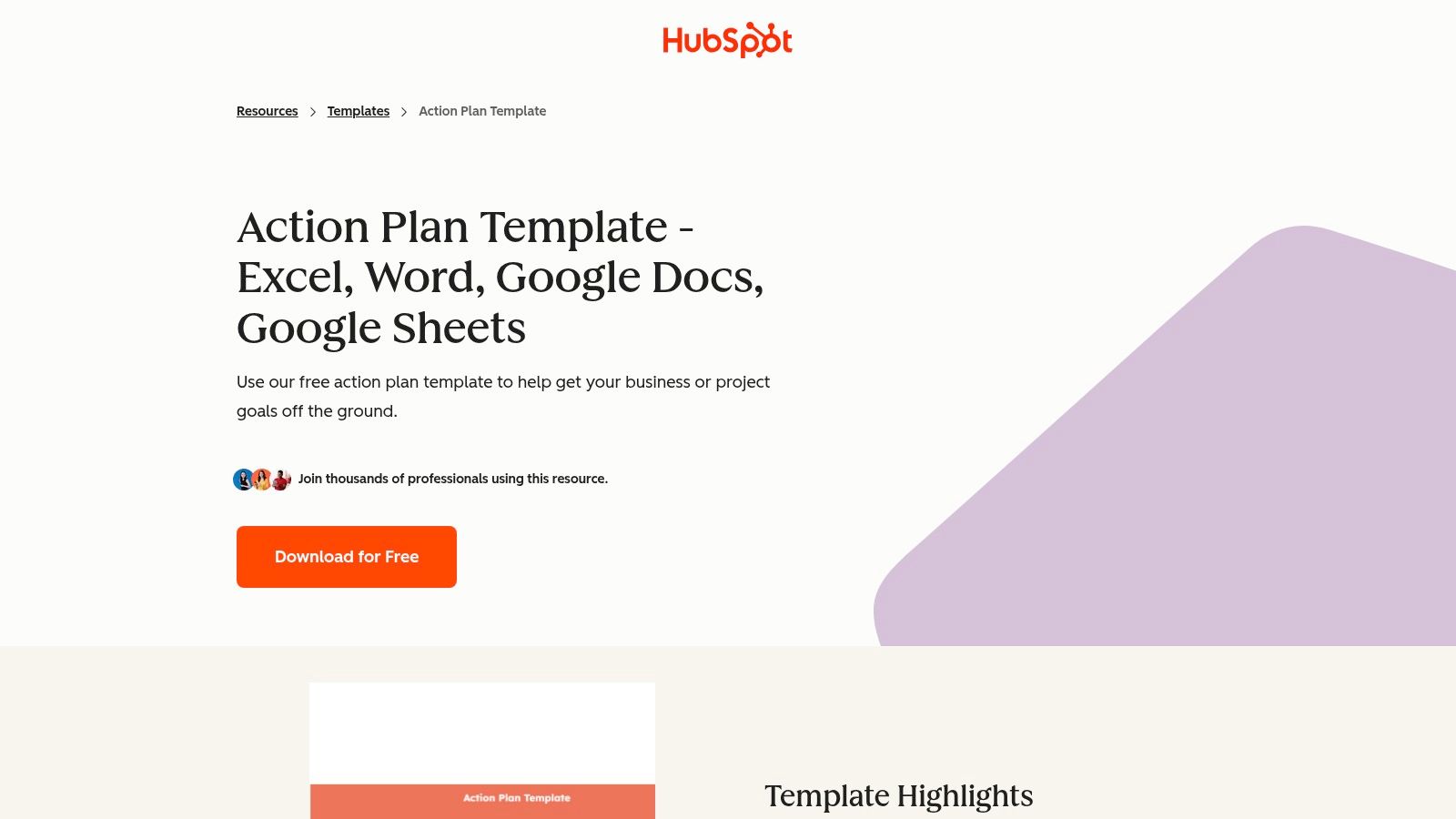
HubSpot offers a straightforward and highly accessible collection of action plan templates free for immediate download. Their core strength lies in providing fundamental, no-frills templates across four popular formats: Google Docs, Google Sheets, Microsoft Word, and Excel. This cross-compatibility ensures that agencies can easily integrate the template into their existing workflows, regardless of their preferred software suite.

HubSpot's action plan template download page showing options for different file formats.

The package is designed for ease of use, making it ideal for teams that need a simple, structured document without the learning curve of a complex project management tool. The templates are clean, professionally formatted, and can be quickly customized with an agency's logo.

Key Features & User Experience

The user experience is simple: you visit the landing page and select your preferred format. While HubSpot sometimes requires an email address to access their free resources, the download process is quick. The templates themselves are intuitive, featuring standard columns for tasks, assignees, deadlines, and status updates.

  • Multi-Format Availability: Get instant access to Word, Excel, Google Docs, and Google Sheets versions in one bundle.
  • Built-in Guidance: The download includes a helpful how-to guide and FAQs, which is particularly useful for junior team members tasked with creating their first action plan.
  • Smart Counters: The spreadsheet versions (Excel/Sheets) include built-in counters that automatically summarize task status (e.g., Not Started, In Progress, Complete), providing a quick visual overview of project progress.

Best for: Agencies needing a versatile, universally compatible, and easy-to-use template for internal projects or straightforward client work where a dedicated software solution is overkill.

Website: HubSpot Action Plan Template

2. Smartsheet

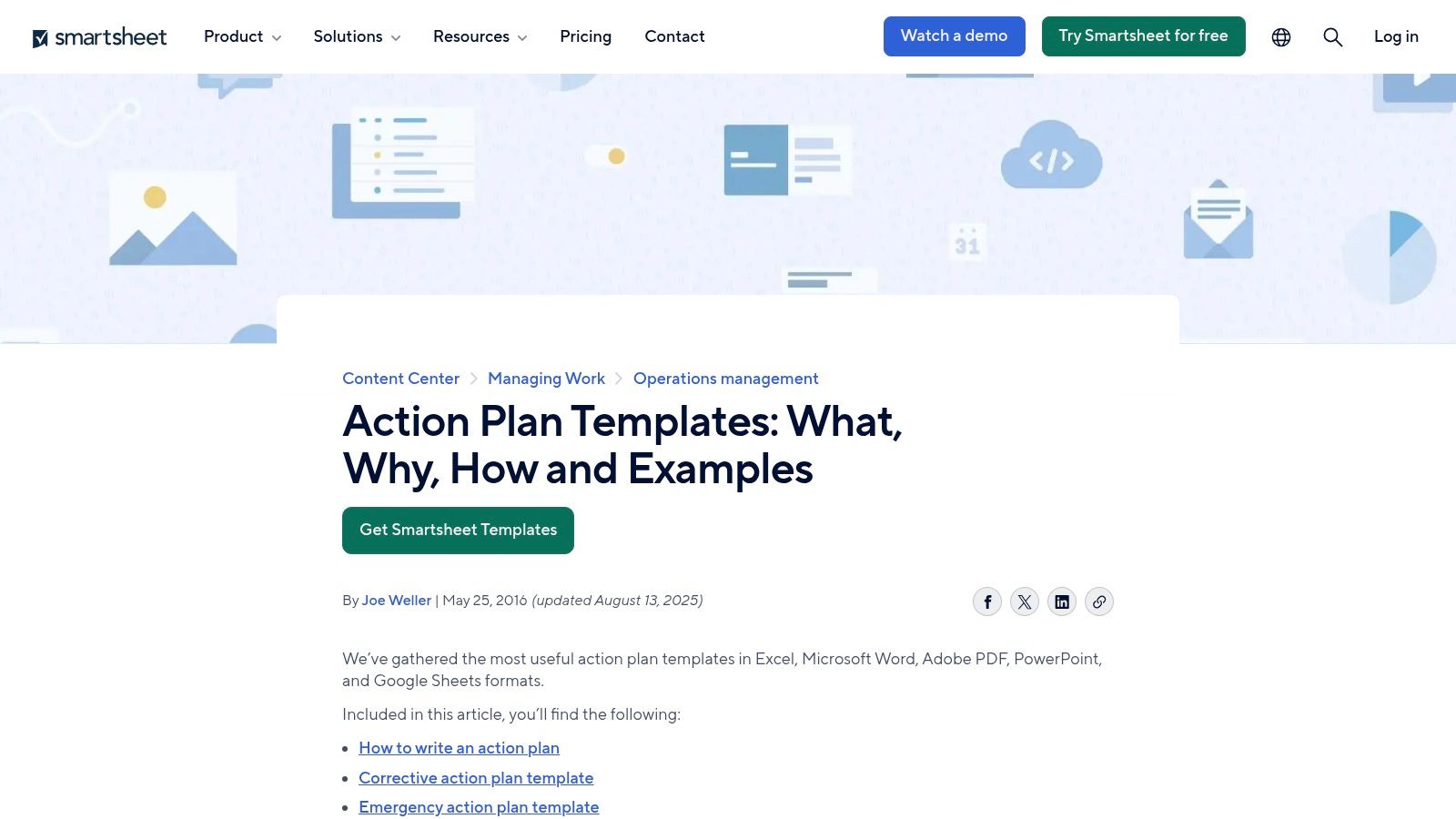
Smartsheet provides a comprehensive library of action plan templates free for download, alongside the option to use them within its powerful work management platform. Its main advantage is bridging the gap between simple, static documents and a dynamic, collaborative system. Users can start with a free template in Excel or Google Sheets and later import it into Smartsheet to unlock real-time dashboards, automation, and advanced tracking.

A preview of an action plan template within the Smartsheet platform.

This dual-pathway makes Smartsheet an excellent choice for agencies that anticipate their project management needs growing. You can begin with a basic, downloadable template for a small project and transition to a more robust, interactive system as the project's complexity increases, without having to start from scratch.

Key Features & User Experience

The user experience begins on a resource page where you can browse and download various templates directly. For those wanting more power, the templates can be opened within Smartsheet's platform, which operates like a spreadsheet on steroids. The true value emerges when these templates are connected to Smartsheet's broader feature set, although this requires an account (a free trial is available).

  • Diverse Template Library: Offers specialized templates for different needs, including corrective action plans, strategic plans, and business action plans.
  • Clear Upgrade Path: Start with a free Excel or Google Sheets download and seamlessly import it into the Smartsheet platform for enhanced features when you're ready.
  • Automation & Integration: When used within the platform, templates can trigger automated alerts, update dashboards in real-time, and integrate with other business tools.

Best for: Agencies looking for enterprise-grade templates with a clear pathway to a more powerful, collaborative, and automated project management solution as their needs evolve.

Website: Smartsheet Action Plan Templates

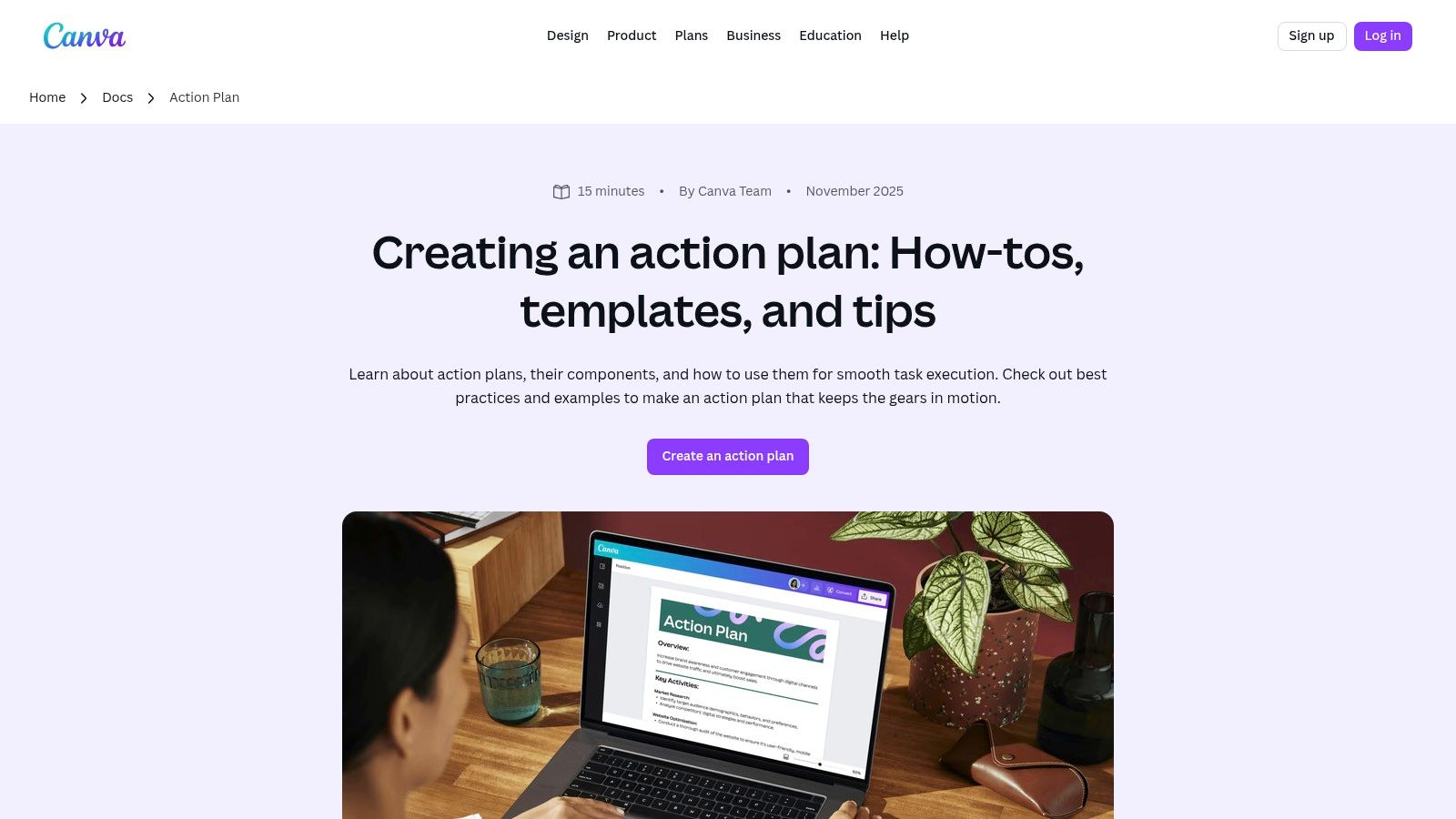
3. Canva

Canva moves beyond simple spreadsheets by offering a vast library of visually engaging action plan templates free within its design-centric ecosystem. Its core advantage is the ability to create polished, presentation-ready documents that align with an agency's branding. Users can choose from hundreds of pre-designed templates and customize them using an intuitive drag-and-drop editor, making it perfect for client-facing action plans.

Canva's action plan template library showing a variety of visual designs and layouts.

These templates are ideal for agencies that want their strategic documents to be as visually compelling as their creative work. The platform facilitates real-time collaboration, allowing team members to edit and comment simultaneously, streamlining the feedback and approval process before sharing with stakeholders or clients.

Key Features & User Experience

The user experience is seamless and highly visual. You browse the template library, select a design, and begin customizing it directly in your browser. The templates are more than just tables; they often include sections for goals, key metrics, and summaries, presented in a digestible format. Sharing is simple, with options to export as a high-quality PDF or share a direct view-only link.

  • Extensive Design Library: Access a wide range of professionally designed templates, from minimalist corporate styles to more creative and colorful layouts.
  • Easy Branding and Customization: The drag-and-drop interface makes it incredibly easy to add logos, change color palettes, and adjust fonts to match brand guidelines.
  • Multiple Export Options: Easily download your finished action plan as a PDF or image file (PNG/JPG) or share it via a public link for easy viewing.

Best for: Agencies that need to create visually impressive, branded action plans for client presentations, proposals, or project kickoffs where aesthetics and clear communication are paramount.

Website: Canva Action Plan Templates

4. Miro

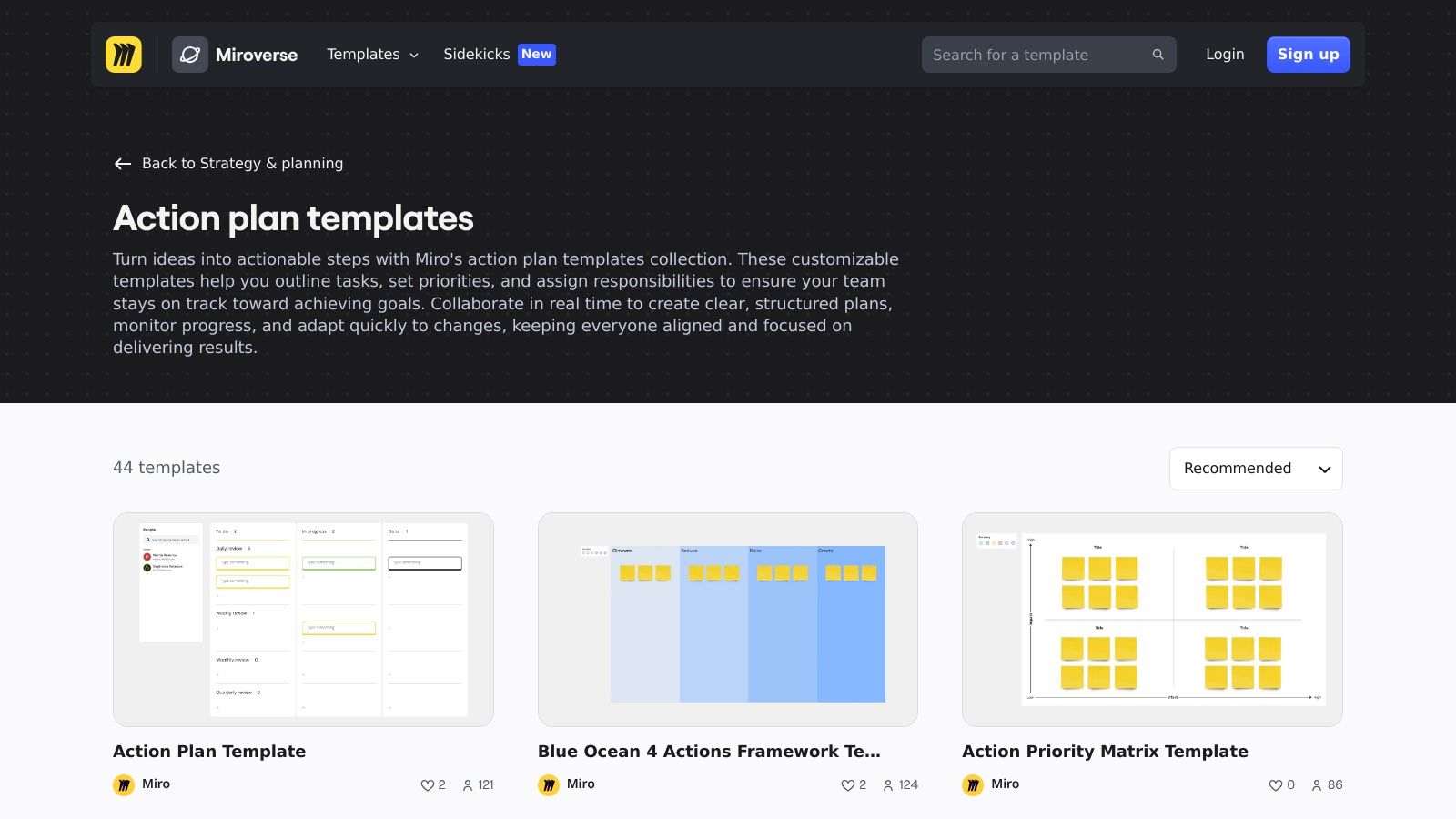
Miro shifts from traditional documents to a dynamic, visual workspace with its collaborative action plan templates free of charge. Its core strength is the infinite canvas, allowing teams to map out action items in a flexible, Kanban-style format. This visual approach is perfect for brainstorming sessions, workshops, and retrospectives where linear documents feel restrictive.

Miro's action plan template showing a visual, card-based layout on a collaborative whiteboard.

The template allows agencies to visually track tasks as they move through stages like "To Do," "In Progress," and "Done." Each task card can hold details, assignees, due dates, comments, and file attachments, making it a centralized hub for project communication. This is far more interactive than a static spreadsheet.

Key Features & User Experience

The user experience is intuitive and highly interactive. You select the action plan template and are immediately placed on a digital whiteboard where you can drag, drop, and connect ideas in real-time with your team. The free plan is robust, though it limits the number of editable boards, which can be a constraint for larger agencies managing multiple projects.

  • Collaborative Whiteboard: Teams can work on the action plan simultaneously, making it ideal for live planning workshops and remote collaboration.
  • Flexible Visualization: Go beyond simple lists with drag-and-drop cards, color-coding, and the ability to link ideas and tasks visually.
  • Rich Media Integration: Attach documents, add links, and leave comments directly on task cards, keeping all relevant context in one place.

Best for: Agencies that favor a visual and collaborative approach to planning, especially for creative brainstorming, project kickoffs, and agile retrospectives where flexibility is key.

Website: Miro Action Plan Template

5. Asana

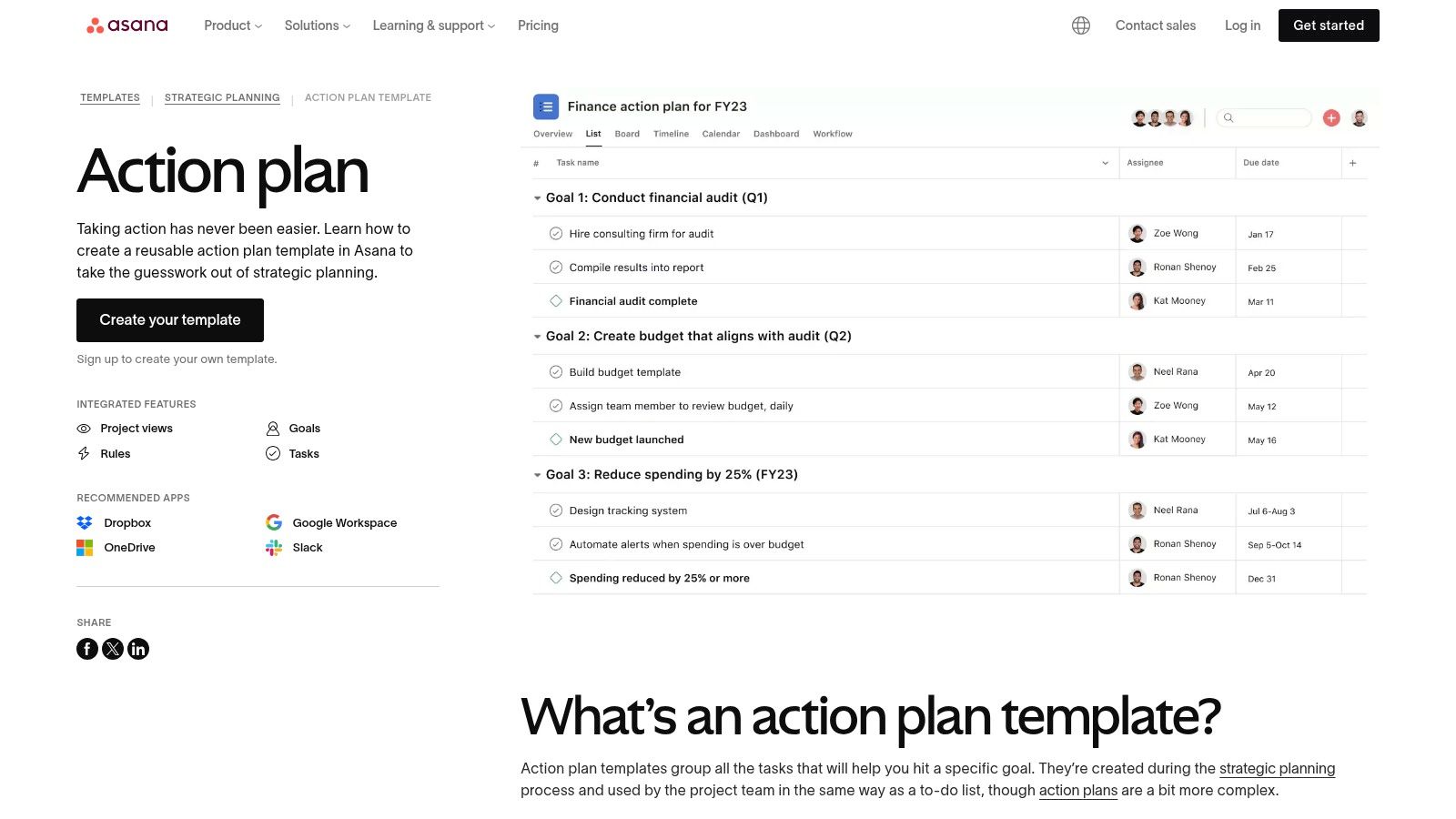
Asana elevates the concept of an action plan from a static document to a dynamic, collaborative project. Instead of downloadable files, Asana provides action plan templates free to use directly within its powerful project management platform. This approach integrates the plan into a live workspace where teams can assign tasks, set deadlines, and track progress in real-time.

Asana's action plan template displayed within its project management interface.

The primary advantage is transforming a simple to-do list into an accountable system. Each action item can be assigned to a specific team member, attachments can be added directly from Google Drive or OneDrive, and conversations can happen within the task itself. This keeps all communication and resources centralized, reducing the need for endless email chains.

Key Features & User Experience

To use the template, you must have an Asana account, although a free tier is available. The setup is straightforward: you select the action plan template, and Asana populates a new project with pre-built sections and example tasks. From there, customization is intuitive. The platform's clean interface and multiple project views are a major strength.

  • Dynamic Task Management: Unlike a spreadsheet, tasks are interactive elements with owners, due dates, dependencies, and subtasks.
  • Multiple Project Views: Users can switch between List, Board (Kanban), and Timeline views to visualize progress in the way that best suits their workflow.
  • Seamless Integrations: Connect tasks to tools your agency already uses, like Slack for notifications or Google Drive for file sharing, creating a connected work hub.

Best for: Agencies already using or willing to adopt a project management tool for a more interactive and accountable approach to executing action plans, especially for complex, multi-stakeholder projects.

Website: Asana Action Plan Template

6. monday.com

For agencies ready to move beyond static documents, monday.com offers dynamic and highly visual action plan templates free within its work management platform. Its strength lies in transforming a traditional action plan into an interactive board where teams can track progress in real-time. The platform's templates are designed for collaborative work, making them a significant step up from shareable spreadsheets.

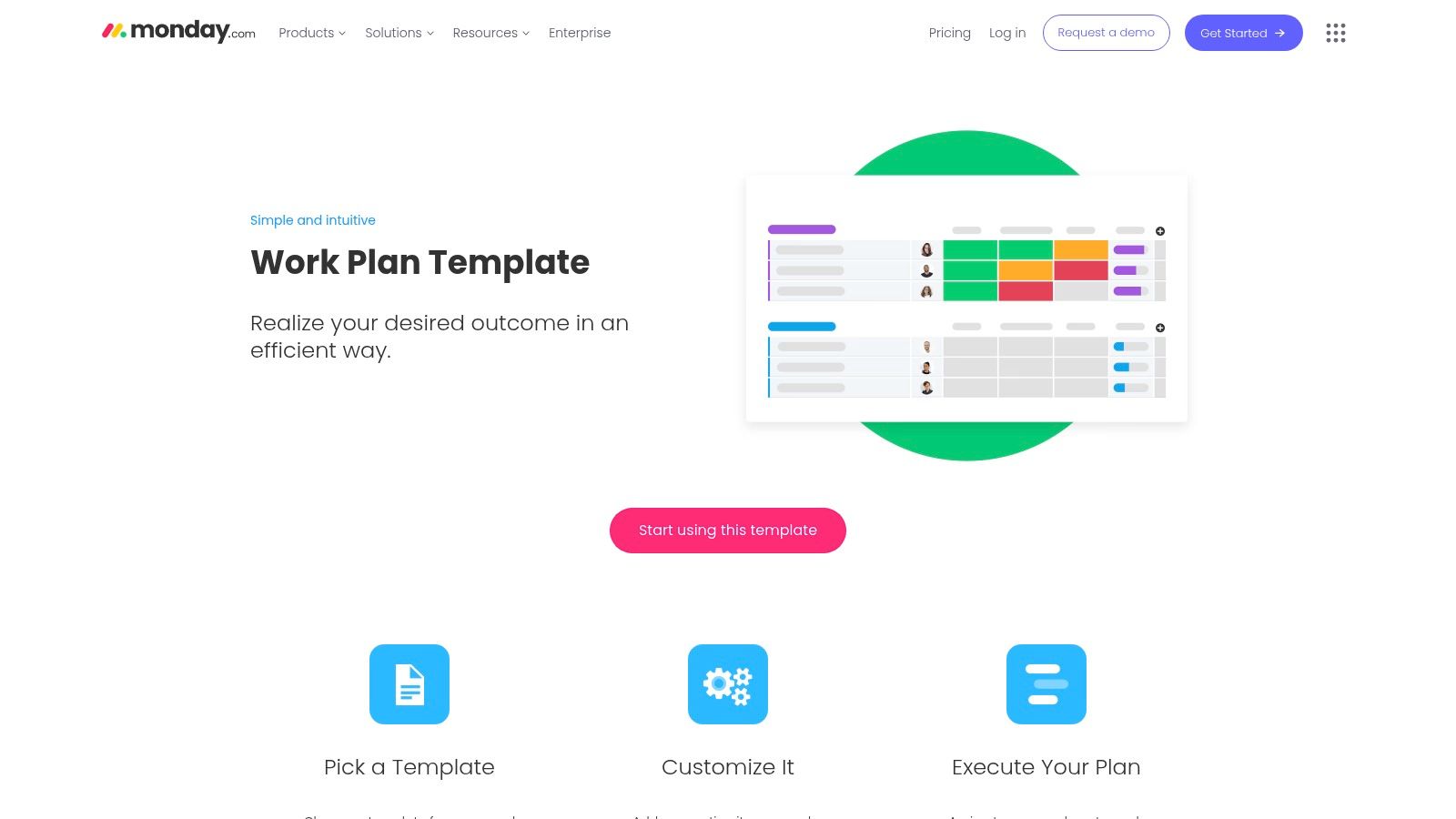
monday.com's work plan template showing a colorful, visual board layout.

The platform is built for scalability, allowing a simple action plan to evolve into a complex project with multiple dependencies and integrations. While its core features are robust, the free plan has limitations, particularly concerning team size and automation capabilities. It’s an ideal entry point for teams wanting to explore a more powerful project management solution without an initial financial commitment.

Key Features & User Experience

Getting started involves signing up for a free monday.com account and selecting the "Work Plan" or a similar template from their library. The user experience is intuitive and color-coded, making it easy to see task ownership, status, and priority at a glance. You can easily import existing data from Excel to populate your board quickly.

  • Customizable Boards: Easily adapt columns for statuses, owners, deadlines, and priorities with a simple drag-and-drop interface.
  • Excel Import/Export: Seamlessly transfer data from existing spreadsheets into a dynamic monday.com board or export board data for reporting.
  • Visual Progress Tracking: Utilize different views like Kanban, calendar, and timeline (on paid plans) to visualize project progress from multiple angles.

Best for: Growing agencies that need a collaborative, visual, and scalable system for managing action plans and are willing to operate within the limitations of a free plan or consider upgrading as their needs evolve.

Website: monday.com Work Plan Template

7. ClickUp

ClickUp provides a suite of dynamic and integrated action plan templates free that extend far beyond static documents. Its core strength is connecting your action plan directly to a powerful work management ecosystem, allowing you to track tasks across various views like Docs, Whiteboards, Timelines, and its dedicated Goals feature. This integration makes it a central hub for planning and execution.

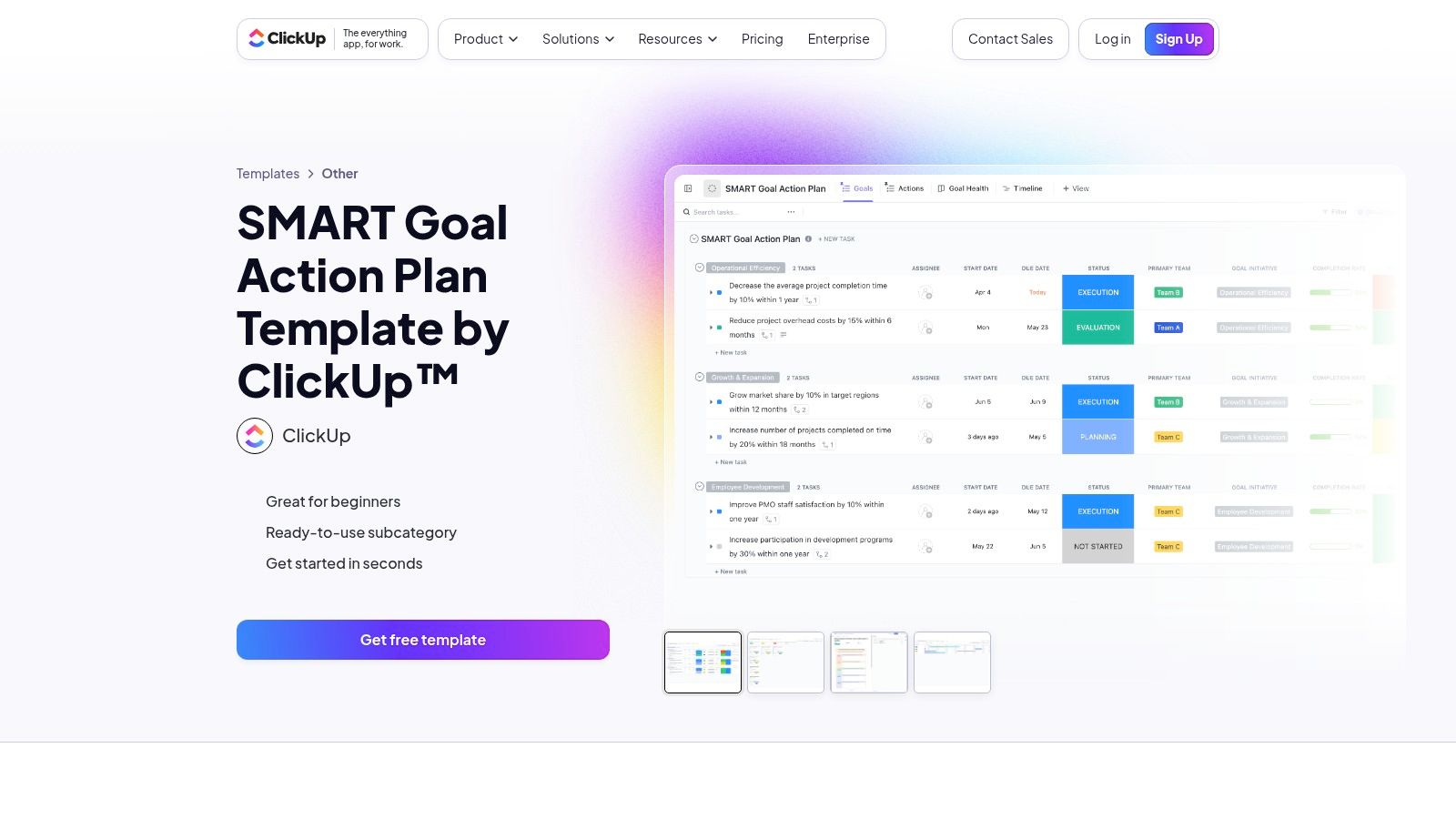
ClickUp's SMART Goal Action Plan template interface showing tasks and timelines.

The platform is built for deep customization, making it suitable for agencies with complex or highly specific planning requirements. Instead of just a downloadable file, you get a fully functional project space that can be adapted with custom fields, statuses, and automations, providing a much more robust framework than a simple spreadsheet.

Key Features & User Experience

The user experience involves adding a template directly into your ClickUp workspace with a single click. From there, you can immediately start assigning tasks, setting deadlines, and customizing the structure. The platform’s versatility allows you to visualize your action plan as a simple list, a Gantt chart, a Kanban board, or even a mind map.

  • Integrated Views: Your action plan isn't confined to one format. You can manage it as a document, visualize it on a Whiteboard for brainstorming, or track it on a Timeline to manage dependencies.
  • Rich Customization: Utilize custom fields, tags, and statuses to tailor the template precisely to your agency's workflow, whether for marketing campaigns, HR initiatives, or operational improvements.
  • Goal Tracking: The SMART Goal Action Plan template directly connects individual tasks to larger strategic objectives, making it easy to see how day-to-day activities contribute to the bigger picture.

Best for: Agencies that want a powerful, all-in-one platform where the action plan is a living, trackable project, not just a static document. It’s ideal for teams that need high levels of customization and multiple ways to visualize progress.

Website: ClickUp SMART Goal Action Plan Template

8. Notion Template Gallery

Notion's own template gallery offers a powerful, database-driven approach to action plans. Unlike static documents, Notion provides action plan templates free that are dynamic and interactive. Users can duplicate templates like the "Action Plan Hub" directly into their own workspace, transforming a simple plan into a living project management tool. This makes it an exceptional choice for agencies already embedded in the Notion ecosystem.

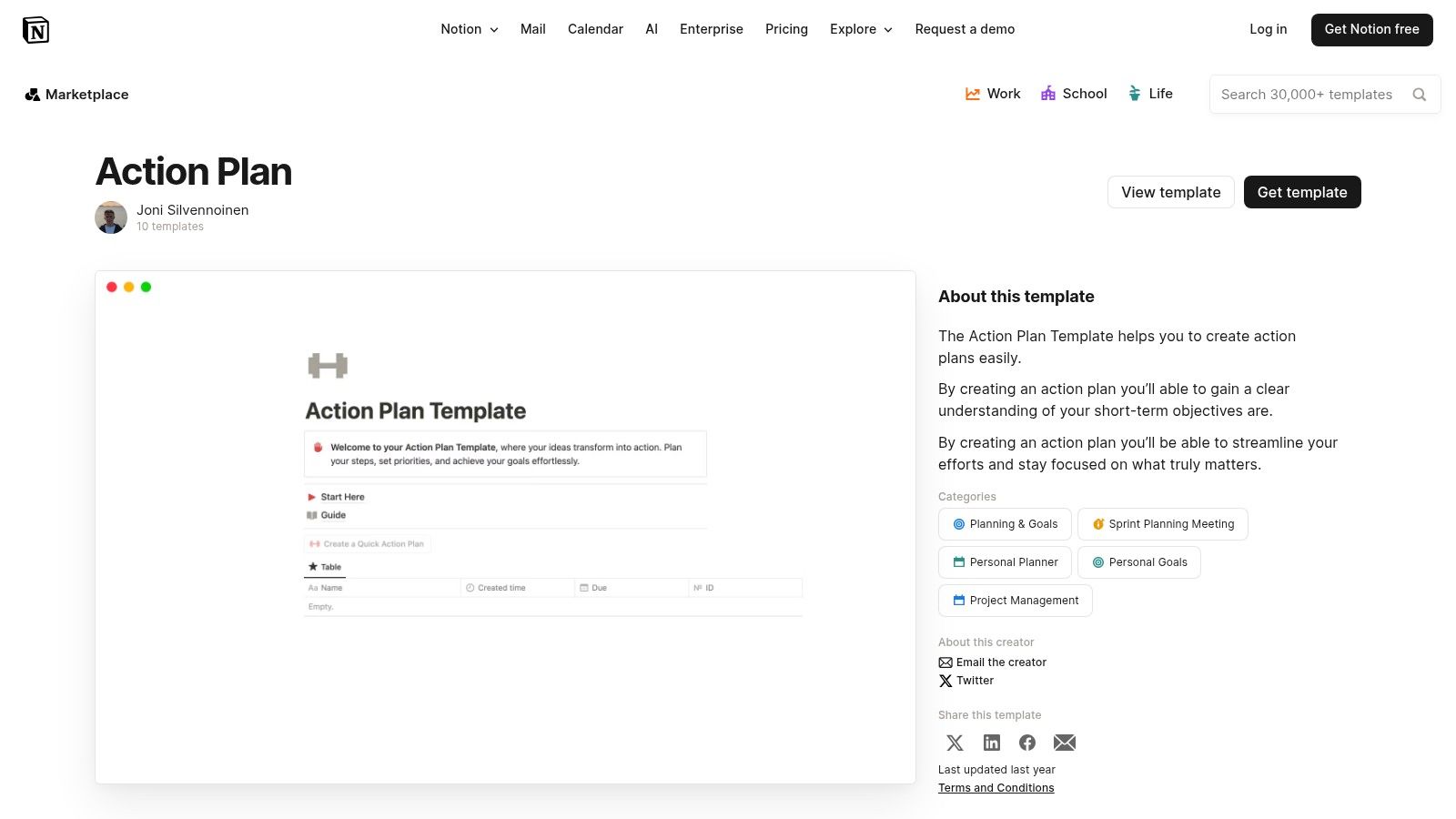
Notion's action plan template displayed within the Notion app interface.

The primary advantage is customization. A Notion action plan isn't just a list; it's a database where each task is its own editable page. This allows teams to add detailed notes, sub-tasks, files, and discussions directly to an action item, centralizing all related information.

Key Features & User Experience

The user experience is seamless for existing Notion users: find a template, click "Duplicate," and it's instantly part of your workspace. For newcomers, there's a learning curve associated with Notion’s database and page structure. The templates themselves are fully functional within Notion’s free plan, making this a cost-effective option for sophisticated planning.

  • Dynamic Database Structure: Action items are database entries with rich properties like owners, due dates, priority levels, and custom-defined statuses.
  • Extreme Customization: Modify every aspect of the template, from database properties and views (e.g., Kanban boards, calendars, timelines) to the layout of the page itself.
  • Integrated Workspace: Link action items directly to other relevant Notion pages, such as meeting notes, client briefs, or project documentation, creating a connected knowledge base.

Best for: Agencies and teams that already use Notion or are willing to invest time in learning a powerful, all-in-one workspace tool for creating highly integrated and customizable action plans.

Website: Notion Action Plan Template

9. ProjectManager

ProjectManager offers a collection of robust, free Excel-based templates designed for more detailed planning. Their primary offering is a comprehensive action plan templates free download that includes several variants, such as corrective, strategic, and business action plans. This makes the resource particularly useful for agencies that need a specific framework for different scenarios, from internal process improvements to long-term client strategy.

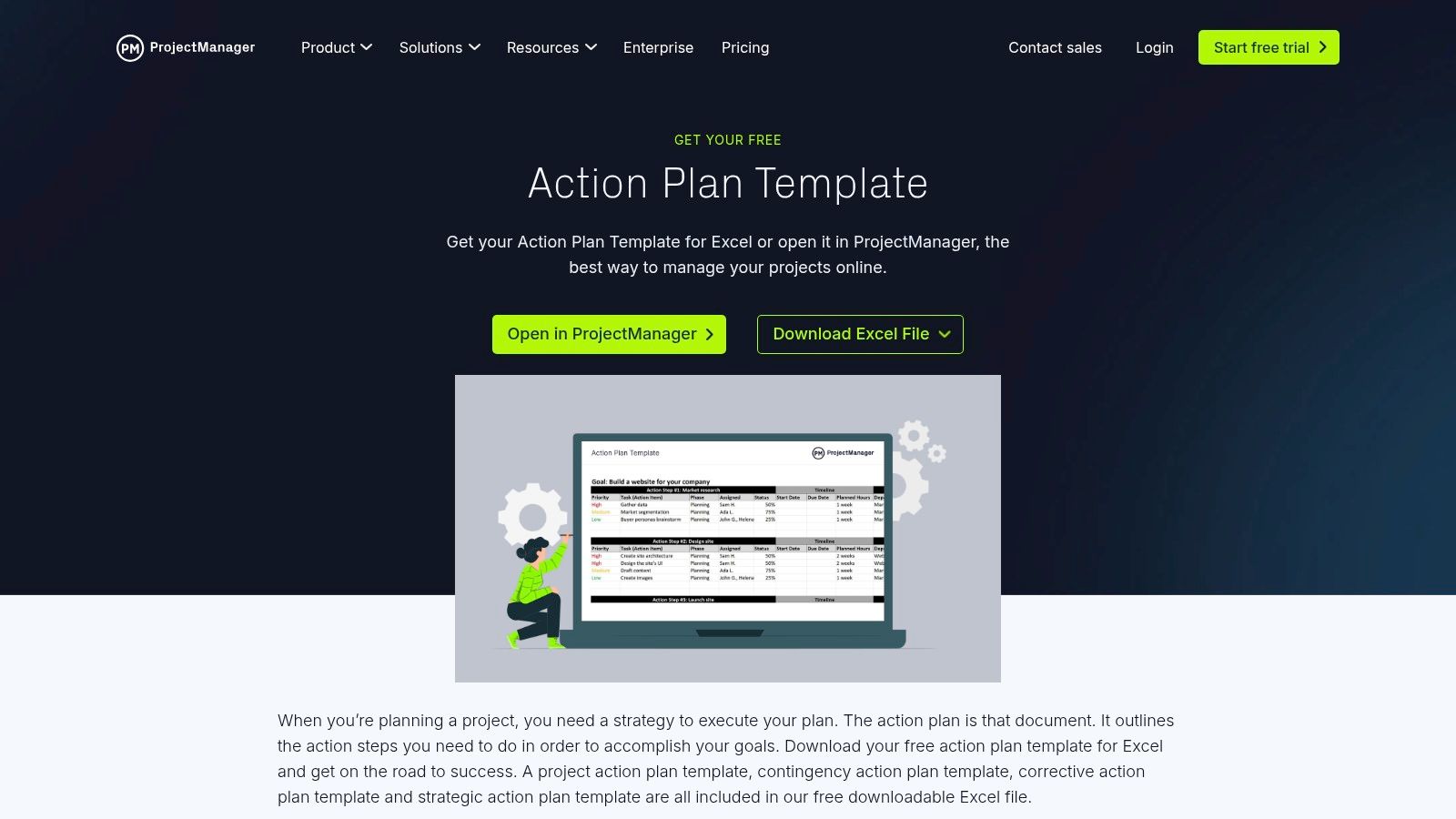
ProjectManager's template download page showing the free action plan template in Excel format.

The templates are well-structured, providing more detail than many basic alternatives. A key distinction is the ability to open and use these static files directly within the ProjectManager software, transforming them into live, collaborative documents with dashboards and Gantt charts. This provides a clear upgrade path for teams whose needs grow beyond a simple spreadsheet.

Key Features & User Experience

Accessing the templates is straightforward: users can download the Excel files directly from the website without needing to provide an email. The templates are thorough, with pre-defined columns for owners, start and due dates, priority levels, required resources, and detailed status updates. This level of detail is ideal for complex projects requiring careful resource allocation.

  • Multiple Template Variants: The download includes specialized templates for corrective, strategic, and contingency planning, providing tailored frameworks for specific agency needs.
  • Clear Documentation: Each template page includes a detailed walkthrough and video explaining how to use the document effectively, reducing the learning curve.
  • Software Integration Path: Users can import the Excel template directly into the ProjectManager platform to leverage advanced features like live dashboards, Kanban boards, and real-time collaboration after a free trial.

Best for: Agencies that appreciate the familiarity and detail of Excel but want a clear, integrated path to a more powerful project management tool as their projects scale in complexity.

Website: ProjectManager Action Plan Template

10. Template.net

Template.net offers a vast library of action plan templates free to download, positioning itself as a comprehensive resource hub for various business needs. Its main advantage is the sheer volume and variety of templates available, covering everything from simple project plans to detailed 30-60-90 day strategic outlines. The platform supports a wide array of formats, including Word, Google Docs, Excel, Sheets, PDF, and even Apple Pages.

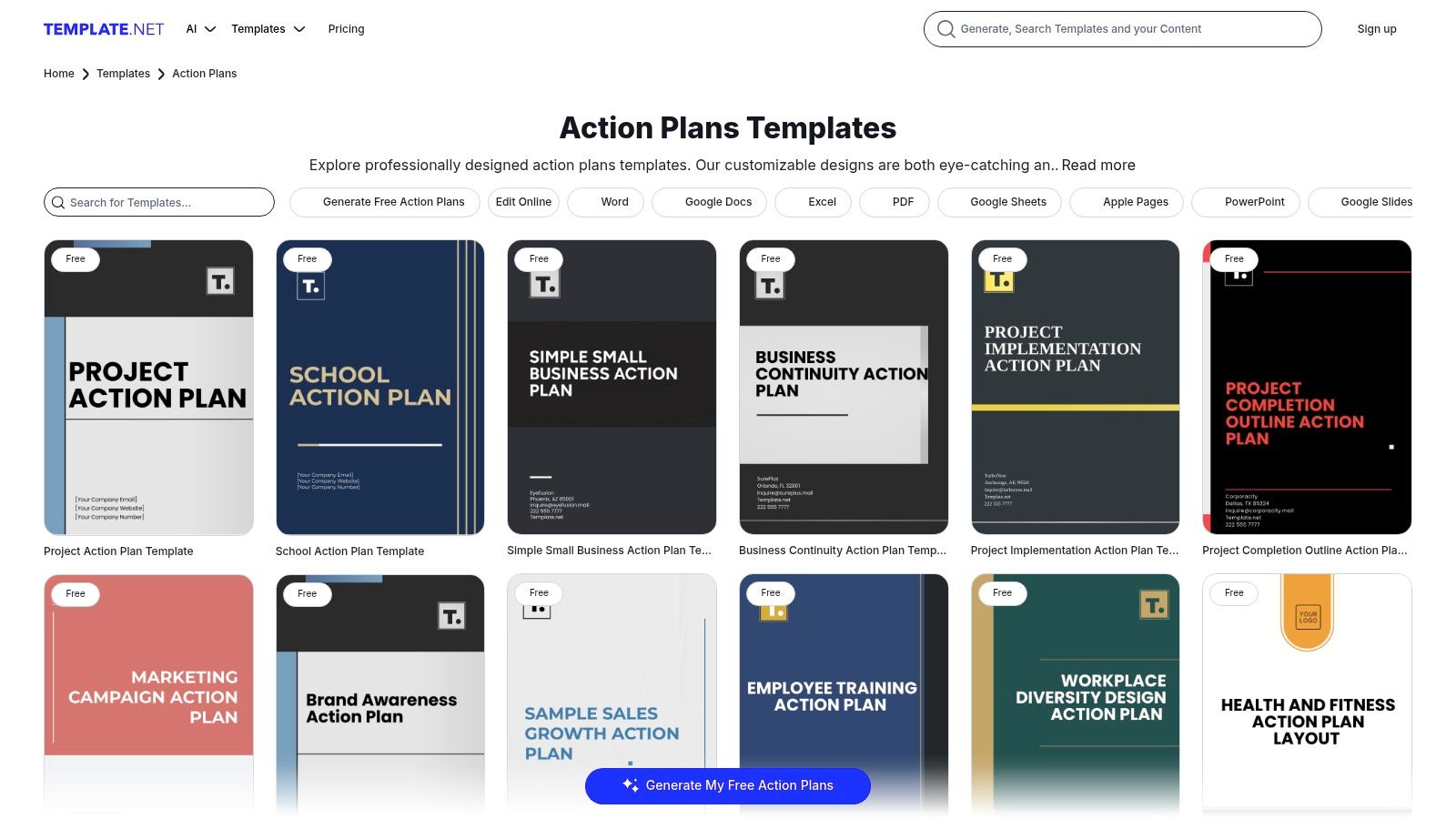
Template.net's action plan template library showing multiple designs.

This extensive catalog makes it a go-to for agencies looking for a specific type of action plan that may not be available on other sites. The platform also includes a basic online editor, allowing for quick text and color adjustments before downloading, which is a convenient feature for simple customizations.

Key Features & User Experience

The user experience on Template.net is similar to a stock photo site; you browse or search for a template and then download it. However, a key distinction is that many of the higher-quality or more complex templates are locked behind a premium subscription. The free offerings are still functional but can be more generic in design and structure. Users should be prepared to filter through options to find the best free downloads.

  • Massive Variety: Find templates for nearly any scenario, including corrective action, employee performance, marketing campaigns, and business development.
  • Multi-Format Support: Downloads are available in almost every popular document format, ensuring compatibility across different agency software stacks.
  • Online Editor: A built-in editor provides a quick way to make minor changes to a template directly in the browser before downloading the final file.

Best for: Agencies that need a highly specific or niche action plan template and are willing to browse through a large catalog that mixes free and premium options.

Website: Template.net Action Plans

11. Vertex42

Vertex42 is a long-standing resource for high-quality spreadsheet templates, offering a range of action plan templates free for download. While not exclusively focused on action plans, its collection includes powerful tools like the Action Items Tracker and various task list planners designed for both Excel and Google Sheets. The core strength of Vertex42 is its commitment to clean, functional, and formula-driven spreadsheets.

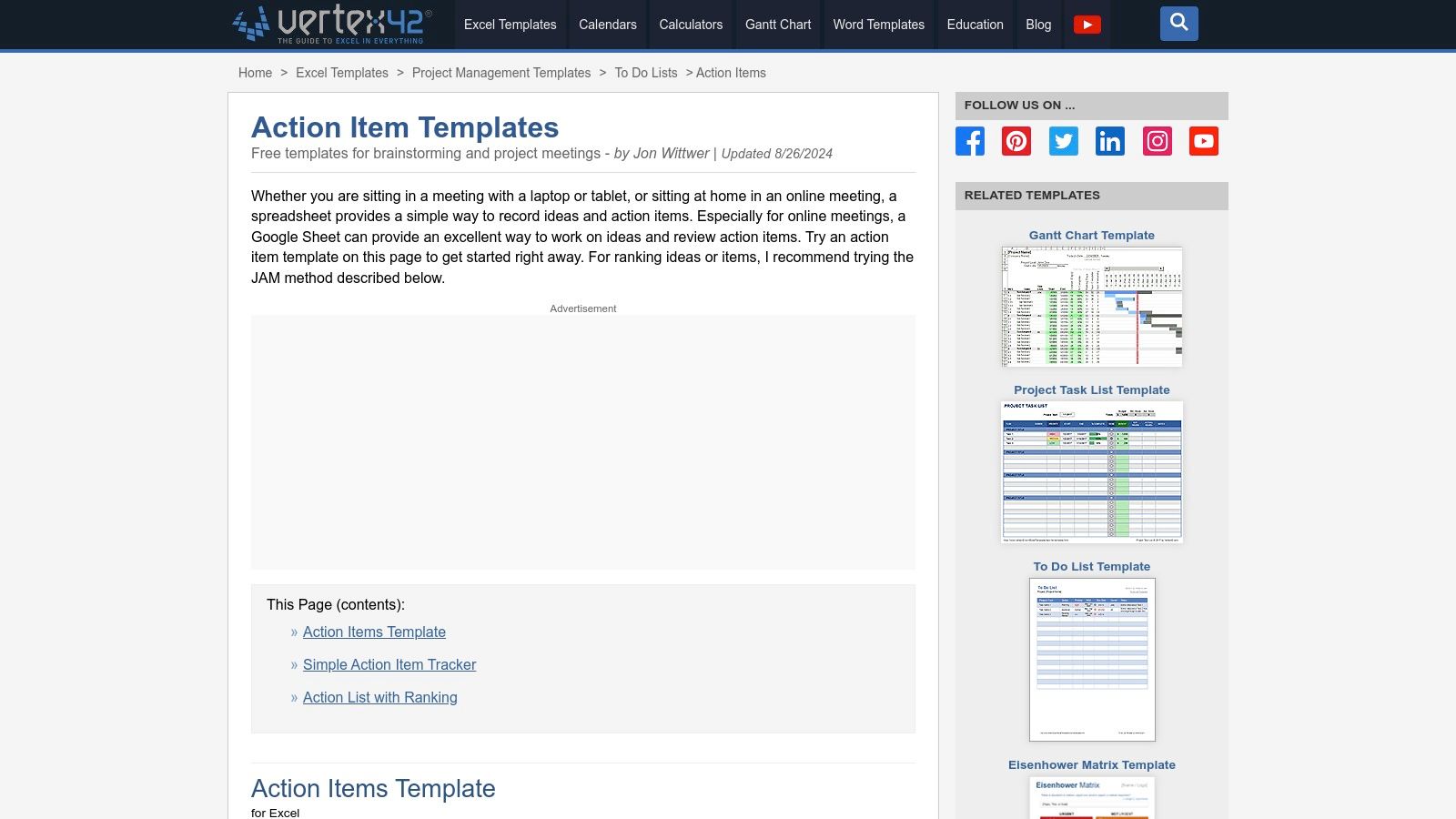
Vertex42's action item template shown in an Excel spreadsheet.

These templates are perfect for agencies that prefer lightweight, adaptable tools without the clutter of excessive design elements. The downloads are immediate and don't require an email signup, providing a frictionless user experience. Each template page also includes detailed notes, usage instructions, and tips for customization, which is a significant advantage.

Key Features & User Experience

The website is simple to navigate, allowing you to find, preview, and download your chosen format in seconds. The Action Items Tracker, for instance, comes pre-configured with columns for priority, due dates, status, and responsible parties, making it a ready-to-use solution for meeting follow-ups or small project tracking. The spreadsheet-centric approach makes these templates highly versatile.

  • Spreadsheet-First Functionality: All templates are optimized for Excel and Google Sheets, featuring built-in formulas, conditional formatting, and sorting capabilities.
  • No-Signup Downloads: Access and download templates instantly without having to provide personal information, which is a major convenience.
  • Detailed Documentation: Each template comes with a comprehensive on-page guide explaining how to use its features effectively.

Best for: Project managers and operations leads who are highly proficient in Excel or Google Sheets and want a no-nonsense, functional template for tracking tasks and action items with precision.

Website: Vertex42 Action Items Template

12. Etsy

While not strictly a source for action plan templates free of charge, Etsy serves as a vast marketplace for professionally designed, low-cost templates that are often more visually polished than standard corporate options. Its strength is the sheer variety offered by thousands of independent creators, providing unique layouts perfect for client-facing documents or internal projects where aesthetics matter. Most templates are available as instant digital downloads, typically in printable or fillable PDF and Excel formats.

This platform is ideal for agencies seeking a specific design or a one-off document without committing to a software subscription. The focus is on presentation, making these templates great for proposals, project kick-off summaries, or formal client reports where a touch of professional design can make a significant impact.

Key Features & User Experience

Navigating Etsy is straightforward: search for "action plan template" and filter by price, format, or style. The user experience is enhanced by a robust review system, allowing you to gauge the quality and usability of a template based on feedback from other buyers.

  • Affordable Professional Design: Access hundreds of unique, design-forward templates for just a few dollars, offering a high-end look on a budget.
  • Instant Digital Access: Once purchased, files are available for immediate download, allowing you to get started without any delay.
  • Seller Ratings and Reviews: Make informed decisions by leveraging community feedback to find the highest-quality and most user-friendly designs from reputable sellers.

Best for: Agencies that need visually appealing, printable, or fillable templates for one-off projects or client hand-offs and are willing to pay a small fee for a superior design.

Website: Etsy Action Plan Templates

Top 12 Free Action Plan Template Comparison

Core features ✨ UX / Quality ★ Price / Value 💰 Target 👥 Top USP 🏆
HubSpot — Multi-format downloads, built-in counters, how‑to guides ★★★★ 💰 Free download (static file) 👥 Solo users & small teams 🏆 Truly free + cross‑format
Smartsheet — Enterprise templates, exportable, dashboards & automation option ★★★★ 💰 Free templates; paid platform for collaboration 👥 Mid-large teams, enterprises 🏆 Upgrade path to live dashboards & automation
Canva — Design templates, drag‑drop editor, shareable exports ★★★★ 💰 Freemium (Pro assets gated) 👥 Marketers, designers, client‑facing teams 🏆 Polished, brandable outputs
Miro — Visual Kanban boards, attachments, comments for workshops ★★★★ 💰 Freemium (limits on free boards) 👥 Remote teams, facilitators, workshops 🏆 Flexible visual collaboration
Asana — Assignable task templates, list/board/timeline views, integrations ★★★★ 💰 Freemium (workspace required; advanced paid) 👥 Project teams, ops managers, agencies 🏆 Strong task ownership & tracking
monday.com — Custom boards, automations, large integrations ecosystem ★★★★ 💰 Paid tiers (limited free) 👥 Growing cross‑functional teams 🏆 Highly visual, scalable tracking
ClickUp — SMART goal templates across Docs/Boards/Goals, custom fields ★★★★ 💰 Freemium (robust free tier) 👥 Teams wanting deep customization 🏆 Broad feature set on free plan
Notion Template Gallery — Duplicateable pages/databases, rich properties ★★★ 💰 Free personal; team plans paid 👥 Notion users, knowledge teams 🏆 Extreme customizability
ProjectManager — Downloadable Excel templates; app for Gantt/dashboards ★★★ 💰 Free templates; paid app for live features 👥 PMs needing spreadsheet templates → app 🏆 Detailed Excel templates + app path
Template.net — Large catalog, multi‑format downloads, online editor ★★★ 💰 Mixed free + subscription for premium 👥 Users needing varied formats 🏆 Huge, format‑diverse template library
Vertex42 — Clean Excel/Sheets trackers, task lists, Gantt planners ★★★★ 💰 Mostly free, spreadsheet‑focused 👥 Spreadsheet users, finance/ops 🏆 High‑quality, practical spreadsheets
Etsy — Designer printable/fillable templates, instant download ★★★ 💰 Low‑cost one‑off purchases 👥 Individuals wanting polished printables 🏆 Affordable, design‑forward options

Beyond the Template: Turning Your Action Plan into an Agency OS

We've explored a comprehensive arsenal of free action plan templates, from the versatile spreadsheets of Smartsheet and Vertex42 to the visually-driven boards of Asana and Miro. Each resource offers a powerful starting point, a structured framework to bring clarity and direction to your agency’s most critical processes, whether you're launching a client campaign or streamlining your support escalation protocol. You now have access to a variety of formats, including Google Docs, Word, Notion, and PDFs, ensuring there is a solution for nearly every workflow preference.

The core takeaway is that a template is not merely a document to be filled out. It is a strategic tool for standardization. When you consistently use a kickoff plan template, you ensure no critical discovery questions are missed. When you deploy a client onboarding template, you create a repeatable, high-quality experience that builds trust from day one. These resources are your first step toward transforming reactive chaos into proactive, predictable execution.

However, the journey from a static document to a dynamic operational asset is where many agencies falter. The greatest weakness of a standalone template, even the best one, is its isolation from the rest of your operational data and workflows.

The Challenge of the Disconnected Template

Think about your daily reality. Your project tasks live in Asana or ClickUp, your client communications are in your CRM or email, your team’s capacity is tracked on a spreadsheet, and your billing is handled by another system entirely. When you use one of the action plan templates free resources we’ve discussed, it often becomes yet another disconnected island of information.

This fragmentation creates significant operational drag. You find your team:

  • Manually duplicating data: Copying and pasting tasks from a Google Doc plan into your project management tool.
  • Losing context: The "why" behind a task, detailed in the action plan, is separated from the "how" and "who" in your task manager.
  • Lacking a single source of truth: Is the official deadline in the template, the project board, or the client’s email? This ambiguity leads to missed deadlines and miscommunication.
  • Struggling with reporting: How do you measure the success of your action plan when the results and the plan itself live in different universes?

The goal is to evolve beyond this "duct-tape" methodology. Your action plan shouldn't be a separate artifact you consult; it should be the living, breathing blueprint integrated directly into the tools where your team executes their work.

From Static Plan to Integrated System

The true power of an action plan is unlocked when it becomes the central nervous system for a project or process. Imagine an action plan where updating a task status automatically notifies the client, logs billable time, and updates a project timeline in real-time. This is the difference between simply planning the work and creating an integrated system that runs the work.

To achieve this, consider these crucial factors as you implement your chosen template:

  1. Centralization: Where will this plan live? Choose a platform that can serve as a hub, connecting to other tools if necessary. Notion and ClickUp are strong contenders for this due to their flexibility.
  2. Automation: Look for opportunities to automate notifications, task creation, and status updates. If your action plan is in Asana, use its built-in rules to move tasks through stages automatically.
  3. Integration: How does this plan connect to your CRM, billing software, and communication channels? A plan that can pull in client data or push out invoices is exponentially more valuable.
  4. Accessibility: Ensure the entire team knows where to find the plan and understands how to use it. A perfect template is useless if it's buried in a forgotten folder.

By thoughtfully integrating your chosen action plan templates free of charge, you elevate them from simple checklists to cornerstones of your agency’s operating system. You build a foundation for scalability, consistency, and ultimately, greater profitability and client satisfaction. Your plan becomes more than a guide; it becomes the engine driving your agency forward.


Tired of juggling disconnected spreadsheets and project boards? RGK unifies your action plans with client management, project execution, and billing in a single, intelligent platform designed for agencies. Stop duct-taping your tools together and start building a true agency OS. Explore how RGK can turn your static plans into dynamic, profitable workflows.

work plan examples: 10 Templates to Boost Efficiency

A well-structured work plan is the blueprint for success, transforming abstract goals into a concrete series of tasks and timelines. Without one, teams drift, deadlines are missed, and resources are wasted. A great plan provides clarity, aligns stakeholders, and creates a clear path from A to B, ensuring everyone understands their role and responsibilities. It’s the essential communication tool that keeps complex projects on track and agency operations running smoothly.

This guide moves beyond theory to provide a curated collection of actionable work plan examples and templates tailored for agency professionals. We will dissect each one, revealing the strategic thinking behind its structure and offering tactical insights you can apply immediately. Whether you're an agency owner, project manager, or freelancer, you will find practical models to adapt for your specific needs.

Here’s exactly what you will get from this comprehensive list:

  • Diverse Examples: From high-level project management plans and agile sprint schedules to granular weekly task lists and employee onboarding outlines.
  • Strategic Breakdowns: For each example, we analyze why it works, what key components to include, and when to use a specific format for maximum impact.
  • Actionable Templates: We provide downloadable templates and clear, step-by-step guidance on how to customize them for your own projects and teams.

Instead of just showing you finished documents, we will break down the mechanics of effective planning. You’ll learn how to build work plans that not only organize tasks but also drive accountability, improve team performance, and deliver measurable results. Let’s dive into the examples.

1. Project Management Work Plan Template

A Project Management Work Plan is the master blueprint for any initiative with a defined start and end. It’s a formal document that details the entire project lifecycle, from initial scope and objectives to specific deliverables, timelines, resource allocation, and budget constraints. This plan serves as the single source of truth, aligning stakeholders and guiding the project team from kickoff to completion.

Its comprehensive nature makes it one of the most essential work plan examples for ensuring a project stays on track, on time, and within budget. This foundational document provides the structure needed to manage complexity and mitigate risks effectively.

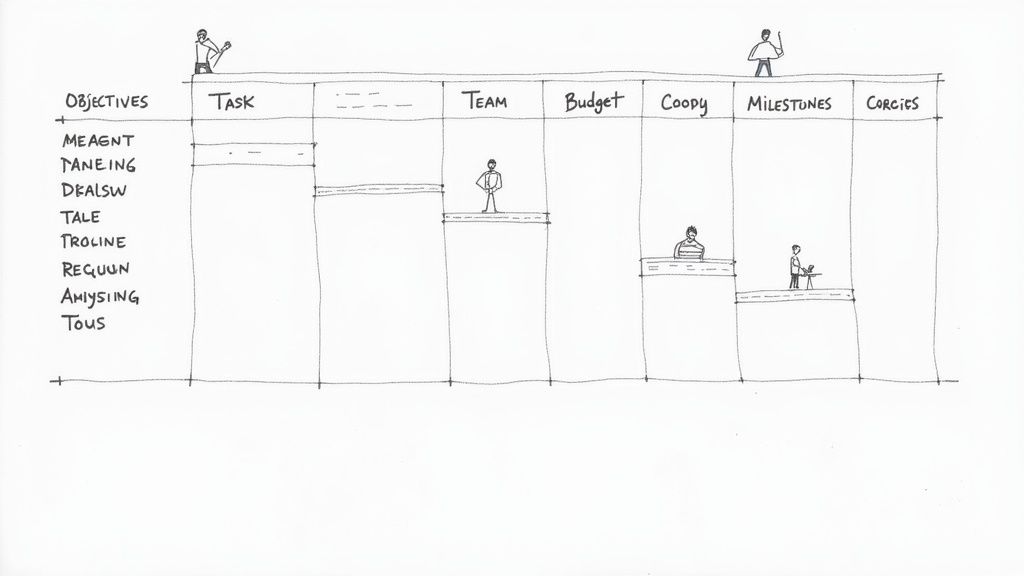
Project management chart showing stick figures climbing stairs through columns labeled task, team, budget, milestones

Strategic Breakdown

The power of a project management work plan lies in its detailed, forward-looking approach. Unlike a simple to-do list, it forces a strategic examination of every project component before work begins. This process uncovers potential dependencies, resource gaps, and risks early on.

For instance, a software development project might use an Agile work plan that breaks the project into sprints, while a construction firm would rely on a Gantt chart-based plan to manage sequential dependencies. Both are rooted in the same principle: deconstructing a large goal into a manageable, documented process.

Key Insight: The primary function of this plan is not just to list tasks, but to create a shared understanding of success. It translates a high-level vision into an actionable roadmap that every team member can follow.

Actionable Takeaways for Agencies

To implement this effectively in your agency, focus on these key areas:

  • Define Success Metrics: Move beyond "launch the website." Instead, use specific KPIs like "increase lead conversion by 15% within 60 days of launch."
  • Establish a Communication Plan: Detail how and when stakeholders will receive updates. This might include weekly progress reports, bi-weekly steering committee meetings, and real-time dashboard access.
  • Build in Contingency: For critical path tasks, add a time and budget buffer. A common practice is to add a 10-15% contingency to account for unforeseen delays or challenges.
  • Regular Review Cadence: Schedule specific checkpoints (e.g., weekly or at the end of each project phase) to review progress against the plan and make necessary adjustments. This ensures the plan remains a living, relevant document.

2. SMART Goals Work Plan

A SMART Goals Work Plan is a strategic framework that structures objectives to be Specific, Measurable, Achievable, Relevant, and Time-bound. Rather than a project-based document, this plan focuses on performance and outcomes, translating broad ambitions into clear, trackable targets for individuals or teams. It serves as a compass for directed effort, ensuring that daily activities contribute directly to larger strategic goals.

This framework is one of the most powerful work plan examples for driving accountability and measuring success with precision. By forcing clarity and creating a finish line, it transforms vague aspirations like "improve sales" into concrete, actionable objectives that leave no room for ambiguity.

Strategic Breakdown

The core strength of a SMART Goals Work Plan is its emphasis on clarity and verifiability. It shifts the focus from busywork to impactful results by defining exactly what success looks like and when it should be achieved. This structured approach eliminates guesswork and aligns individual efforts with organizational priorities.

For instance, a marketing agency could use this plan to move from a general goal of "increase brand awareness" to a SMART goal like: "Increase organic website traffic by 20% in Q3 by publishing four new SEO-optimized blog posts per month." This immediately clarifies the required actions, the metric for success, and the deadline.

Key Insight: The primary function of this plan is to create a direct link between effort and outcome. It provides a non-negotiable definition of success that is understood and agreed upon by everyone involved.

Actionable Takeaways for Agencies

To implement this effectively in your agency, focus on these key areas:

  • Make Goals Collaborative: Involve team members in the goal-setting process. When employees help define the objectives, their buy-in and motivation increase significantly.
  • Establish Visible Tracking: Use shared dashboards or a central document to track progress toward each goal. Visual progress tracking maintains momentum and reinforces accountability.
  • Balance Ambition with Reality: The 'Achievable' component is critical. Set goals that stretch the team but are not so unrealistic that they cause burnout or demotivation. Analyze past performance to set a realistic baseline.
  • Connect Individual to Company Goals: Ensure every individual or team SMART goal clearly supports a larger company objective. This provides a sense of purpose and shows team members how their work contributes to the bigger picture.

3. Agile Sprint Work Plan

An Agile Sprint Work Plan is a dynamic, iterative document central to Scrum and other Agile methodologies. Instead of mapping out an entire project from start to finish, it focuses on organizing work into short, time-boxed cycles called sprints, which typically last one to four weeks. Each sprint has a specific goal, and the plan contains a selection of high-priority tasks (user stories) from a larger backlog that the team commits to completing within that cycle.

This cyclical approach makes it an incredibly effective work plan example for projects where requirements are expected to evolve, such as software development or fast-paced marketing campaigns. It prioritizes flexibility, continuous feedback, and delivering value incrementally.

Strategic Breakdown

The strength of an Agile Sprint Work Plan is its emphasis on adaptability and focused execution. By breaking down a large, complex project into manageable sprints, teams can maintain momentum and adjust their priorities based on real-time feedback and changing business needs. This structure fosters a culture of continuous improvement through sprint retrospectives, where the team reflects on what went well and what could be improved for the next cycle.

For instance, a product development team at a startup can use a two-week sprint plan to build and test a new feature, gather user feedback, and then use those insights to define the scope of the next sprint. This prevents wasting months building a product that doesn't meet market demands.

Key Insight: This plan transforms project management from a predictive, linear process into a responsive, empirical one. Its primary goal is to maximize the team's ability to learn, adapt, and deliver value quickly.

Actionable Takeaways for Agencies

To integrate this effectively into your agency’s workflow, concentrate on these practices:

  • Define Clear User Stories: Every task in the sprint backlog should be a well-defined user story with clear acceptance criteria. This removes ambiguity and ensures everyone understands what "done" means.
  • Maintain Consistent Sprint Lengths: Consistency is key to establishing a rhythm and accurately measuring team velocity. Choose a sprint length (e.g., two weeks) and stick with it.
  • Prioritize Ruthlessly: The product owner must rigorously prioritize the backlog before each sprint planning meeting. This ensures the team is always working on the most valuable items first.
  • Leverage Velocity Metrics: Track how many story points your team completes per sprint. This historical data (velocity) becomes an invaluable tool for more accurate future sprint planning and forecasting.

4. Waterfall Project Work Plan

A Waterfall Project Work Plan is a linear, sequential model where each project phase must be fully completed before the next one can begin. This traditional methodology emphasizes comprehensive planning, detailed documentation, and fixed requirements from the outset. Once a phase is complete, moving backward to make changes is difficult and costly, creating a one-way flow similar to a waterfall.

This structured approach is ideal for projects with clearly defined, unchangeable requirements and a stable scope. For agencies managing large-scale, predictable initiatives like government contracts or hardware manufacturing, it provides one of the most reliable work plan examples for ensuring meticulous execution and compliance.

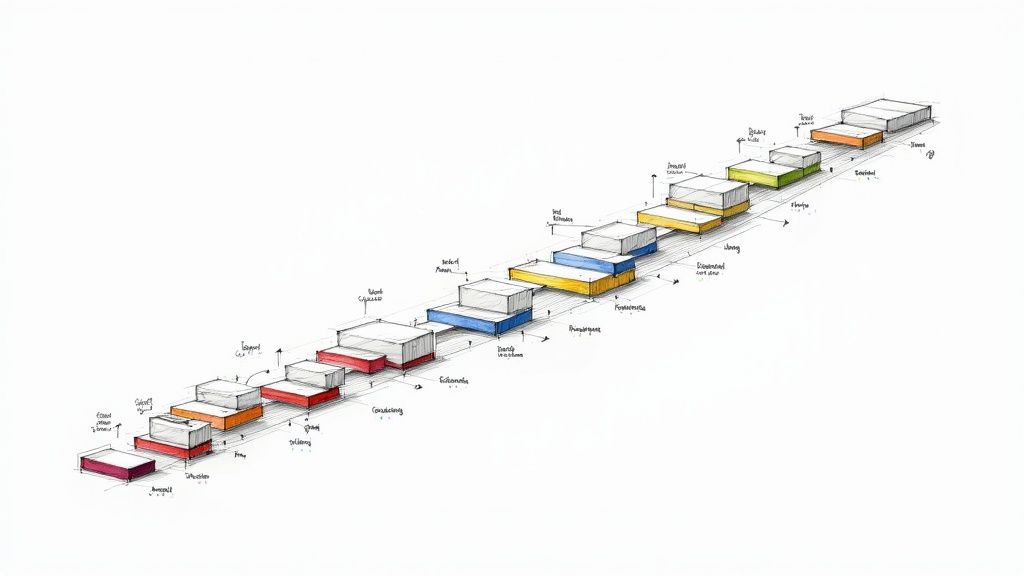
Architectural diagram showing stacked layers of project phases in colorful isometric perspective illustration

Strategic Breakdown

The core strength of the Waterfall model is its rigorous, upfront investment in discovery and planning. By forcing stakeholders to define and agree upon every requirement before development starts, it minimizes the risk of scope creep and unexpected changes during execution. This makes it a powerful tool for projects where predictability is more important than flexibility.

For example, a construction project cannot easily move a building's foundation once it's laid; the requirements must be finalized first. Similarly, a large enterprise software implementation for a heavily regulated industry needs a documented, auditable process where each stage from design to testing is formally signed off.

Key Insight: The Waterfall work plan prioritizes control and predictability over speed and iteration. Its primary goal is to deliver a well-defined product correctly the first time, not to adapt to evolving user feedback mid-project.

Actionable Takeaways for Agencies

To successfully implement a Waterfall work plan, your agency should focus on these critical practices:

  • Invest Heavily in Upfront Requirements: Dedicate significant time to the initial requirements gathering and analysis phase. Conduct thorough stakeholder interviews and create a detailed Business Requirements Document (BRD) that leaves no room for ambiguity.
  • Establish Formal "Gate" Reviews: Implement mandatory sign-off checkpoints at the end of each phase (e.g., requirements, design, development). No work on the next phase should begin until the previous phase's deliverables have been formally approved by all key stakeholders.
  • Document Everything Meticulously: Maintain comprehensive documentation for every phase, from design specifications to test cases and user manuals. This creates a clear audit trail and is essential for compliance and long-term maintenance.
  • Create a Detailed Master Schedule: Use a Gantt chart to map out the entire project timeline, showing the rigid dependencies between tasks. This visual representation makes it clear how a delay in one phase will directly impact all subsequent phases.

5. Weekly/Daily Work Plan Template

A Weekly or Daily Work Plan breaks down high-level project goals into manageable, short-term tasks. It’s a tactical tool used by individuals and teams to organize their immediate activities, prioritize efforts, and maintain focus on what needs to be accomplished in a given day or week. This plan translates strategic objectives into concrete, daily actions.

This granular approach makes it one of the most practical work plan examples for boosting personal and team productivity. It ensures that day-to-day work directly contributes to larger project milestones and agency goals, preventing drift and ensuring accountability.

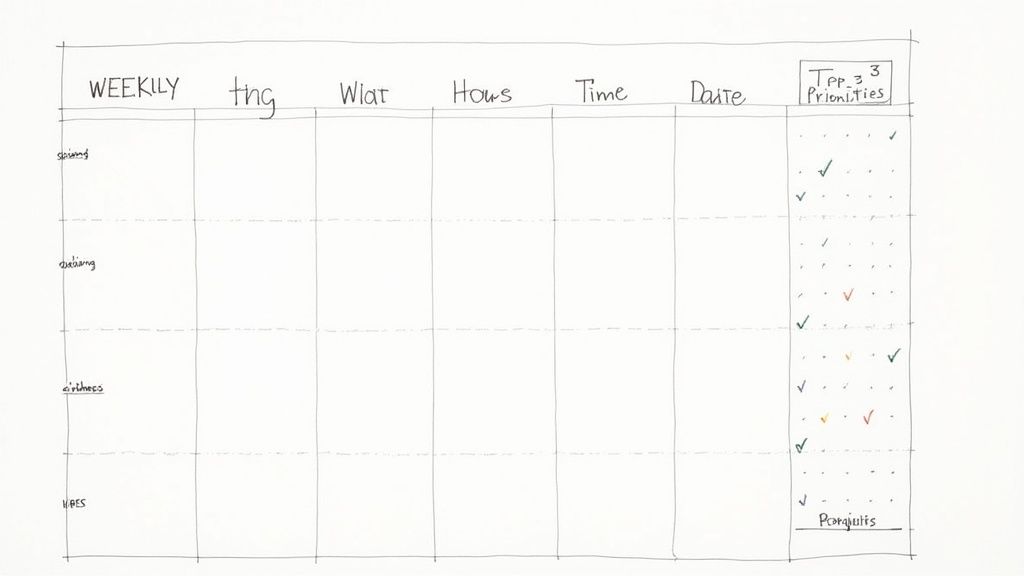
Weekly planner template with columns for tracking what, hours, time, date and top three priorities

Strategic Breakdown

The strength of a daily or weekly plan is its focus on execution and momentum. While a project plan sets the overall direction, this short-term plan addresses the "how" of getting work done amidst competing priorities and daily distractions. It forces a realistic assessment of what can be achieved in a limited timeframe.

For example, a sales representative might use a daily plan to time-block prospecting calls and follow-ups, while a content creator uses a weekly plan to schedule writing, editing, and publishing tasks. Both templates serve the same core function: creating intentionality and structure for short-term work cycles.

Key Insight: This plan's primary purpose is to combat reactive work. By pre-committing to priorities, team members can proactively manage their time instead of just responding to the most urgent (but not always most important) demands.

Actionable Takeaways for Agencies

To effectively implement this in your agency, focus on these key areas:

  • Identify Daily "Big 3": Instruct team members to identify their top three most important tasks each day. This simple prioritization method ensures that critical work is always moving forward.
  • Implement Time Blocking: Encourage the practice of assigning specific time slots to tasks. This helps protect focused work time and reduces the negative impact of context switching.
  • Establish a Weekly Review: Dedicate time on Friday afternoon or Monday morning for a "weekly reset." Team members should review the past week's accomplishments and plan the upcoming week’s priorities.
  • Integrate with Project Tools: Ensure daily tasks are linked back to larger project goals in your management software (e.g., Asana, Jira). This provides a clear line of sight from daily effort to overall project success.

6. Strategic Departmental Work Plan

A Strategic Departmental Work Plan translates an organization's high-level strategic goals into an actionable roadmap for a specific department. It’s a comprehensive annual or multi-year document used by department heads to guide team efforts, allocate resources, and manage performance in direct support of the company's vision. This plan ensures that daily tasks are not just busywork but are explicitly linked to broader business objectives.

Its top-down, alignment-focused approach makes it one of the most critical work plan examples for ensuring that every part of the organization is pulling in the same direction. This document bridges the gap between executive strategy and operational execution, giving teams a clear sense of purpose and direction.

Strategic Breakdown

The core strength of a departmental work plan is its ability to create direct line-of-sight from individual contributor tasks to top-tier company goals. It forces department leaders to think critically about how their team's activities contribute value. This process moves a department from a reactive cost center to a proactive, strategic partner within the business.

For example, an HR department’s plan might detail initiatives for talent acquisition and retention directly linked to the company's five-year growth targets. Similarly, a marketing team's plan would outline go-to-market strategies for new products, aligning campaign milestones with the organization's revenue goals.

Key Insight: This plan's primary value is not just in organizing work, but in demonstrating and measuring a department's strategic contribution. It shifts the conversation from "what are we doing?" to "what impact are we having?"

Actionable Takeaways for Agencies

To build a powerful departmental plan, focus on these critical areas:

  • Align with Executive Strategy: Before drafting, hold a specific alignment meeting with executive leadership to confirm your department's key priorities and their corresponding business KPIs.
  • Balance Strategic and Operational Goals: Dedicate clear sections of your plan to both "run the business" operational tasks and "grow the business" strategic initiatives. A good ratio is often 70% operational and 30% strategic.
  • Set Quarterly Review Checkpoints: Establish formal quarterly reviews to assess progress against the plan's objectives. Use these meetings to re-prioritize initiatives based on business performance and market changes.
  • Communicate Clearly and Regularly: Host a departmental kickoff to present the final plan and follow up with monthly updates. This ensures every team member understands their role in achieving the shared objectives.

7. Event Planning Work Plan Template

An Event Planning Work Plan is a highly specialized roadmap for executing successful events, from large-scale conferences and product launches to webinars and corporate retreats. It’s a comprehensive document that coordinates countless moving parts, including venue selection, vendor management, marketing promotion, attendee registration, on-site logistics, and post-event analysis. This plan ensures every detail is accounted for, preventing last-minute chaos.

Its meticulous, timeline-driven approach makes it one of the most critical work plan examples for anyone tasked with creating a memorable and seamless experience. It provides the structure needed to manage complex logistics, stakeholder expectations, and tight deadlines effectively.

Strategic Breakdown

The strength of an event planning work plan is its ability to transform a high-concept idea into a flawlessly executed reality. It forces planners to think chronologically and cross-functionally, breaking down the entire event lifecycle into distinct phases: pre-event, on-site, and post-event. This systematic approach ensures that critical dependencies, like booking a venue before launching ticket sales, are properly sequenced.

For instance, a tech conference plan would heavily detail speaker acquisition and content tracks months in advance, while a nonprofit fundraising gala plan would focus intensely on sponsorship packages, donor communication, and auction logistics. Both plans are built on the same core principle: creating a single source of truth for a time-sensitive, multi-faceted project.

Key Insight: This plan's primary purpose is to orchestrate a complex series of simultaneous and sequential tasks. It's less about a single project goal and more about managing a symphony of logistics to deliver a specific experience at a fixed point in time.

Actionable Takeaways for Agencies

To leverage this for your agency's events, focus on these key areas:

  • Create a Master Timeline: Start with the event date and work backward, setting deadlines for major milestones like securing a venue (6-9 months out), launching marketing campaigns (3-4 months out), and finalizing vendors (2 months out).
  • Develop a Detailed Budget: Itemize every potential expense, from catering and AV equipment to marketing collateral and staff travel. Track actual spending against this budget religiously using a shared spreadsheet or software.
  • Establish a "Run of Show" Document: This is a minute-by-minute schedule for the event day itself. It details who does what, where, and when, from keynote speaker introductions to catering breaks, ensuring the live event runs smoothly.
  • Build a Contingency Plan: What happens if a key speaker cancels or the Wi-Fi goes down? Document potential risks and create clear backup plans for each. This proactive step is crucial for managing day-of emergencies with confidence.

8. Research and Development (R&D) Work Plan

A Research and Development (R&D) Work Plan is a highly specialized document designed to navigate the inherent uncertainty of innovation. Unlike a standard project plan with predictable outcomes, an R&D plan structures the process of exploration, experimentation, and discovery. It balances the need for creative freedom with the strategic goals of the organization, outlining hypotheses, testing methodologies, and potential pivots.

This plan is critical for initiatives where the final outcome is unknown, such as developing new technology or conducting scientific research. It provides a framework for managing risk and resources while pursuing breakthroughs, making it a unique and vital type of work plan examples for forward-thinking agencies.

Strategic Breakdown

The core strength of an R&D work plan is its acceptance of ambiguity. It’s built on a foundation of hypothesis testing rather than a linear sequence of tasks. This approach allows teams to systematically explore an idea, validate or invalidate assumptions, and make informed decisions about whether to continue, pivot, or terminate a project.

For example, a tech firm exploring a new AI algorithm would structure its plan around a series of experiments, each with clear success criteria. Funding and resources might be allocated in stages, contingent on the successful completion of key milestones. This "gated funding" approach minimizes financial risk while maximizing the potential for groundbreaking innovation.

Key Insight: This plan's primary purpose is not to guarantee a specific result but to manage the process of discovery. It turns an open-ended question into a structured, evidence-based journey toward a potential solution.

Actionable Takeaways for Agencies

To successfully implement an R&D work plan for innovative agency projects, concentrate on these areas:

  • Define Clear Hypotheses: Start with a testable statement, such as "Using generative AI to create initial ad copy drafts will reduce creative development time by 30% without impacting client satisfaction."
  • Establish Staged Funding Gates: Break the project into phases (e.g., initial research, proof-of-concept, pilot). Allocate budget and resources for each phase only after the previous one meets its defined success metrics.
  • Embrace Rigorous Documentation: Meticulously document every experiment, including the methodology, data, results, and learnings. This creates an invaluable knowledge base, even for failed experiments.
  • Manage Stakeholder Expectations: Be transparent about the experimental nature of the work. Communicate that the goal is learning and that "failure" (invalidating a hypothesis) is a valuable and expected outcome.

9. Performance Improvement Plan (PIP) Work Plan

A Performance Improvement Plan (PIP) is a structured, formal document designed to address and correct an employee's underperformance. It outlines specific areas needing improvement, sets clear, measurable goals, and provides a timeline for achieving them. This plan is a critical tool for giving struggling employees a clear path to success while documenting the support provided by the organization.

While often viewed negatively, a well-executed PIP is one of the most important work plan examples for talent management. It formalizes the process of performance recovery, ensuring fairness, clarity, and a documented effort to help an employee meet job expectations. It’s a tool for rehabilitation, not just a precursor to termination.

Strategic Breakdown

The effectiveness of a PIP lies in its objectivity and structured support. Unlike informal feedback, it removes ambiguity by defining precise, measurable outcomes and the steps required to get there. It shifts the conversation from subjective opinions to data-driven performance metrics, creating a fair and transparent process for both the employee and the manager.

For example, a project manager consistently missing deadlines might receive a PIP focused on improving project scheduling and communication. The plan would include specific goals like "95% of project milestones must be met on time over the next 60 days" and provide support through project management software training or mentorship from a senior PM.

Key Insight: A PIP’s primary goal is to provide a structured, supportive, and time-bound opportunity for an employee to succeed. It transforms a difficult situation into a clear, actionable roadmap for improvement.

Actionable Takeaways for Agencies

To implement a PIP effectively and respectfully in your agency, focus on these key areas:

  • Be Specific and Measurable: Avoid vague goals like "improve communication." Instead, use concrete metrics such as "reduce customer support response time to under 4 hours for 90% of tickets."
  • Provide Tangible Support: The plan must include resources for success. This could be access to training courses, weekly coaching sessions with a manager, or software tools that aid in organization.
  • Establish a Regular Check-in Cadence: Schedule mandatory weekly or bi-weekly meetings to review progress against the PIP goals. This keeps the employee engaged and allows for course correction.
  • Document Everything: Meticulously document all conversations, progress reviews, and actions taken by both the employee and management. Always consult with HR before initiating a PIP to ensure legal and procedural compliance.

10. Grant Writing and Compliance Work Plan

A Grant Writing and Compliance Work Plan is a highly specialized document used to navigate the lifecycle of securing and managing grant funding. It outlines every step, from identifying potential funders and developing proposals to tracking expenditures, reporting outcomes, and ensuring adherence to strict compliance regulations post-award. This plan is indispensable for nonprofits, research institutions, and any organization relying on grant-based funding.

This document’s meticulous nature makes it one of the most critical work plan examples for organizations where financial accountability and programmatic integrity are paramount. It transforms the often-chaotic grant process into a structured, repeatable, and defensible operation, safeguarding both funding and reputation.

Strategic Breakdown

The core value of this work plan is its dual focus on both acquisition and stewardship. It doesn't stop once the check is cashed; instead, it provides a long-term roadmap for managing the grant effectively. This includes scheduling grant report deadlines, outlining data collection methods for impact measurement, and assigning responsibilities for financial tracking and compliance audits.

For example, a nonprofit securing a federal grant for a community health program would use this plan to schedule public outreach milestones, track participant data for quarterly reports, and document every expense to prepare for the final audit. The plan ensures that the organization’s actions continuously align with the promises made in the grant proposal.

Key Insight: This plan's primary goal is to ensure fidelity to the grant agreement. It acts as an internal control mechanism, preventing non-compliance and demonstrating responsible use of funds to grantors, which is crucial for securing future funding.

Actionable Takeaways for Agencies

To adapt this framework for grant-seeking or managing client grants, focus on these critical actions:

  • Develop a Grants Calendar: Create a master calendar that tracks all key dates for current and potential grants, including application deadlines, reporting periods, and grant close-out procedures.
  • Assign Clear Compliance Roles: Designate a specific person or team responsible for monitoring expenses, collecting performance data, and preparing reports. Do not leave these crucial tasks undefined.
  • Template Your Reporting: Create standardized templates for common reporting requirements (e.g., financial statements, narrative progress reports). This saves significant time and reduces the risk of errors.
  • Conduct Pre-Submission Reviews: Implement a mandatory peer or leadership review process for every grant proposal and report. This ensures alignment with organizational goals and catches potential mistakes before submission.

10 Work Plan Templates Compared

Work Plan Implementation complexity 🔄 Resources & efficiency ⚡ Expected outcomes ⭐ Ideal use cases 📊 Key advantages & tips 💡
Project Management Work Plan Template 🔄 High — detailed scopes, dependencies, ongoing updates ⚡ Moderate–High — PM tools, budget tracking, dedicated PM time ⭐⭐⭐⭐ — Clear direction, accountability, measurable progress 📊 Construction, large software projects, marketing rollouts 💡 Strong governance; break into phases and review regularly
SMART Goals Work Plan 🔄 Low–Medium — structured goal definition ⚡ Low — stakeholder time and simple tracking tools ⭐⭐⭐ — Measurable targets and improved accountability 📊 Sales quotas, HR targets, marketing KPIs 💡 Involve team for buy‑in; review and adjust quarterly
Agile Sprint Work Plan 🔄 Medium — iterative cycles and ceremonies ⚡ Moderate — cross‑functional teams, sprint tooling ⭐⭐⭐⭐ — Rapid iterations, continuous feedback and improvement 📊 Software development, product teams, sprinted campaigns 💡 Keep sprint length consistent; prioritize backlog ruthlessly
Waterfall Project Work Plan 🔄 High — linear phases with heavy upfront planning ⚡ High — extensive documentation, formal approvals ⭐⭐⭐ — Predictable delivery when requirements are stable 📊 Construction, government contracts, hardware projects 💡 Invest in requirements gathering and formal checkpoints
Weekly/Daily Work Plan Template 🔄 Low — short‑term task lists and priorities ⚡ Low — individual tools (planners, apps) ⭐⭐ — Better daily focus and time management 📊 Individual contributors, admin, sales calling plans 💡 Identify top 3 priorities daily; time‑block similar tasks
Strategic Departmental Work Plan 🔄 High — multi‑year alignment and coordination ⚡ High — leadership time, budgets, reporting systems ⭐⭐⭐⭐ — Strategic alignment and optimized resource allocation 📊 Department roadmaps (IT, HR, Finance, Marketing) 💡 Align with executive strategy; set quarterly review checkpoints
Event Planning Work Plan Template 🔄 Medium–High — many vendors, logistics, contingency plans ⚡ High — vendor management, staffing, detailed timelines ⭐⭐⭐ — Organized execution and improved attendee experience 📊 Conferences, product launches, fundraisers, retreats 💡 Build a master timeline early and create backup plans
R&D Work Plan 🔄 High — experimental design and staged decision gates ⚡ High — specialized equipment, skilled staff, phased funding ⭐⭐ — Outcomes uncertain but high potential innovation 📊 Pharma trials, innovation labs, autonomous vehicle R&D 💡 Define clear hypotheses and go/no‑go gates; stage funding
Performance Improvement Plan (PIP) Work Plan 🔄 Medium — structured steps, regular reviews, documentation ⚡ Moderate — manager time, coaching/training resources ⭐⭐ — Improved performance or documented basis for decisions 📊 Underperforming employees (sales, CS, PMs) 💡 Use measurable metrics, provide support, and document all steps
Grant Writing and Compliance Work Plan 🔄 High — strict deadlines, reporting, compliance obligations ⚡ High — proposal teams, finance tracking, grants software ⭐⭐⭐ — Higher funding success and reduced audit risk 📊 Nonprofits, academic research, government grant programs 💡 Maintain a grants calendar; track expenses and reporting continuously

Final Thoughts

We've journeyed through a comprehensive collection of work plan examples, from the high-level strategic roadmap of a departmental plan to the granular, task-oriented structure of a daily work log. The core lesson is clear: a work plan is not a static document but a dynamic tool for communication, alignment, and execution. It transforms abstract goals into a tangible series of steps, providing the clarity needed to navigate complexity and drive projects forward with purpose.

Each template we analyzed, whether for a complex Agile sprint, a structured waterfall project, or a sensitive performance improvement plan, shares a common DNA. They all hinge on defining objectives, assigning accountability, and establishing a timeline. The real power, however, lies in adapting these foundational elements to fit your specific context.

From Examples to Execution: Your Core Takeaways

The difference between a work plan that gathers dust and one that actively guides your team lies in its practicality and relevance. As you move from reviewing these work plan examples to creating your own, keep these strategic principles at the forefront:

  • Clarity Over Complexity: The best work plan is one that everyone can understand at a glance. Prioritize clear language, simple formatting, and a logical flow. If a team member needs a lengthy explanation to understand their role in the plan, it’s a sign to simplify.
  • Adaptability is Key: No plan survives contact with reality unscathed. Build your work plans with flexibility in mind. Incorporate regular check-ins, buffer time for unexpected delays, and establish a clear process for adapting the plan when priorities shift or new information emerges.
  • The "Who" and "When" Are Non-Negotiable: A task without a clear owner and a firm deadline is merely a suggestion. The most critical function of any work plan is to establish unambiguous accountability. Ensure every action item is assigned to a specific individual or team and has a realistic due date.
  • Measurement Defines Success: How will you know if you've succeeded? Your work plan must be tied to measurable outcomes. Whether you use SMART goals, KPIs, or other metrics, defining success from the outset is crucial for tracking progress and demonstrating value.

Your Actionable Next Steps

Mastering the art of the work plan is a tangible skill that directly impacts efficiency, profitability, and team morale. It's the bridge between a brilliant idea and a successful outcome. By implementing what you've learned from these diverse work plan examples, you are equipping yourself and your agency with a repeatable process for success.

Start small. Select one upcoming project or a single team's weekly workflow. Apply the principles from the most relevant template we've discussed. Use it to facilitate a planning session, gather feedback from your team, and commit to using it as a central source of truth. Observe the impact it has on alignment, communication, and your ability to proactively address challenges. This hands-on application is where theoretical knowledge transforms into a powerful operational habit.

Ultimately, a well-crafted work plan is more than a project management tool; it’s a commitment to intentional action. It’s a declaration that you are moving beyond reactive firefighting and embracing a proactive, strategic approach to achieving your most important goals.


If you're ready to move beyond static templates and manage your agency’s work with a dynamic, all-in-one platform, it’s time to explore RGK. Our system is designed to help agencies streamline everything from project planning and task management to time tracking and invoicing, turning the principles of effective work plans into seamless, automated workflows. Try RGK today to see how your team can achieve new levels of productivity and clarity.

Article created using Outrank