What Is an Expense Report A Practical Guide for Agencies

At its most basic, an expense report is simply a formal document that tracks money an employee spends on behalf of the company. It’s the official record of everything from a client lunch and cross-country flights to a new software subscription. For agencies, this isn't just paperwork; it's a critical tool for tracking spending, staying on budget, and making sure team members are paid back correctly.
Understanding the Modern Expense Report
Think of an expense report as a detailed travel log for your agency's money. It’s less about just listing numbers and more about answering three core questions for every dollar spent outside of payroll: Where did it go, why was it spent, and which business goal did it support?
This document acts as the bridge connecting an employee’s out-of-pocket spending with the company’s official financial records. It’s what turns a shoebox full of crumpled receipts into a clear, auditable story that your finance team can use for bookkeeping, client invoicing, and budget planning.
From Paper Stacks to Smart Platforms
While the idea of tracking expenses is ancient, the execution has changed completely. We’ve moved far beyond the days of stapling faded receipts to paper forms and waiting weeks for a reimbursement check. Today’s best expense reporting happens digitally, often through smart software that handles most of the tedious work automatically.
This shift is a game-changer for fast-moving agencies that can't afford to get bogged down by administrative tasks. A solid expense reporting process feeds vital data into several key areas of the business.
Expense reports do more than just facilitate reimbursements; they are fundamental to an agency's financial health and operational discipline. The table below breaks down their main jobs.
Core Functions of an Expense Report
| Function | Description | Impact on Your Agency |
|---|---|---|
| Financial Reimbursement | Repaying employees for approved business costs they covered with their own money. | Ensures team members are compensated quickly and fairly, boosting morale. |
| Budgetary Control | Providing a real-time view of how project or department funds are being spent. | Helps managers prevent overspending and make informed financial decisions. |
| Accurate Client Billing | Tracking pass-through costs that need to be invoiced directly to specific clients. | Guarantees that all billable expenses are captured, protecting agency profitability. |
| Compliance and Auditing | Creating a clear, documented audit trail with proof of purchase for every expense. | Simplifies tax preparation and ensures adherence to internal spending policies. |
Ultimately, a well-structured expense report provides a clear line of sight into where money is going, which is essential for both day-to-day operations and long-term strategic planning.
An expense report is more than just a request for money; it’s a vital instrument for financial transparency and operational control. It ensures that every expenditure is justified, documented, and aligned with the agency's goals.
The sheer scale of this is massive. The Global Business Travel Association (GBTA) projected that business travel spending alone would climb to $1.57 trillion in 2025. You can read the full research about these global spending trends from the GBTA to see just how big this is. This incredible flow of money highlights why the humble expense report is such an indispensable tool—it brings order and accountability to a complex and costly part of doing business.
Why Expense Reports Are Critical for Agency Success
For an agency, an expense report isn't just internal paperwork—it's a core tool that has a direct line to your profitability, client relationships, and overall project success. While every business needs to keep an eye on spending, agencies are in a unique spot where costs are often directly tied to specific client work. If you don't manage this process with surgical precision, you can watch your profit margins disappear.
Think about it this way: every single dollar spent on a project, whether it's for a freelance designer or a client lunch, has to be tracked. Without a solid expense reporting system, those costs can easily fall through the cracks. This leads to under-billed projects and gives you a completely warped view of your agency's financial health. It’s the difference between guessing if you're profitable and knowing it, down to the last penny.
Protecting Profitability with Accurate Client Billing
One of the most important jobs of an expense report in an agency is to capture all the pass-through costs. These are simply the expenses you pay for on behalf of a client with the full intention of billing them back.
Imagine you're running a multi-day video production shoot. Your team is going to rack up expenses for all sorts of things:
- Equipment rentals for cameras, lights, and sound gear.
- Location scouting fees and the permits needed to film.
- Travel and accommodation for the crew if the shoot is on the road.
- Catering to keep everyone on set fed and energized.
Each of these is a direct project cost. If just one of these items gets missed on an expense report, the agency eats that cost, which cuts directly into the project's profit. Meticulous reporting makes sure every single billable dollar is caught and invoiced, protecting your bottom line.
An expense report transforms abstract project spending into a concrete, billable ledger. It's the mechanism that ensures clients pay for the resources they use, not your agency.
Building Client Trust Through Transparency
Beyond just protecting profits, transparent expense reporting is a fantastic way to build iron-clad trust with your clients. When you can hand them a clear, itemized breakdown of pass-through costs, you're showing them you're fiscally responsible and positioning your agency as a true partner. It kills any ambiguity and proves you're managing their investment with care.
This level of detail is becoming more important as business costs keep going up. For example, the average price for business airfare in the U.S. and Canada jumped from $668 in 2023 to $701 in 2024, and hotel rates are on the rise, too. By carefully documenting these real-world costs in an expense report, you can justify them to clients with confidence. You can find more business travel cost trends at Engine.com.
Ultimately, getting a handle on what an expense report is and why it matters gives your agency a serious competitive edge. It delivers the financial clarity you need to keep tight control over project budgets, make smarter forecasts, and build the kind of long-term client relationships that fuel sustainable growth.
Anatomy of a Perfect Expense Report
Think of an expense report as telling a story. It's the financial narrative of a business trip, a client project, or a specific purchasing period. To get paid back quickly and keep the finance team happy, that story needs to be clear, logical, and backed up with evidence.
A messy, incomplete report just creates headaches for everyone. It forces your manager to play detective, asking questions and chasing down details, which slows the whole process down. The goal is to build a report so airtight that anyone can look at it and immediately get the who, what, when, where, and why for every dollar spent.
Core Identifying Information
Before you even list a single coffee or taxi ride, every report needs a solid foundation. This is the basic contextual information that frames the entire document, and it's absolutely crucial for proper filing and tracking.
This top-level section should always include:
- Employee Details: Your full name and employee ID.
- Reporting Period: The specific date range the report covers (e.g., “October 1-5, 2024”). This tells the approver the timeframe they’re reviewing.
- Submission Date: The day you officially send it off for approval.
- Purpose of Expenses: A quick, clear summary, like “Client Onsite Workshop in Chicago” or “Q4 Software Subscription Renewals.”
Getting these details right is the first step. It immediately tells your manager what they're looking at and why it matters.
Deconstructing the Line Items
Now for the main event—the individual expenses. Each transaction you list is a "line item," and this is where most reports either succeed or fail. For an expense to be considered legitimate, it needs a complete set of details.
Here’s a look at the essential fields that should be in every expense report. Getting these right is the key to a smooth approval process and ensures your finance team has everything they need for their records.
| Field Name | Purpose | Example |
|---|---|---|
| Transaction Date | Pinpoints the exact day the purchase was made. | October 3, 2024 |
| Vendor/Merchant | Identifies who you paid. | Delta Airlines, Marriott Hotels, Adobe Inc. |
| Expense Category | Classifies the spending for budgeting and accounting. | Airfare, Accommodation, Software, Client Meals |
| Description | Explains the specific business reason for the expense. | Lunch with Jane Doe (ABC Corp) re: Project Phoenix |
| Total Amount | Shows the full cost, including all taxes and tips. | $78.50 |
| Proof of Purchase | Provides verifiable evidence of the transaction. | A clear photo or PDF of the receipt/invoice. |
Treat each line item as a mini-report in itself. When every single entry has these details, you’re not just submitting a list of numbers; you’re providing a clear, auditable record that justifies every expense.
A detailed description is your best defense in an audit. It transforms a simple transaction into a justifiable business expense, leaving no room for ambiguity or questions about its legitimacy. Every line item should tell a complete story.
Streamlining Your Submission and Approval Workflow
Getting an expense report filled out correctly is just half the battle. The real test of your agency's efficiency is what happens next: the submission and approval workflow. This is the journey a report takes from an employee’s hands to their bank account, and without a solid process, it can quickly turn into a frustrating maze of delays and corrections.
Let's be honest, an email-based system is usually the biggest culprit. Reports get buried in crowded inboxes, simple questions spiral into confusing email chains, and managers have zero visibility into what’s waiting for their sign-off. This manual approach isn't just slow—it's ripe for human error and creates real friction when people are waiting on their money.
Think of it like an assembly line. Each stage has to be done right for the final product to pass inspection.
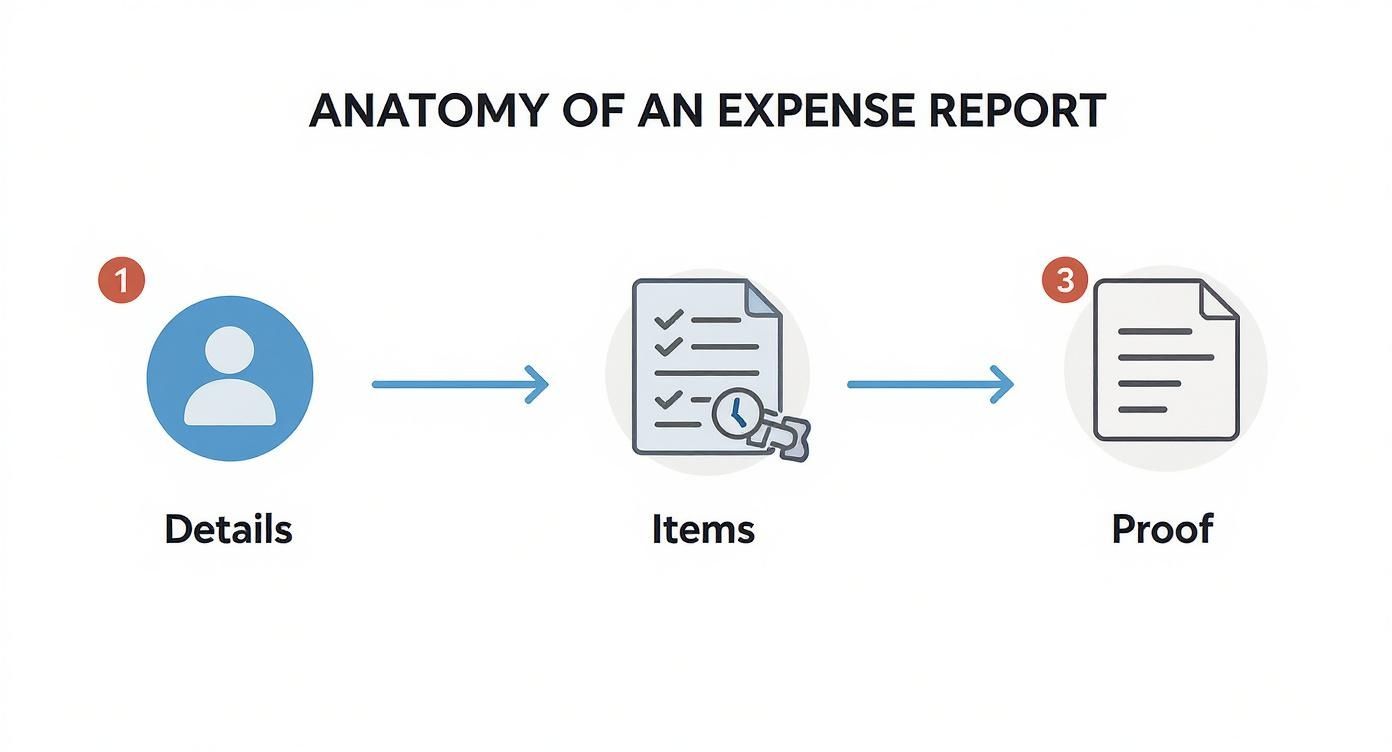
When you capture the details, itemize the costs, and attach the proof correctly, you’ve built a report that can sail smoothly through the approval process.
The Three Key Roles in the Workflow
A successful workflow hinges on everyone knowing their part. When the responsibilities are crystal clear, the whole process moves forward instead of grinding to a halt.
- The Employee (The Submitter): Their job is simple: submit a complete and accurate report on time. That means attaching every receipt, writing clear descriptions for each purchase, and making sure everything falls within company policy.
- The Manager (The Approver): Think of the manager as the first line of defense. They review the report to make sure it aligns with the budget, follows policy, and has a legitimate business reason. It's their job to catch anything that looks off before it goes any further.
- The Finance Department (The Processor): Finance is the final checkpoint. They give everything a final audit for accuracy, ensure the documentation is airtight for bookkeeping and tax season, and then process the payment to reimburse the employee.
A streamlined workflow isn't just about moving faster; it's about building clarity and trust. When employees, managers, and finance are all on the same page, the entire process becomes quicker, more accurate, and a whole lot less stressful.
To make this all work, you need clear timelines. Set firm deadlines for submissions (like within five business days of a trip) and define a service-level agreement (SLA) for approvals and payments (for instance, reimbursement within 10 business days of submission).
This is where modern, automated systems really change the game. They can send automatic reminders for deadlines, route reports to the right person without anyone lifting a finger, and give everyone real-time visibility into where a report is. This shift does more than just speed up reimbursements; it gives everyone back hours of their day.
Integrating Expense Reports with Agency Management Tools
It’s time to stop thinking of expense reports as isolated documents. When you pull them into a central agency platform, they transform from simple reimbursement requests into powerful data points for measuring project health and overall business performance.
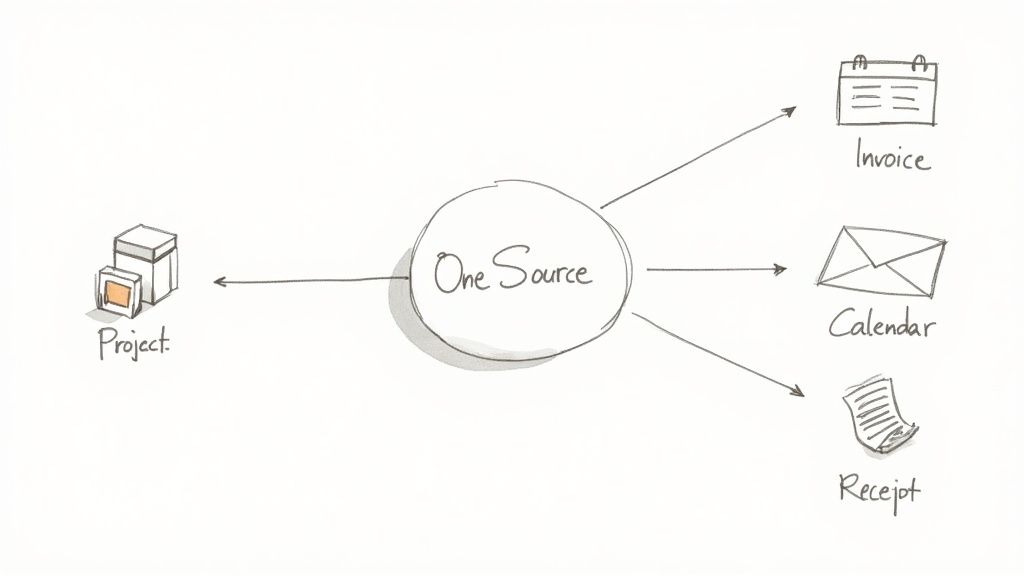
This approach connects the dots between what you spend and what you earn. By linking every expense directly to a specific project, task, and client, you get an immediate, real-time view of profitability. There’s no more guesswork or late-night spreadsheet wrangling to figure out if a project is actually on budget.
Creating a Single Source of Truth
The single biggest win from integration is creating a single source of truth. When your time tracking, project management, and expense data all live in the same ecosystem, you put an end to conflicting information and data silos. Everything is in one place, giving you a complete picture of your agency's financial operations.
Think about a project manager trying to check a project's budget. Without an integrated system, they’re stuck:
- Checking one system for the team's billable hours.
- Digging through a separate spreadsheet or shared folder for travel and material costs.
- Manually piecing it all together to get a rough idea of where things stand.
With an integrated platform, all of that information is right there on a single dashboard. This empowers your leaders to make sharp, data-driven decisions on everything from project pricing and resource allocation to bigger-picture business strategy.
When expenses are integrated, they become part of a larger financial narrative. This single source of truth allows agency leaders to see not just what was spent, but how that spending directly impacts client profitability and operational efficiency.
Automating Key Financial Workflows
Integration also unlocks some serious automation that can save countless hours of administrative work. Once an expense is approved within your management tool, that data can flow seamlessly into other critical systems. For instance, a billable client expense can automatically be tacked onto the next invoice without anyone having to lift a finger.
This automation carries over to accounting, too. Data can be synced directly with your bookkeeping software, ensuring your financial records are always accurate and up-to-date. This cuts down on the risk of human error and frees up your finance team to focus on more strategic work.
The technology here is making a real difference. As of 2024, the use of mobile-based reporting has jumped by 42%, and almost half of all companies are now using AI-powered tools to spot errors. You can find more insights in these expense management statistics on ExpenseOut.com.
Common Mistakes and Compliance Best Practices
Even with a slick expense reporting system, simple, avoidable errors can bring everything to a grinding halt. These slip-ups don't just delay reimbursements; they can cause major compliance headaches and put your agency in a tough spot during an audit. Getting ahead of these common pitfalls is the key to building a truly bulletproof process.
What trips people up most often? You guessed it—the simple stuff. Missing receipts are the number one offender, instantly creating a gap in your paper trail. Another big one is late submissions, which can completely derail your monthly financial forecasts and make it impossible to track project budgets accurately.
Top Errors to Avoid
To keep things running smoothly, you need to be on the lookout for a few repeat offenders. With clear policies and a little bit of training, you can stop these issues before they start.
- Miscategorized Expenses: Tossing a "Client Meal" into the "Software" bucket does more than just look messy; it completely skews your budget data. Getting the categories right is non-negotiable for accurate financial analysis.
- Claiming Non-Reimbursable Items: Submitting expenses that are clearly outside of company policy—like alcohol at a business dinner or a spontaneous first-class upgrade—just creates friction for everyone involved.
- Vague Descriptions: An expense entry that just says "Travel" is worthless. On the other hand, "Taxi from LAX to Client ABC Meeting" gives approvers and auditors all the context they need.
A crystal-clear expense policy isn't about restricting your team; it's about empowering them. It removes ambiguity, sets clear expectations, and ensures fairness and consistency across the board.
Building a Strong Expense Policy
Your best defense against these mistakes is a comprehensive, easy-to-find expense policy. This document should be the go-to source for any and all questions about spending.
A rock-solid policy needs to clearly lay out:
- Spending Limits: Be specific. Set clear caps for common categories like daily meals (per diems), hotels, and client entertainment so there’s no guesswork.
- Approval Rules: Define how your team should get pre-approval for large purchases or any non-standard expenses. This prevents unwelcome surprises later.
- Required Documentation: Make it explicit: every single line item requires a legible receipt or invoice. No exceptions.
By getting out in front of these common mistakes and documenting your rules in a clear policy, your agency can cut down on so much administrative friction. This means faster reimbursements, a clean audit trail, and a team that can focus on what they do best—not on fixing their expense reports.
Frequently Asked Questions About Expense Reports
Even with a solid process in place, you’re bound to run into some specific questions. Let's tackle some of the most common things that come up when dealing with expense reports in an agency, so you can clear up any confusion and keep things running smoothly.
How Long Do We Need to Keep Expense Reports and Receipts?
This is a big one. Generally, tax authorities like the IRS require businesses to hang onto financial records for anywhere from three to seven years. The best move is to establish a firm record retention policy so everyone is on the same page.
This used to mean boxes and boxes of paper, but thankfully, that's no longer the case. A good digital expense management tool takes care of this for you, storing everything securely in the cloud. When audit time comes, you can pull up what you need in seconds instead of digging through a dusty file cabinet.
What's the Difference Between Per Diem and Actual Expenses?
It’s easy to get these two mixed up. Reimbursing actual expenses is exactly what it sounds like: an employee submits a report detailing the specific cost of everything—the $15 lunch, the $30 cab ride—and gets paid back for that exact amount, receipts and all.
Per diem, on the other hand, is a fixed daily allowance for things like meals and incidental costs during travel. This makes life simpler because you don't need to track every single small purchase. The employee gets a set amount per day, though major costs like flights and hotels are still handled as actual, separate expenses.
Are Digital or Scanned Receipts Okay to Use?
Absolutely. In fact, they’re not just okay—they’re usually preferred. High-quality digital copies and scans are the new standard for most companies and even tax authorities.
As long as the image is clear and includes all the key details (who was paid, when, and how much), it’s considered valid proof. Pushing for digital receipts is a smart move; it prevents paper from getting lost and makes the whole approval and auditing process much faster. Just be sure to double-check your local regulations, but for the most part, digital is the way to go.
An integrated system is the key to managing everything from individual expense reports to overall project profitability. RGK gives you a single, unified platform, eliminating the need to patch together different tools and creating one source of truth for your entire agency. Learn how to stop duct-taping your software together at https://rgk.app.