How to Improve Team Productivity for Modern Agencies

If you want to boost your team's productivity, you first need to figure out what's slowing them down. It’s tempting to jump straight to solutions when you see symptoms like missed deadlines or projects creeping over budget. But that’s like putting a band-aid on a broken bone. The real fix starts with a thorough audit to uncover the friction points in your daily workflows.

Uncovering Your Team's Real Productivity Blockers
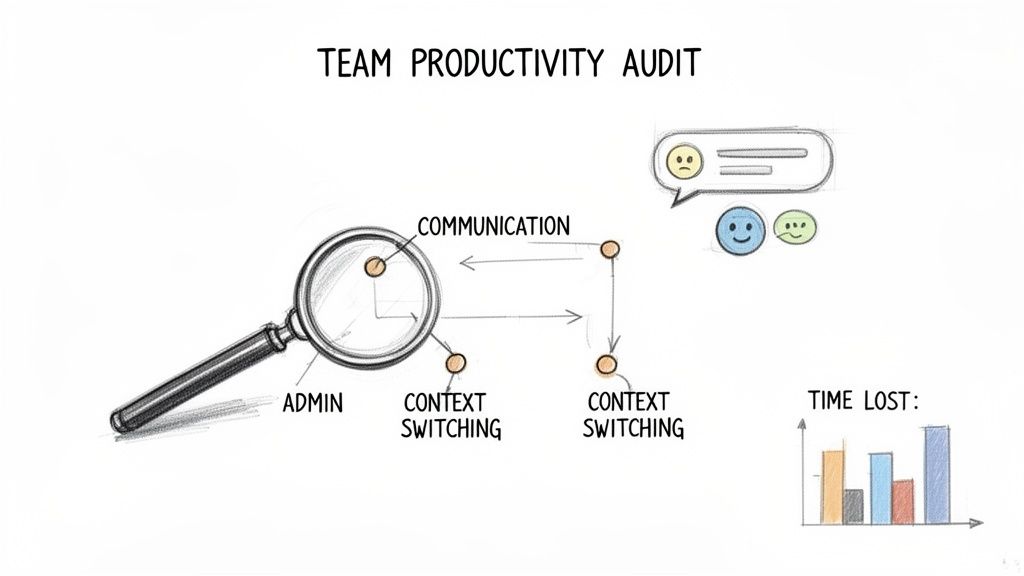
An illustration showing a team productivity audit, highlighting communication, admin, and context switching leading to time lost.

Before you can fix what's broken, you have to find it. Many agency leaders see the end results of inefficiency but struggle to pinpoint the exact cause. The key is to get past the surface-level problems and dig into the hidden friction that grinds your team’s gears.

The goal here isn't to assign blame. It's to get a clear, data-backed picture of reality so you can focus your efforts where they'll actually make a difference.

A solid productivity audit is a two-pronged attack: it combines human insights with hard data. This approach is critical because it tells you both what is happening and why it's happening, straight from the people doing the work.

Combining Qualitative and Quantitative Insights

First, gather the qualitative feedback—the stories behind the data. This is where you uncover the nuances that numbers alone will never show you.

One-on-one conversations are invaluable. Sit down with your team members and ask open-ended questions to understand their daily frustrations. Try prompts like, "What's one task that consistently takes way more time than it should?" or "If you could kill one meeting on your calendar, which one would it be and why?"

Anonymous surveys are another fantastic tool, especially for more sensitive topics like management styles or friction between departments. They create a safe space for brutally honest feedback. Use a simple form to ask about:

  • Communication Gaps: Where does information get lost in translation?
  • Tooling Frustrations: Which software is clunky, slow, or just plain redundant?
  • Administrative Overhead: How much time are you really spending on non-billable stuff like time tracking and reports?

While this feedback is pure gold, you need to back it up with quantitative data from your project management and time-tracking tools. Dig into the numbers and look for patterns. Are certain project phases always a bottleneck? Does one type of task consistently blow past its estimated hours? This hard data validates the stories you're hearing and helps you prioritize the biggest fires.

"Your team's productivity isn't a mystery to be solved; it's a system to be understood. The answers are already there, hidden in your daily routines and workflows. Your job is to make them visible."

Identifying the Common Culprits

As you sift through all this information, you’ll probably start to see a few familiar villains emerge. In most agencies I've worked with, the biggest productivity drains can be traced back to a handful of recurring problems.

The High Cost of Context Switching

Context switching is the absolute enemy of deep, focused work. Every time a designer has to jump from a creative brief to a Slack notification, then to an "urgent" email, and back again, they lose their flow. Each of those little switches comes with a cognitive cost, making it harder and harder to get back into the zone. Your audit might reveal that the constant barrage of pings and notifications is the main source of this disruption.

Disjointed Communication Channels

Think about it: a project conversation starts in Slack, moves to email, gets referenced in a Jira comment, and is finally decided in a Zoom call. Sound familiar? When communication is scattered across a half-dozen platforms, your team wastes precious time just trying to find the latest update. This fragmentation also creates a massive risk of critical details slipping through the cracks, which almost always leads to painful rework.

The Burden of Administrative Tasks

Repetitive, low-value admin work is a silent productivity killer. Things like manual data entry, compiling reports from different sources, or chasing down approvals can eat up a shocking amount of a skilled professional's day. These tasks don't just pull them away from high-impact, billable work; they’re also a major contributor to burnout and disengagement.

And don't underestimate the role of leadership here. Effective frontline managers are an incredibly powerful lever for productivity. A Gallup State of the Global Workplace report found that managers account for roughly 70% of the variance in team engagement. With global employee engagement sitting at just 21%, that shortfall is costing the global economy an estimated $438 billion every year.

Building a Tech Stack That Actually Helps People Work
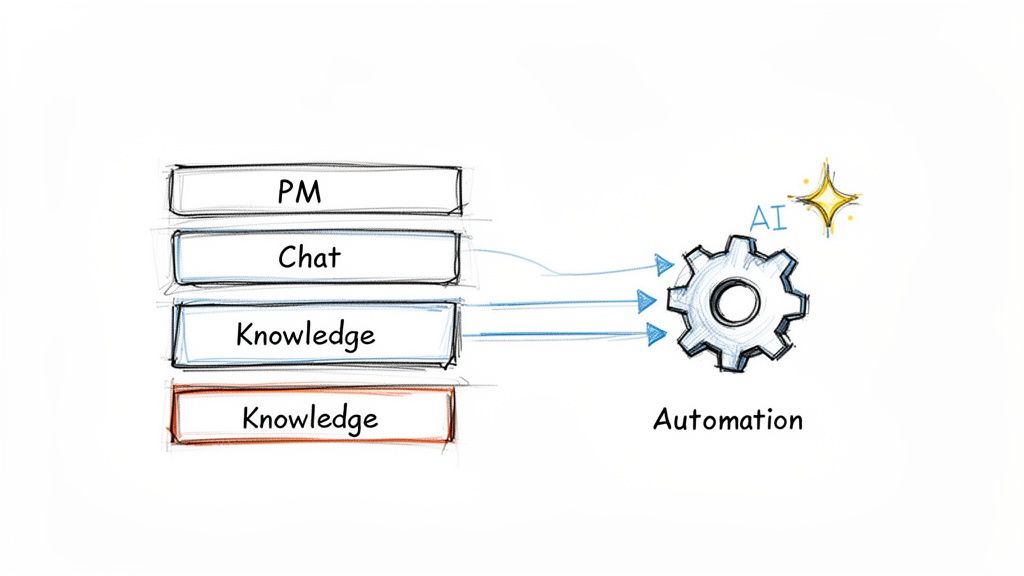
A diagram illustrating data from PM, Chat, and Knowledge sources feeding into an AI-enhanced automation process.

Let’s be honest: technology should be a partner in productivity, not a source of daily frustration. For too many agencies, the "tech stack" is really just a jumble of disconnected apps. This forces your team to constantly switch tabs, hunt for information, and waste creative energy on digital busywork.

The goal isn't just to buy more software. It’s to consolidate that messy toolkit into a cohesive system where work flows smoothly. This means picking tools that solve your agency's actual problems, not just chasing the latest trend.

The Three Pillars of an Agency Tech Stack

Most of an agency’s work boils down to three core functions. When the tools supporting them don't talk to each other, you get information silos, duplicate effort, and a team that's pulling its hair out. A huge step toward better productivity is making sure these pillars are solid and connected.

  1. Project Management: This is your command center. Think of tools like Asana or monday.com as the single source of truth for who is doing what, by when. No more confusion.

  2. Communication: Real-time chat on platforms like Slack is non-negotiable for quick questions and keeping the team in sync. But without clear ground rules, it can quickly turn into a 24/7 distraction machine.

  3. Knowledge Management: This is the agency's brain. A central hub like Notion or Confluence is where your SOPs, client briefs, and hard-won best practices should live—not buried in someone’s inbox or a random Slack thread.

When these systems are isolated, your team is forced to reinvent the wheel on every project. When your PM tool doesn't sync with your chat app, critical context gets lost. True productivity happens when these three pillars are seamlessly integrated.

Picking the Right Tools for Your Team

Choosing the right software can feel overwhelming, but it's about matching the tool to your team's specific needs and workflows. A small, nimble team has very different requirements than a 100-person agency juggling enterprise clients. Here’s a quick breakdown to help you navigate the options.

Productivity Tool Comparison for Agencies

Tool Category Example Tool Best For Key Productivity Feature
Project Management Asana Creative & Marketing Agencies Visual timelines and workflow automation that simplifies complex campaign tracking.
Project Management monday.com Agencies Needing Customization Highly flexible boards that can be adapted for any workflow, from sales to delivery.
Communication Slack Teams Needing Fast-Paced Collab Channels that organize conversations by project or client, plus countless integrations.
Knowledge Mgmt Notion All-in-One Documentation Combining docs, wikis, and project boards in one highly flexible workspace.
Knowledge Mgmt Confluence Teams Deep in Atlassian Suite Tight integration with Jira for linking technical specs to development tasks.
Automation Zapier Connecting Any App Creating "Zaps" that automate tasks between thousands of different web apps.

Ultimately, the "best" tool is the one your team will actually use. Start by mapping your most common workflows and see where the biggest friction points are. That's where a new tool can make the most impact.

Integrating AI and Automation Responsibly

The biggest productivity leap available right now comes from layering smart automation and AI onto this foundation. This isn't about replacing your talented people. It's about augmenting their skills by offloading the mind-numbing, repetitive tasks that eat up their day.

For example, you can use AI to knock out the first draft of a blog post, summarize a dense research report into key takeaways, or automatically transcribe a client call and pull out action items. These small efficiencies compound, freeing your team for the high-value strategic and creative work clients pay you for.

The connection between AI adoption and productivity is becoming crystal clear. Highly productive employees are 242% more likely to use AI than their peers. On top of that, organizations that automate routine tasks save an average of 3 to 3.6 hours per employee every week. You can dig into more of these employee productivity statistics and trends.

Putting Your Tech Stack into Action

Picking the right tools is just the first step. The real magic happens when you connect them and build smart processes around them.

Consider what happens when a new client request lands in your inbox.

  • The Manual Way: A project manager reads the email, opens Asana, creates a new project, manually copies and pastes all the details, then pings the team on Slack to give them a heads-up. It’s slow and leaves way too much room for human error.

  • The Automated Way: An automation rule sees the email, instantly creates a new project in Asana from a pre-built template, assigns the initial tasks to the right people, and posts a summary with a direct link to the project in the designated Slack channel.

The second scenario is faster, more reliable, and gets the project moving immediately. It eliminates a half-dozen manual steps and ensures nothing falls through the cracks. This is what a well-built tech stack should do: actively help your team work smarter, not just give them another password to remember.

Designing Workflows That Create Clarity and Consistency
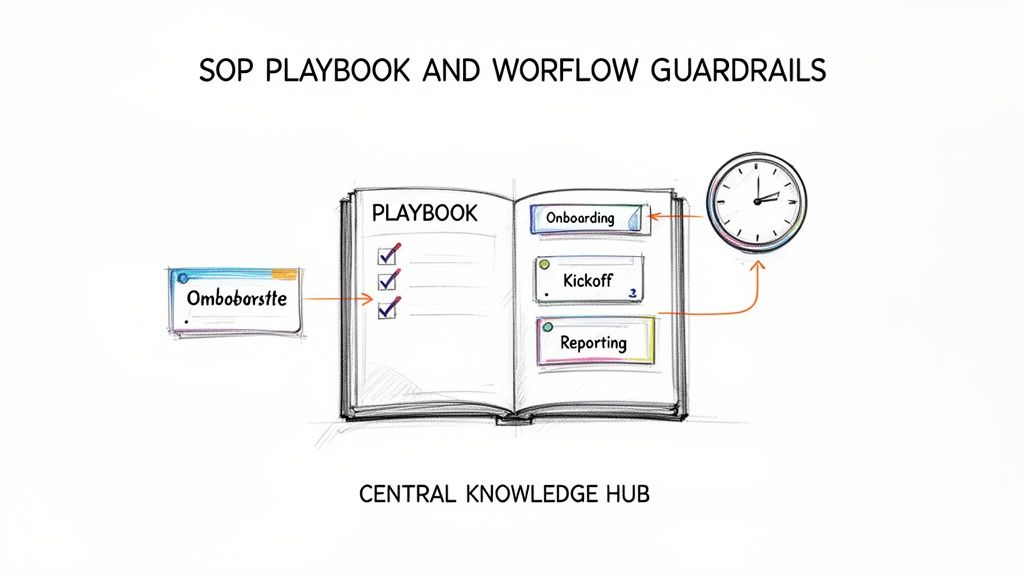
An illustrated playbook shows workflow guardrails for onboarding, kickoff, and reporting from a central knowledge hub.

Having the perfect, integrated tech stack is a great start, but it's only half the battle. Without clear processes showing your team how to use those tools, you’ve just handed them a faster car with no map. This is where we translate high-level strategy into day-to-day action, designing lightweight, repeatable workflows for the moments that matter most.

The goal here isn't bureaucracy; it's clarity. When everyone knows the "how" and "why" behind their work, they can stop reinventing the wheel and pour that mental energy into delivering exceptional results for your clients.

From Dusty Binders to Actionable Playbooks

Let's be honest, nobody reads a hundred-page operations manual sitting in a forgotten folder. Modern SOPs (Standard Operating Procedures) need to be dynamic, easy to find, and built for how people actually work. Think of them less as a rulebook and more as a simple playbook for key agency moments.

So, where do you start? Pinpoint the high-stakes, repeatable activities where inconsistency hurts you the most. For most agencies, these are the usual suspects:

  • Client Onboarding: How do you consistently roll out the red carpet, gather all the right assets, and set the stage for a great partnership from day one?
  • Project Kickoffs: What are the absolute non-negotiables to make sure the entire team is aligned on goals, scope, and timelines before a single hour gets billed?
  • Campaign Reporting: What's the standard for pulling data, analyzing performance, and telling a compelling story to clients that showcases your value?

For each of these, build a simple checklist or a step-by-step guide. A truly great SOP doesn't just list tasks; it includes links to the right templates, shows examples of "what good looks like," and briefly explains why each step is important. Make sure these live in a central, searchable knowledge base like Notion or your project management hub, so they're always just a few clicks away.

Creating Guardrails for Better Collaboration

Beyond the big project milestones, you also need to establish some simple "guardrails" for daily collaboration. These aren't meant to be rigid rules, but shared agreements that cut through the noise and protect everyone’s focus. Without them, you end up with a culture of constant interruptions and shoulder-tapping.

Two of the biggest productivity black holes in any agency are communication and meetings. It’s time to set some clear guidelines.

Communication Etiquette

Define the right channel for the right message. This one small change can stop crucial information from getting lost in a sea of notifications and help your team improve productivity instantly.

A simple framework might look like this:

  • Email: Use this for formal client comms, final deliverable sign-offs, and anything that needs a clear paper trail.
  • Slack/Teams: Keep this for quick, informal questions, real-time brainstorming, and general team chatter. Establish a firm rule: truly urgent requests never live only in a DM.
  • Project Management Tool (Asana/Monday.com): This is home base. All task-specific questions, updates, and files should be attached directly to the relevant task. It creates a single source of truth that anyone can refer back to.

Poor communication has a very real cost. Research shows that 64% of workers lose at least three hours of productivity each week due to inefficient collaboration. Simple guardrails give that time back to your team.

Building Quality into the Process

Finally, your workflows should have quality assurance baked right in, not tacked on as a frantic afterthought. One of the most effective ways to do this without adding a ton of admin overhead is with simple QA checklists.

For example, before a new website goes live, the developer runs through a pre-launch checklist. It’s not complicated. It just ensures nothing gets missed.

  1. Mobile Responsiveness Check: Does the site look and work great on all major screen sizes?
  2. Form Submission Test: Are all lead capture and contact forms actually sending data where they’re supposed to?
  3. Broken Link Scan: Run a quick crawl to make sure there are no 404s.

This approach transforms quality control from a stressful, last-minute fire drill into a calm, predictable part of the process. You catch mistakes early, drastically reduce rework, and ensure every deliverable consistently meets your agency's high standards.

Measuring Productivity Without Micromanaging

You can't fix what you can't see. But the moment you start tracking performance, you risk making your team feel like they're under a microscope. Let's be clear: the goal isn't to watch every click and keystroke. It’s about getting a simple, honest look at your agency’s health and your clients' success.

This is all about shifting the conversation from "Are you busy?" to "Are we effective?" That one change makes all the difference. Busywork just leads to burnout, but effective work is what grows your agency and keeps clients happy. The right Key Performance Indicators (KPIs) act as your guide, pointing everyone toward what really moves the needle.

Focus on Outcomes, Not Activity

The first rule is to stop tracking vanity metrics. Honestly, who cares how many hours someone logged or how many emails they sent? Those numbers tell you almost nothing about the quality of their work or the progress of a project.

Instead, every single KPI you track should tie directly back to project health and client happiness. These are the metrics that actually impact your revenue and your reputation.

For most agencies, a few core metrics will give you 80% of the insight you need with only 20% of the tracking effort. Start with these essentials:

  • Project Completion Rate (On-Time & On-Budget): This is your agency’s heartbeat. A high completion rate means your scoping, planning, and execution are working together beautifully. If it starts to dip, you have an early warning that something is broken—maybe unrealistic timelines, scope creep, or a resource bottleneck.

  • Resource Utilization: This metric shows you how much of your team's available time is spent on billable client work. You're looking for a sweet spot, usually around 75-85%. If it's too low, you’ve got inefficiency and money left on the table. If it's consistently too high, you’re on the fast track to burning out your best people.

  • Client Satisfaction (NPS): The Net Promoter Score is a brutally simple way to measure how clients feel about your work. It just asks, "How likely are you to recommend us?" This one number is a powerful reflection of your work quality and the strength of your client relationships.

Building Your Productivity Dashboard

Once you know what you're tracking, you have to make it visible. A complicated spreadsheet that only you can decipher is completely useless. What you need is a clean, shared dashboard that gives everyone a real-time snapshot of performance without overwhelming them.

Your project management tool is the perfect place to build this. Most platforms—like Asana, monday.com, or our own RGK—can pull this data automatically from the work your team is already doing. This completely removes the soul-crushing task of manual reporting, which is a massive productivity drain in itself.

Your dashboard shouldn't be a report card; it should be a scoreboard. A report card is static and judgmental. A scoreboard is dynamic, shared, and shows the team exactly where they stand in the game so they can adjust their strategy to win.

To give you a clearer picture, here’s a quick breakdown of the essential KPIs you should be looking at.

Essential Productivity KPIs for Agency Teams

This table breaks down the key metrics to track, what they measure, and the tools you can use to monitor them effectively.

KPI What It Measures Why It's Important Example Tool
Utilization Rate The percentage of an employee's time spent on billable tasks. Ensures you're profitable without overworking your team. RGK, Harvest, Toggl
Project Margin The profitability of individual projects (Revenue – Costs). Identifies your most (and least) profitable types of work. QuickBooks, Float
On-Time Completion Rate The percentage of projects or tasks completed by their deadline. A direct indicator of your team's efficiency and planning accuracy. Asana, monday.com
Client Satisfaction (NPS) A client's likelihood to recommend your agency on a 1-10 scale. The ultimate measure of client happiness and future referrals. SurveyMonkey, Delighted

Tracking these metrics gives you a solid foundation. You'll have a clear view of your team's capacity, project profitability, and client sentiment without having to chase anyone for updates.

Use Data to Coach, Not to Command

This is the part where so many leaders stumble. The data on your dashboard is not a weapon to be wielded during a performance review. It’s a conversation starter.

When you see a project budget trending into the red, your first instinct might be to ask, "Why are you over budget?" Don't.

Instead, try this: "Hey, I noticed the budget on Project X is getting tight. What roadblocks are you hitting? How can I help clear them for you?"

That subtle change in phrasing transforms the entire interaction. You go from accusation to collaboration. You're no longer a micromanager scrutinizing their every move; you're a coach, using insights to help your team succeed. This approach builds a culture of trust and shared accountability, which is the true engine of lasting productivity.

Making Change Stick with Smart Rollouts and Feedback

Getting a new tool or process in place is one thing. Making sure people actually use it—and that it works—is a whole different ball game. I've seen too many agency leaders make the classic mistake of a "big bang" rollout, forcing a new system on everyone overnight. That approach is a recipe for chaos, pushback, and a quick retreat to the old, comfortable way of doing things.

Boosting your team's productivity isn't a one-and-done project. It’s about building a culture where getting better is part of the job. Change has to be a collaborative effort, not a command from on high. The secret is to introduce changes carefully, listen constantly, and adjust your plan based on what your team is experiencing on the ground.

Start Small with a Pilot Team

Before you even think about a company-wide overhaul, pick a small, motivated pilot team to be your guinea pigs. This group becomes your real-world lab for testing a new tool or workflow. Let them try the new project management setup or a revised client onboarding process on a single, low-stakes project.

This phased approach is powerful for a few key reasons:

  • It minimizes disruption. The rest of the agency keeps humming along, totally unaffected by the experiment.
  • It creates a safe space to fail. Glitches, confusing steps, and unexpected hurdles can be found and fixed on a small scale without blowing up a major client deliverable.
  • It builds internal champions. When the pilot team has a great experience, they become your best evangelists for the new system. Their genuine enthusiasm creates a pull-effect that makes everyone else want to adopt it.

The pilot team's experience is pure gold. Their feedback will be brutally honest and incredibly specific, letting you iron out all the kinks before anyone else has to deal with them. This makes the eventual full rollout a thousand times smoother.

Build Simple, Consistent Feedback Loops

Once a new system is out in the wild, you need to know what your team really thinks—the good, the bad, and the outright broken. Feedback can't be an afterthought; it has to be baked right into the workflow. Waiting for the annual review is far too late to fix a process that's causing daily friction.

Don't overcomplicate it. A few simple, consistent channels will do the trick:

  • Dedicated Slack Channel: Spin up a #process-feedback channel where anyone can drop a question, suggest a tweak, or flag something that’s not working. It creates a public, searchable log of ideas and solutions.
  • Regular Retrospectives: At the end of a project or a sprint, hold a quick retrospective meeting. Just ask three simple questions: What went well? What didn’t go well? What will we do differently next time? This turns feedback directly into action.
  • Quick "Pulse" Surveys: Use a simple tool to send out a one or two-question survey every few weeks. Ask something like, "On a scale of 1-10, how well is the new project kickoff process working for you?"

The goal of a feedback loop isn't just to collect complaints. It's to create a collaborative system where the people doing the work have a direct hand in improving how that work gets done. This shifts productivity from being a mandate into a shared mission.

This flow shows how the core pillars of measuring effectiveness—project completion, resource management, and client happiness—all tie together.
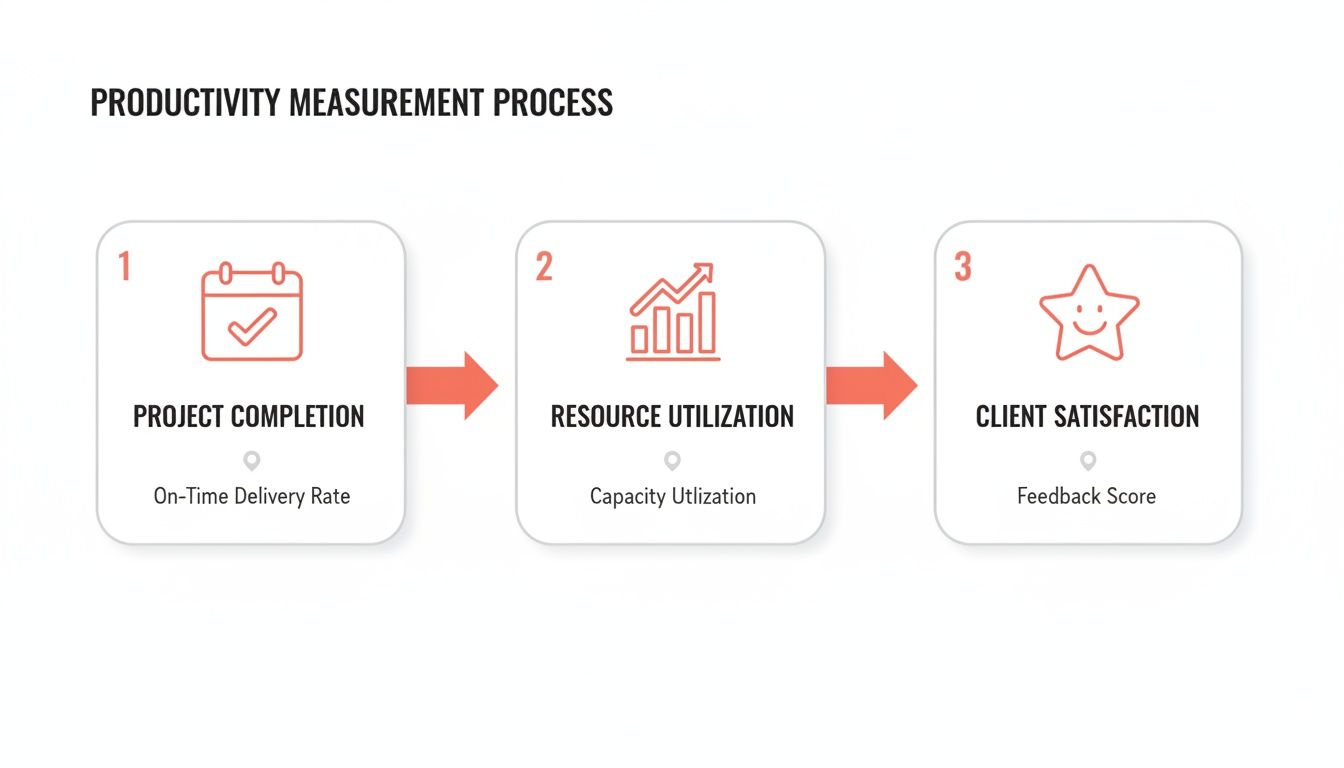
A three-step productivity measurement process flow, outlining project completion, resource utilization, and client satisfaction.

Think of this visual as a reminder that successful outcomes are a mix of efficient delivery, smart resourcing, and happy clients. All three should inform your feedback and iteration cycles.

Adopt an Iterative Mindset

The last—and most important—piece of the puzzle is to treat productivity as an ongoing experiment. No process is ever "finished." Your agency will grow, your clients' needs will shift, and your tools will get updates. Your workflows have to be flexible enough to keep up.

Embrace a simple, iterative cycle: Launch, Measure, Learn, Adapt.

Launch the new process with your pilot team. Measure its impact with the KPIs we talked about earlier. Learn from your team's feedback and the hard data. Then, adapt the process based on those insights before you roll it out to the next group. This methodical approach is how you build long-term productivity and create a resilient agency that’s truly built to scale.

Got Questions? We've Got Answers.

Even the best-laid plans hit a snag. Rolling out changes to improve productivity always comes with real-world challenges that no playbook can fully predict. Over the years, I've seen agency leaders run into the same handful of obstacles again and again.

Let's tackle some of the most common questions head-on. This isn't about theory—it's about navigating the messy, human side of leading a team through change.

How Do I Get My Team to Actually Use a New Tool or Process?

Let's be honest: forcing a new system on your team without their input is a recipe for disaster. Real adoption, the kind that sticks, comes from making people part of the solution, not just forcing a decision on them.

Start by explaining the why. Don't just announce, "We're switching to a new project management tool." That means nothing. Instead, connect it directly to their daily frustrations.

Try something like this: "I know everyone is sick of digging through Slack DMs and email chains for client feedback. This new tool is designed to put every project conversation in one place, so you can stop hunting for information and get back to doing great work." See the difference?

Better yet, get them involved in the decision. Pick two or three solid options and let a few key people from different teams test them out. When the final recommendation comes from their peers, it feels like a shared choice, not a top-down mandate.

People don't resist change; they resist being changed. Bring your team into the process from the very beginning, and they'll become advocates for the new way of working, not roadblocks.

Finally, make the transition as smooth as possible. Give them clear documentation, run a hands-on training session (with snacks!), and maybe even let the old system run in parallel for a week or two. This takes the pressure off and shows you respect their current workflow.

What if My Team Hates the New Process and Pushes Back?

Pushback is almost never about the process itself. It's usually a symptom of something bigger. Before you just tell everyone to "get on board," take a moment and get curious. Is the new SOP genuinely more confusing than the old way? Does it feel like you've introduced a solution for a problem that didn't exist?

The best thing you can do is listen. Pull the team (or a few vocal members) into an informal chat and ask some open-ended questions:

  • "What's the single most annoying part of this new workflow for you?"
  • "If you had a magic wand, what's one thing you would change about how we're doing this?"

You'll often uncover a totally valid point you missed. Maybe that new report template requires them to pull data that takes an hour to find. Acknowledging their feedback and making a small adjustment shows you value their expertise on the ground. This simple act can turn resistance into collaboration.

When Is a Productivity Dip a Sign of a Deeper Problem?

Productivity is never a flat line; it has natural peaks and valleys. A slow week might just be the result of a grueling project launch or a post-holiday slump. But a sustained drop over several weeks? That's a warning sign you can't afford to ignore.

Start with the data. Are deadlines slipping for everyone, or is it just one team or client? Is your resource utilization chart constantly pinned at 100%? The numbers will help you narrow down the source of the problem.

A prolonged slump usually points to one of three culprits:

  1. Burnout: Is everyone consistently logging overtime? High utilization looks great on paper, but it's a disaster if it leads to exhaustion and apathy. This is a huge red flag to re-evaluate workloads and project scopes immediately.
  2. Fuzzy Priorities: When everything is marked "urgent," nothing is. Productivity plummets when your team feels overwhelmed and has no clear direction on where to focus their energy. It's time to revisit your agency's goals and clarify what really matters right now.
  3. Broken Workflows: A process that was perfect for a five-person team will completely fall apart for a team of fifteen. The slump might be your team's way of telling you that your foundational systems can no longer support your agency's size.

Don't sweep these signs under the rug. A temporary dip in output is easy to fix. A burnt-out, disengaged team is a much, much bigger problem. Use this dip as a signal to find the root cause before it becomes a full-blown crisis.


At RGK, we've built the operating system designed to solve these exact challenges, integrating project management, AI-driven insights, and core agency operations into a single source of truth. Stop fighting with disconnected tools and see how a unified platform can transform your team's productivity. Learn more and see how RGK can help your agency scale smarter.

How to Improve Operational Efficiency: how to improve operational efficiency

Before you can plug the leaks, you have to find them. Improving your agency's efficiency starts with a brutally honest look at where you're losing time, money, and momentum. This isn't about some abstract business theory; it's about getting crystal clear on what to fix so you can make changes that actually move the needle.

Diagnosing Your Operational Bottlenecks

Trying to boost efficiency without first finding your specific problems is like trying to fix a car that won't start by just washing it. It might look better, but you haven't touched the engine. Too many agency leaders jump straight to buying shiny new software or overhauling processes, only to realize they've solved a problem they didn't really have.

So, the first and most important step is to assess where you are right now. This means getting past gut feelings and digging into the real friction points in your daily workflows, from the second a lead hits your inbox to the moment you send that final invoice.

Map Your Current Reality

You can’t improve a process you don't fully understand. Start by mapping out your core workflows as they actually happen, not how they’re supposed to happen. Get in a room with a whiteboard or a simple tool like Miro and sketch out the journey.

For a standard client project, that might look something like this:

  • Intake: A new lead fills out a form on your website.
  • Assignment: The project gets handed off to a project manager.
  • Kickoff: You schedule and hold a discovery call.
  • Execution: Your team gets to work on the deliverables.
  • Review: Drafts go to the client for their feedback.
  • Revisions: You make changes based on that feedback.
  • Final Delivery: The finished project is officially handed over.

Just getting this down on paper forces you to see every handoff, every decision, and every potential spot where things get stuck. It’s a simple exercise that gets the whole team on the same page.

Gather Ground-Level Intelligence

Your team knows where the bodies are buried. They live with the frustrating workarounds and the mind-numbing repetitive tasks every single day. If you want to know what's really broken, you have to talk to them.

The goal isn't to find fault; it's to find friction. When team members feel heard and know their insights are valued, they become active partners in building a more efficient system rather than passive participants.

Pull people aside for informal one-on-one chats or get small groups together. Ask open-ended questions like, "What's the most annoying part of your day?" or "If you had a magic wand, what's the one task you'd make disappear forever?" You’ll be amazed at the patterns that pop up.

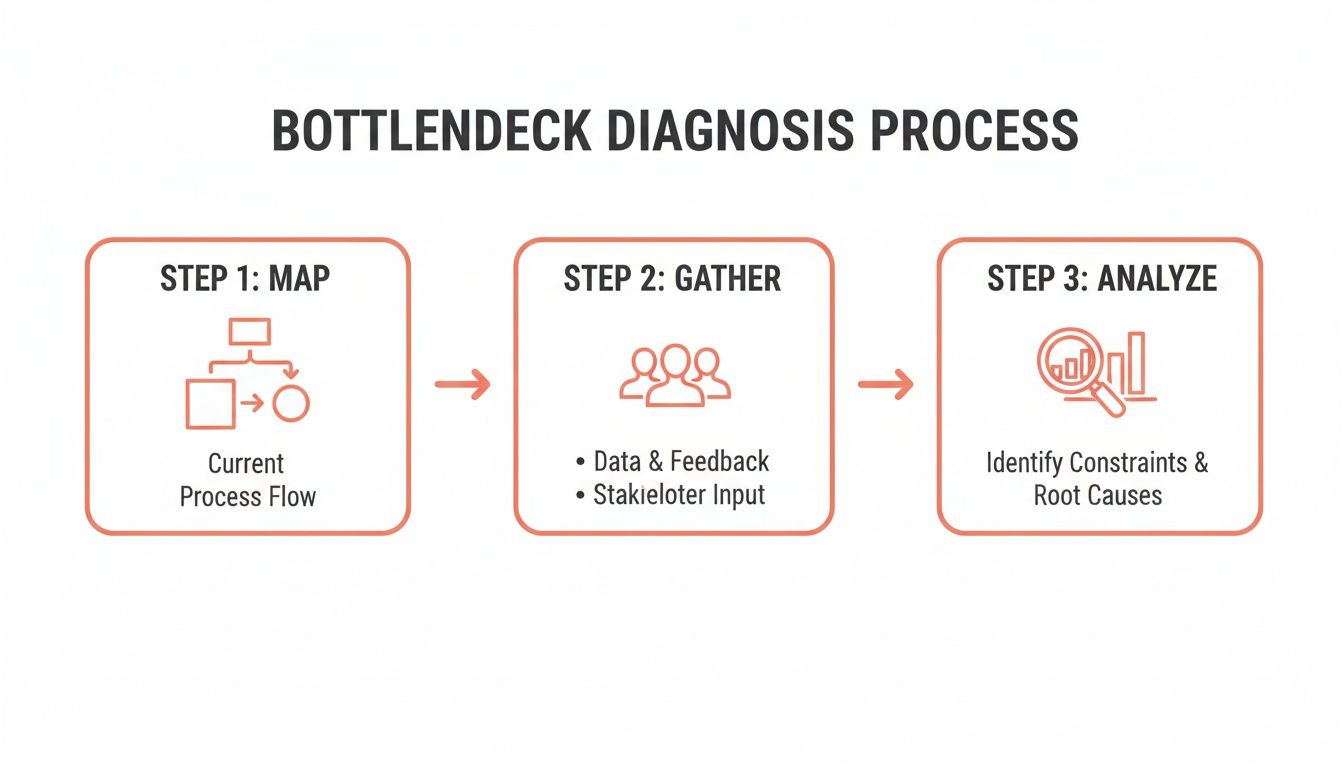
A three-step bottleneck diagnosis process illustrating mapping, gathering data, and analyzing constraints to improve efficiency.

This process shows how a systematic approach—moving from a high-level map to human insights and finally to data-backed analysis—is the most effective way to figure out where to focus your energy.

Analyze Simple Data for Hidden Clues

Finally, back up what you've heard with some simple numbers. You don't need a fancy business intelligence dashboard for this. Just look at basic metrics that tell a story.

For example, you might look at your project management data and realize that 74% of your projects go through more than two rounds of client revisions. That's not just a hunch anymore; it’s a clear sign that something is off in your initial briefing or review process.

Or maybe you find that the average time from project completion to sending the final invoice is 12 days. That’s almost two weeks of cash just sitting there, pointing directly to a snag in your finance workflow.

These little data points are gold. They turn vague feelings into concrete, actionable problems. This whole diagnostic phase sets the foundation for everything else, making sure that when you do start making changes, you're fixing the things that will make the biggest difference.

Defining Success with Clear KPIs and Metrics

Once you’ve pinpointed the bottlenecks slowing your agency down, the next question is obvious: What does better actually look like? You can't improve what you don't measure. This is where Key Performance Indicators (KPIs) become your agency’s scoreboard, turning vague ambitions into tangible goals.

Without solid metrics, you're just guessing. You might feel like your team is busier than ever, but activity doesn't always equal progress. The real win is moving beyond vanity metrics (like the number of emails sent) and zeroing in on the data that truly reflects the health and profitability of your operations.

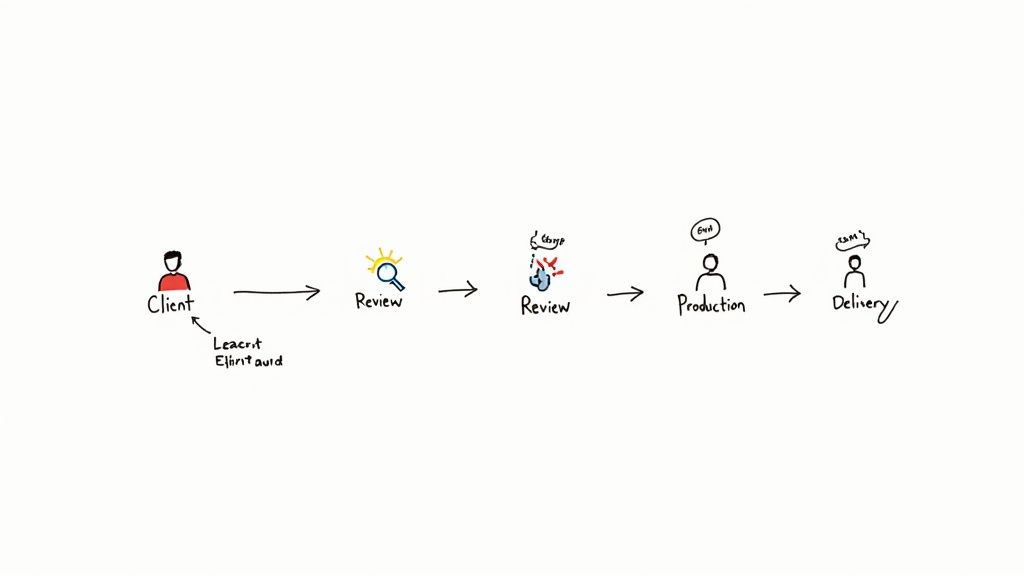
Workflow diagram depicting client input, review, production, delivery, with a note on learning and iteration.

From Vague Goals to Specific Metrics

It's common for agency leaders to set goals that sound great but are impossible to track. Think "boost client happiness" or "make the team more productive." How do you put a number on that? The trick is to translate these broad objectives into specific, measurable figures.

For instance, "boost client happiness" is a fantastic goal, but it becomes actionable when you start tracking your Net Promoter Score (NPS) after each project wraps. Or, even simpler, track the number of revision cycles a project goes through. Fewer revisions almost always mean you nailed the brief, leading to happier clients.

In the same way, "make the team more productive" gets real when you measure your team utilization rate or the average project turnaround time. These numbers give you a crystal-clear picture of your team’s capacity and speed, showing you exactly where the improvement opportunities are.

KPIs That Truly Matter for Agencies

While your agency has its own unique rhythm, a few core KPIs offer a ton of insight for just about everyone in the service business. These are the metrics that cut through the noise.

Here’s a breakdown of some essential KPIs that we see the most successful agencies tracking.

KPI What It Measures Operational Goal
Project Profitability Revenue minus all direct costs, including billable hours. Ensure every project contributes positively to the bottom line.
Team Utilization Rate The percentage of an employee's time spent on billable work. Maximize billable output without causing team burnout.
Average Billable Rate The effective hourly rate you're actually earning on a project. Identify if scope creep or inefficiencies are eroding your profits.
Process Cycle Time The total time from project start to finish. Shorten delivery timelines to increase capacity and cash flow.
Revision Cycles The number of times a deliverable is sent back for changes. Improve initial communication and the quality of first drafts.

This isn't an exhaustive list, but it’s a powerful starting point for understanding where your time, money, and energy are really going.

A classic mistake is trying to track everything at once. Pick three to five KPIs that directly address the bottlenecks you’ve already identified. A cluttered dashboard quickly becomes an ignored one.

Building Your Efficiency Dashboard

You don’t need a fancy, expensive business intelligence tool right out of the gate. Honestly, a well-organized spreadsheet or a simple dashboard in your existing project management software like Asana or ClickUp is more than enough to get started. The important part is making the data visible and reviewing it regularly.

Make it a habit. Block off time in your weekly or monthly leadership huddles to go over the numbers. Ask the tough questions:

  1. What is this metric telling us?
  2. Why did it move up or down this week?
  3. What's one thing we can do next week based on this trend?

This simple routine turns your KPIs from a list of numbers into a powerful tool for driving real change. It builds a culture where decisions are backed by data, and every process tweak is measured by its impact on the metrics that matter most.

Time to Build Your Agency's Playbook

Once you’ve pinpointed your bottlenecks and have your KPIs dialed in, the next move is all about creating consistency. Running an agency without standard processes is like trying to run a professional kitchen where every chef makes the same dish their own way. The results are all over the place, quality is a guessing game, and training new cooks is a nightmare.

Real operational efficiency isn’t about luck; it’s built on a bedrock of clear, repeatable systems that take the guesswork out of daily work.

This is where your Standard Operating Procedures (SOPs) come into play. Forget the idea of rigid, bureaucratic manuals. Think of SOPs as your agency’s playbook—the best, most efficient way to get recurring tasks done right, every single time. It's how you empower everyone on the team to perform with the same confidence and quality.

From "Ask Steve" to a Documented Playbook

Let's be honest. In most agencies, the "process" for critical tasks lives inside the heads of a few key people. This “tribal knowledge” is a massive risk. What happens when that person goes on vacation, calls in sick, or worse, leaves the company? The whole system grinds to a halt, projects stall, and chaos takes over.

The goal here is to pull that invaluable knowledge out of people's heads and turn it into a simple, accessible guide that anyone can follow. Start by thinking about your core, repeatable workflows. Good candidates for your first few SOPs are usually things like:

  • Client Onboarding: What are the exact steps from a signed contract to a successful project kickoff? Who’s responsible for gathering assets, setting up the project in Asana or ClickUp, and scheduling that first call?
  • Project Kickoff Meetings: What's the standard agenda? What information do you absolutely need to collect from the client every single time to ensure the project starts smoothly?
  • Content Creation & Review: How does a blog post or social media campaign move from a brief to a final, client-approved piece? Who needs to sign off at each stage? Map it out.
  • Final Project Handoff: What does "done" actually look like? Detail exactly what files, reports, and access credentials the client gets at the end of an engagement.

Documenting these workflows instantly clarifies roles, sets clear expectations, and cuts down on the endless back-and-forth that kills productivity.

Creating Living Documents, Not Dusty Binders

The biggest mistake I see agencies make is treating SOPs as a one-and-done project. They create a beautiful document, save it to a shared drive, and it’s never seen again. An SOP is only valuable if it’s a living, breathing part of your daily operations.

To avoid creating a process graveyard, stick to these principles:

  1. Keep It Simple and Visual: Nobody wants to read a 20-page wall of text. Use checklists, annotated screenshots, and quick video recordings (a Loom walkthrough is perfect for this). Break it down into a simple, scannable list.
  2. Make Them Easy to Find: Don't bury your SOPs in a maze of folders. Put them where your team already works—a dedicated Slack channel, a Notion database, or right inside your project management tool.
  3. Assign an Owner: Every single SOP needs a designated owner who is responsible for keeping it current. When a tool gets an update or a process changes, their job is to update the documentation right away.

Your playbook does more than just reduce errors; it empowers your team. It frees up your senior talent from constantly answering the same basic questions, letting them focus on high-impact strategic work instead of being the process police.

But building a playbook is just one piece of the puzzle. Workforce and productivity metrics are just as critical. Recent survey data from 2024–2025 shows a bit of a disconnect; while 58% of tech leaders expected their budgets to increase in 2025, only 17% ranked improving processes as a top priority. This shows that many organizations are trying to balance new digital investments with cost pressures, when really, process improvements should be driving efficiency across the board. You can discover more insights about these technology leadership trends for a deeper dive.

By building this solid foundation of SOPs, you’re not just cleaning up your current workflows. You’re building the very structure you need to scale your agency effectively and profitably.

Get Your Systems Talking and Automate the Grunt Work

Once you’ve standardized your core processes, the next big win for your agency's efficiency is getting your tools to do the heavy lifting. This is where you claw back hours, slash human error, and rescue your team from the soul-crushing monotony of manual, repetitive tasks. Think of it as building a digital assembly line that handles the boring stuff, freeing up your people for strategy and creative work.

The modern agency runs on a whole stack of specialized software—a CRM for sales, a project management tool for delivery, maybe Slack or Teams for communication. When these systems don’t talk to each other, your team is forced to act as the human glue, constantly copying and pasting information between platforms. This isn't just slow; it’s a breeding ground for mistakes and a major source of frustration for your team.

Bridge the Gaps in Your Tech Stack

The goal here is to create a seamless flow of information. An action in one system should automatically trigger the next logical step in another.

Let's take client onboarding. When a deal is marked "won" in your CRM, a whole cascade of events should fire off without anyone lifting a finger:

  • A new project pops up in Asana or ClickUp using your standard onboarding template.
  • A private Slack channel is instantly created for the project team and the client.
  • A welcome email sequence kicks off, sending the kickoff meeting scheduler and initial questionnaire.

That’s the real power of system integration. You’re not just saving a few minutes here and there; you're building a reliable, error-proof engine that runs your operations in the background.

Tools like Zapier and Make have become the central nervous system for thousands of agencies for this very reason. They let you connect different apps without having to write a single line of code.

Here’s a classic example: a simple automation that connects a website form to your project management tool, instantly turning a new lead into a task for your team.

This visual setup shows how you can link a "trigger" (a new form submission) to an "action" (creating a task), completely removing the need for manual data entry.

Find the Best Candidates for Automation

You don't need to automate everything. The sweet spot is high-frequency, low-complexity work. Look for the recurring tasks that don’t require a ton of critical thinking but chew up a surprising amount of your team’s day.

Start by spotting the common "if-this-then-that" scenarios happening in your agency:

  • If a project task is marked "Ready for Review," then ping the project manager in Slack.
  • If a client support ticket sits unanswered for over 2 hours, then automatically escalate it to the support lead.
  • If a project hits 75% of its budgeted hours, then send an alert to the account manager.

Automation isn't about replacing people. It's about augmenting them. When you let technology handle the tedious admin load, you free up your team to focus on the high-value work clients are actually paying for.

This focus isn't just an agency trend; it's a near-universal business priority. In a 2025 operations survey of 610 executives, a massive 93% of respondents said increasing operational efficiency was a top goal. What's more, 96% of tech and telecom leaders reported that digital tools gave them much better cost visibility. The same study also found that 62% of executives see AI as "very effective" at creating value through higher productivity. You can dive deeper into these findings in the PwC 2025 Digital Trends in Operations Survey.

By connecting your systems and putting these routine workflows on autopilot, you shift from being reactive—constantly chasing down information and fixing mistakes—to being proactive. Your processes just run themselves. That shift is absolutely fundamental if you want to scale your agency without just throwing more people at every problem.

Bring in AI and Assistants to Power Up Your Workflow

Once you’ve standardized your processes and connected your core systems, you have a solid operational engine. Now, it's time to add the high-octane fuel. This is where you bring in Artificial Intelligence (AI) and specialized assistants to create a workflow that’s not just efficient, but genuinely smart.

Let's be clear: this isn't about replacing your talented people. It's about giving them superpowers. Think of AI as the ultimate junior team member—one that can draft, research, and analyze at an incredible pace, freeing up your team for the strategic, high-value work that actually grows the business.

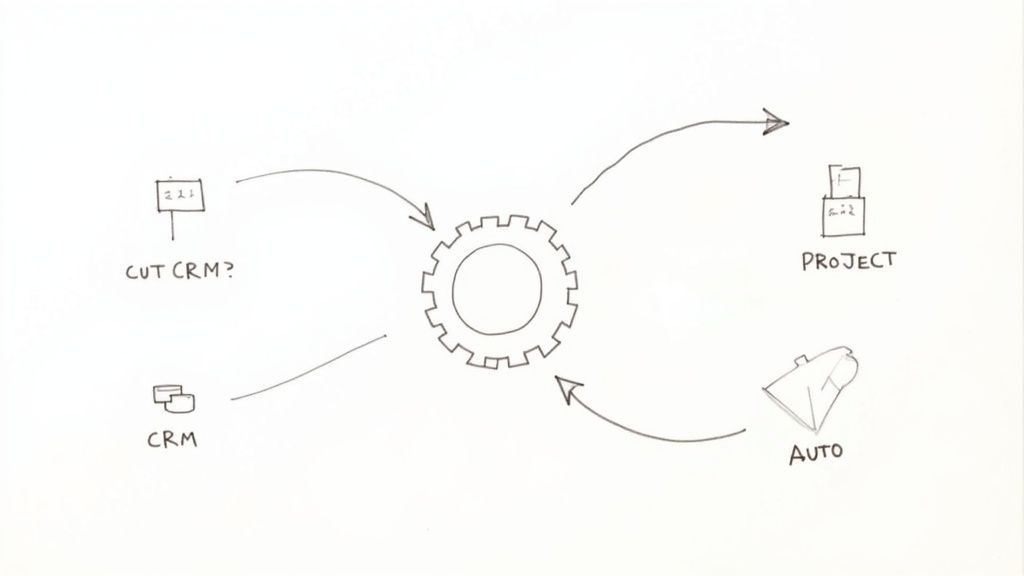
A hand-drawn diagram illustrating a central gear connected to 'CUT CRM?', 'PROJECT', 'AUTO', and 'CRM' in a circular flow.

From First Drafts to Quick Insights

AI has moved beyond sci-fi and into the everyday toolkit of savvy agencies. We're seeing teams get immediate wins by using AI to bust through common bottlenecks in creative and strategic work.

For instance, that dreaded blank page is becoming a thing of the past. Instead, your team can use AI to:

  • Generate initial content briefs: Plug in client goals and audience info to get a structured brief complete with key themes, headline ideas, and SEO keywords.
  • Draft marketing copy: Get first drafts for social media updates, ad copy, or email campaigns that your team can then polish and perfect.
  • Summarize research: Feed AI a lengthy report or a client interview transcript and get back a clean, bulleted summary in moments.

This approach massively shortens the "time to first draft," which means your team can jump straight to editing, strategizing, and adding that uniquely human creative spark.

Delegate the Administrative Drag

Besides content, the single biggest drain on any skilled team is administrative overhead. These are all the necessary evils that eat away at productive, billable hours. This is the perfect place to deploy a virtual assistant (VA) or other specialized support.

A good VA can take over the countless tasks that pull your senior people away from actual client work.

Here are some of the most common things we see agencies offload:

  1. Scheduling & Calendar Juggling: Coordinating meetings across different time zones is a classic time-sink.
  2. Data Entry & CRM Hygiene: Making sure client records are current and new leads are logged correctly.
  3. Basic Research: Pulling together lists of outreach targets or finding preliminary industry stats for a new project.
  4. Report Prep: Grabbing data from different platforms and dropping it into your standard weekly or monthly report template.

By handing off this work, you're not just saving time; you're protecting the focus and energy of your most critical thinkers. This is a direct line to improving operational efficiency.

Don't think of delegation as just offloading work. You're creating capacity. Every hour a senior strategist spends scheduling meetings is an hour they're not building a client's growth plan.

The financial upside here is real. Companies that have jumped on AI and automation are seeing serious gains. Industry data shows these technologies can drive logistics cost reductions of about 15%, cut inventory by roughly 35%, and boost service-level efficiency by nearly 65%. These figures aren't abstract; they show how smarter, AI-driven planning directly impacts the bottom line. You can read the full analysis of these supply chain statistics to dig deeper.

Building a Leaner, Smarter Agency

Bringing AI and assistants into the fold isn't a one-and-done project. It’s about developing a new instinct across your organization. The goal is to get everyone asking, "Could an AI or an assistant do this faster?"

My advice? Start small. Pinpoint one or two repetitive, high-friction tasks inside a single team. Pilot a new tool or hire a part-time VA to focus only on that workflow. Track the time saved and, just as importantly, ask the team how it feels.

Once you prove the value in one spot, you can start expanding the model across the rest of the agency. This deliberate, phased approach ensures you build a smarter, more resilient operation—one where technology truly empowers your people to do their absolute best work. The result is an agency that produces more, better work without just throwing more people at the problem.

Frequently Asked Questions

Cartoon drawing of a robot passing a draft document to a man analyzing data, symbolizing improved efficiency.

As you start pulling on these threads, you’re bound to have questions. This isn't about ticking boxes on a checklist; it's a living, breathing part of running your agency. I've gathered some of the most common questions and concerns that come up when leaders like you start putting these ideas into practice.

Let’s get into some of the real-world hurdles you're likely to face.

Where Should I Start Improving Operational Efficiency on a Tight Budget?

You don't need a huge budget to make a real difference. In fact, some of the highest-impact moves cost nothing more than your time and focus.

The best place to begin is almost always process mapping. Grab your team, pick one core process that feels like a mess—client onboarding is a classic culprit—and just map out every single step on a whiteboard. I guarantee you'll spot redundancies, communication breakdowns, or weird workarounds that can be fixed on the spot, no new software required.

Focus on these low-cost, high-return moves first:

  • Create simple checklists: Make sure every project kickoff or creative handoff follows the same essential steps.
  • Define communication channels: Establish a simple rule like, "Client feedback lives in the project tool, urgent questions go to Slack." This alone can save hours of confusion.
  • Run a "gripe session": Seriously. Book an hour for the team to vent about their biggest daily frustrations. The solutions are often hiding in those complaints.

Nailing these fundamentals gets the human side of your operations sorted out. That creates a solid foundation for any tech you might decide to invest in later on.

How Do I Get My Team on Board with New Processes and Tools?

Here's a hard truth: without your team's buy-in, even the most brilliant new process is doomed. The secret is to make them partners in the change, not just recipients of it. Resistance isn't about stubbornness; it's about feeling like change is being done to them.

So, don't just drop a new SOP or tool on their desk. Bring them into the conversation from day one. Ask them what's broken. Ask them what would make their jobs easier. Frame the changes as the solution to their problems, not just another way for management to track things.

A pro tip: always start with a small pilot program. Find a few people on the team who are excited about the change and let them test the new process on a single project. Their success stories will do more to convince the skeptics than any memo you could ever write.

What Are the Most Common Mistakes Businesses Make When Trying to Improve Efficiency?

So many agencies try to get more efficient and end up spinning their wheels. It's almost always because they fall into one of a few classic, and completely avoidable, traps.

The biggest mistake, by far, is buying tech before understanding the process. A leader sees a shiny new tool, thinks it's a silver bullet, and buys it. But without a clear workflow to plug it into, the software just adds another layer of complexity. Always map out the process first, then find a tool that fits it—never the other way around.

Another common pitfall is the "set it and forget it" mentality. Improving your operations isn't a one-and-done project. It's a constant cycle of doing, measuring, and tweaking. Your SOPs should be living documents that evolve as your agency grows.

Finally, and this is a big one, don't neglect the human element. If a new process makes your team's life harder or they don't understand the "why" behind it, they'll just go back to the old way of doing things the second you turn your back. Communication and training aren't optional—they're how you make change actually stick.


Tired of duct-taping your agency's operations together with a dozen different tools that don't talk to each other? RGK is the unified operating system built for agencies, by an agency. Stop fighting your software and start scaling your business with a single source of truth for projects, clients, and billing. Discover how RGK can streamline your agency's workflow today.

10 Transformative Benefits of Process Automation for Agencies in 2025

Running a modern agency often feels like a constant battle against operational chaos. Disconnected tools, manual data entry, and repetitive client tasks create bottlenecks that stifle growth and drain profitability. While 'automation' is often thrown around as a magic solution, the reality is far more strategic and impactful. The core benefits of process automation aren't just about saving a few minutes here and there; they are about fundamentally re-architecting your agency to be more resilient, scalable, and profitable.

In a competitive market where client expectations for speed and quality are higher than ever, implementing smart automation is no longer a luxury, it's the new operational standard. Manual processes are not just inefficient, they introduce risk, limit your team's capacity, and prevent you from focusing on high-value strategic work. Shifting from reactive problem-solving to proactive system-building is the key to breaking free from the cycle of operational drag.

This article moves beyond generic advice to provide a comprehensive breakdown of the 10 most critical automation benefits. For each point, we will provide actionable steps, concrete examples, and clear guidance on measuring ROI. You will learn not just what the benefits are, but how to implement the right systems to achieve them. Our goal is to give you a clear roadmap for transforming your agency's efficiency, empowering your team, and building a robust foundation for sustainable growth.

1. Increased Productivity and Efficiency

One of the most immediate and impactful benefits of process automation is the substantial boost in operational productivity and efficiency. By delegating rule-based, repetitive tasks to automated systems, agencies free their teams from the manual work that consumes valuable time and energy. This shift allows skilled employees to redirect their focus toward strategic, creative, and client-facing activities that drive real business growth.

Automation fundamentally redefines workflow capacity. Instead of measuring tasks in human hours, organizations can measure them in machine-speed seconds. This accelerates task completion cycles dramatically, enabling teams to handle a higher volume of work without a corresponding increase in headcount or burnout. The result is a more agile, responsive, and productive operation capable of delivering results faster.

Real-World Impact

  • Accounting: A digital marketing agency using Robotic Process Automation (RPA) can automate invoice processing. A bot can extract data from incoming invoices, validate it against purchase orders, and enter it into the accounting system, reducing a process that once took 15 minutes per invoice down to under a minute.
  • Manufacturing: In production environments, automated assembly lines can increase output by over 50% while simultaneously reducing error rates, operating 24/7 without fatigue.
  • Marketing: Platforms like HubSpot or Marketo automatically segment audiences, trigger personalized email sequences, and nurture leads based on user behavior. This allows a small marketing team to manage complex campaigns that would otherwise require significant manual effort.

Key Insight: True efficiency isn't just about doing the same tasks faster; it's about reallocating your most valuable resource, your team's cognitive power, to work that automation cannot perform, such as innovation, strategy, and complex problem-solving.

How to Implement and Measure

To successfully leverage automation for productivity gains, start by identifying high-volume, low-complexity tasks.

  1. Establish Baselines: Before implementing any solution, meticulously measure the current state. Track key metrics like "time per task," "tasks completed per week," and "error rate."
  2. Involve Process Owners: Collaborate directly with the employees who perform the tasks. Their insights are crucial for designing an effective automation workflow that addresses real-world nuances.
  3. Start Small: Begin with a pilot project that has a clear and measurable ROI. A successful first implementation builds momentum and provides a strong business case for broader adoption.
  4. Track Post-Implementation: After launch, continuously monitor the same baseline metrics to quantify the improvement and calculate the return on investment. This data proves the value of your automation efforts.

2. Cost Reduction and Improved ROI

One of the most compelling benefits of process automation is its direct and measurable impact on the bottom line. Automation drives significant cost reduction by minimizing manual labor expenses, reducing costly human errors that lead to rework, and optimizing the allocation of valuable resources. This financial efficiency allows agencies to re-invest savings into growth-oriented activities like innovation, client acquisition, and talent development.

A detailed sketch showing a gear facing a piggy bank with an ROI coin on its tail.

By automating high-volume, rule-based tasks, organizations can achieve more with their existing headcount, avoiding the need to hire additional staff as the workload increases. This translates to lower overhead and improved profitability per project. Furthermore, automated systems operate with near-perfect accuracy, eliminating the financial drain associated with correcting mistakes, re-running processes, and managing compliance issues that arise from manual data entry.

Real-World Impact

  • Financial Services: JPMorgan Chase’s COIN (Contract Intelligence) platform automates the review of commercial loan agreements. This technology saves the bank an estimated 360,000 labor hours annually, drastically cutting operational costs and freeing legal experts for more strategic work.
  • Insurance: By automating claims processing, insurance companies can reduce processing costs by up to 25%. Bots can extract data from claim forms, verify policy details, and flag fraudulent activity, accelerating settlement times and lowering administrative overhead.
  • Banking: Automated Know Your Customer (KYC) and Anti-Money Laundering (AML) processes help banks reduce compliance costs and avoid hefty fines. Automation handles identity verification and transaction monitoring with speed and precision, ensuring regulatory adherence.

Key Insight: The ROI of automation extends beyond direct labor savings. It encompasses the value of avoided errors, enhanced compliance, and the strategic redeployment of your team's expertise toward revenue-generating opportunities, creating a powerful compounding effect on profitability.

How to Implement and Measure

To ensure automation delivers a strong financial return, approach implementation with a focus on a clear cost-benefit analysis.

  1. Conduct a Cost-Benefit Analysis: Before investing, map out the current costs of a manual process, including labor hours, error correction expenses, and opportunity costs. Compare this to the projected cost of an automation solution.
  2. Calculate Total Cost of Ownership (TCO): Look beyond the initial software license. Factor in implementation, maintenance, training, and potential integration costs to get a complete picture of the investment.
  3. Prioritize High-Impact Processes: Start with tasks that have a high manual labor cost but a relatively low automation complexity. These "quick wins" deliver the fastest and most visible ROI.
  4. Track and Monitor Savings: Implement a system to continuously track metrics like "cost per transaction" and "manual hours saved." Regularly report on these savings to demonstrate the value of automation and justify further investment.

3. Enhanced Accuracy and Quality Control

Beyond speed, one of the most critical benefits of process automation is the dramatic improvement in accuracy and quality control. Human error is an unavoidable variable in any manual process, leading to costly mistakes, rework, and inconsistent client deliverables. Automated systems, however, execute tasks based on pre-defined rules with perfect consistency every single time. This eliminates typos, miscalculations, and procedural oversights, ensuring a higher standard of quality.

An abstract architectural diagram showing concentric circles, a central grid, a blue dot, and a rectangular extension.

This level of precision is fundamental to maintaining brand reputation and client trust. When every report, transaction, and deliverable is produced with machinelike accuracy, agencies build a reputation for reliability and excellence. This operational integrity, heavily influenced by methodologies like Six Sigma and the Toyota Production System, ensures that quality is not an occasional outcome but an integrated part of the process.

Real-World Impact

  • Financial Services: Banks can automate transaction verification and fraud detection algorithms. This significantly reduces the risk of fraudulent activities, with some institutions reporting a decrease of over 40% in certain types of financial fraud.
  • Manufacturing: Computer vision systems on an assembly line can inspect thousands of components per hour, detecting microscopic defects invisible to the human eye. This ensures near-perfect quality control before products are shipped.
  • Pharmaceuticals: Automated systems in pharmaceutical manufacturing ensure precise measurements and adherence to strict formulas for every batch. This level of accuracy is crucial for regulatory compliance and patient safety.

Key Insight: Automation transforms quality control from a reactive, inspection-based activity into a proactive, built-in function of your workflow. It embeds accuracy into the process itself, rather than trying to correct errors after they occur.

How to Implement and Measure

To enhance quality, automation must be designed with precision in mind from the start.

  1. Map Critical Quality Points: Identify the stages in your current process where errors are most common or have the highest impact. These are your prime candidates for automation.
  2. Incorporate Validation Checkpoints: Build rules and validation steps directly into your automated workflows. For example, an automation that processes data can cross-reference it against a primary source to confirm accuracy before proceeding.
  3. Implement Statistical Process Control (SPC): Use software to monitor key quality metrics in real-time. SPC charts can automatically flag any deviation from the expected standard, allowing for immediate intervention.
  4. Combine with Human Oversight: Schedule periodic human reviews of automated outputs, especially during the initial rollout. This hybrid approach builds confidence and helps refine the automation rules for even greater accuracy.

4. Improved Employee Satisfaction and Retention

Beyond operational metrics, one of the most significant benefits of process automation is its profoundly positive impact on your team. Automating mundane, repetitive, and low-value tasks liberates employees from the drudgery that often leads to burnout and disengagement. This strategic shift allows your team to focus their intellect and creativity on more fulfilling, strategic, and high-impact work that drives the business forward.

When employees feel their daily contributions are meaningful and that their skills are being utilized for complex problem-solving rather than administrative churn, job satisfaction skyrockets. This enhanced sense of purpose and value directly contributes to higher morale, a more positive workplace culture, and, crucially, improved employee retention. A happier, more engaged team is a more stable and innovative team.

Real-World Impact

  • Human Resources: An agency’s HR department can automate the initial screening of resumes for open positions. A bot can parse applications, check for required qualifications, and shortlist candidates, freeing up HR professionals to focus on meaningful interviews and building relationships with top talent.
  • Customer Support: By implementing a chatbot to handle common, tier-one support queries (e.g., "What are your business hours?"), support agents can dedicate their time to resolving complex, high-stakes customer issues that require empathy and critical thinking.
  • Creative Teams: Automation tools can manage project setup, file organization, and administrative reporting for creative projects. This allows designers, writers, and strategists to spend more time on creative ideation and execution, which is their core expertise and primary job motivator.

Key Insight: Automation isn't about replacing people; it's about augmenting their capabilities. By handling the robotic work, you empower your team to be more human, focusing on creativity, strategic relationships, and innovation, which are the cornerstones of a thriving agency.

How to Implement and Measure

To use automation to boost morale and retention, focus on communication and employee involvement.

  1. Frame Automation as an Ally: Communicate openly about automation initiatives, emphasizing that the goal is to eliminate tedious work and create opportunities for professional growth, not to replace jobs.
  2. Involve Your Team: Ask employees which parts of their jobs are the most repetitive or least rewarding. Involve them in the process of identifying and designing automation solutions to ensure buy-in and effectiveness.
  3. Invest in Upskilling: Provide training programs to help employees develop new skills that align with a more strategic, tech-enabled workplace. Create clear career paths that show how automation can lead to more advanced roles.
  4. Measure Employee Sentiment: Use tools like employee Net Promoter Score (eNPS), regular pulse surveys, and formal feedback sessions to track changes in job satisfaction and morale before and after implementation. Correlate this data with retention and turnover rates.

5. Scalability and Business Growth Enablement

One of the most strategic benefits of process automation is its ability to decouple business growth from operational headcount. Automation builds a framework that allows an organization to scale its operations, handle increased transaction volumes, and expand into new markets without a proportional increase in manual labor or infrastructure costs. This empowers agencies to pursue growth opportunities aggressively without being constrained by their current operational capacity.

Automated systems are designed to handle variable workloads with consistent performance. As your client base or project complexity grows, these systems absorb the additional demand seamlessly, whereas a manual process would quickly become a bottleneck. This creates an elastic operational model where your agency can scale up during peak seasons and down during lulls, ensuring you only pay for the resources you need while maintaining high service levels.

Real-World Impact

  • E-commerce: Shopify’s platform automation allows a small startup to manage thousands of orders, process payments, and handle shipping logistics with minimal human intervention, enabling them to compete on a global scale.
  • Media and Entertainment: Netflix uses sophisticated automation to manage its massive content library, personalize recommendations for millions of users, and optimize streaming quality globally, a feat impossible to achieve manually.
  • Logistics: Amazon's automated fulfillment centers use robots to pick, sort, and pack orders, allowing the company to process an immense volume of transactions and enable services like same-day delivery at a massive scale.

Key Insight: Scalability through automation isn't just about handling more work; it's about building a business architecture that is inherently ready for future growth, allowing you to say "yes" to new opportunities without hesitation.

How to Implement and Measure

To build an automation strategy that supports growth, focus on creating flexible and resilient systems.

  1. Design for Scalability: From the outset, architect automation workflows with future growth in mind. Use cloud-based platforms like AWS or Azure that offer elastic scaling capabilities.
  2. Adopt a Modular Approach: Build automation in smaller, independent components. This makes it easier to update, replace, or scale individual parts of a process without disrupting the entire system.
  3. Monitor Performance Metrics: Track key performance indicators (KPIs) like transaction throughput, system response time, and resource utilization. These metrics will signal when it's time to scale your infrastructure.
  4. Forecast Future Demand: Use business growth projections to anticipate future automation needs. Proactively plan for increases in data volume, user load, and process complexity to avoid future bottlenecks.

6. Better Compliance and Risk Management

Beyond speed and cost savings, one of the most critical benefits of process automation is its ability to fortify compliance and mitigate operational risk. Automated systems enforce business rules and regulatory standards with unwavering consistency, removing the potential for human error or oversight that often leads to costly compliance breaches. This creates a more secure, auditable, and resilient operational framework.

By embedding compliance checks directly into workflows, automation ensures that every transaction, report, and client interaction adheres to required protocols. It generates immaculate, time-stamped audit trails for every action taken, simplifying internal reviews and external regulatory inspections. This systematic approach transforms compliance from a periodic, manual effort into an ongoing, automated function, protecting the agency from legal penalties, reputational damage, and financial loss.

Real-World Impact

  • Financial Services: Banks and FinTech agencies use automated systems for Anti-Money Laundering (AML) screening, automatically flagging suspicious transactions against global watchlists in real-time, a task impossible to perform manually at scale.
  • Healthcare: A healthcare marketing agency can automate HIPAA compliance checks on its digital platforms, ensuring patient data is handled, stored, and transmitted according to strict privacy and security rules.
  • Insurance: Insurers automate Know Your Customer (KYC) verification processes, using bots to cross-reference customer documents with official databases, ensuring compliance and reducing the risk of fraud.

Key Insight: Automation shifts risk management from a reactive, post-incident activity to a proactive, preventative strategy. It builds compliance directly into the DNA of your operations, making adherence the default standard rather than an afterthought.

How to Implement and Measure

To enhance compliance through automation, focus on codifying rules and creating transparent, auditable systems.

  1. Map Regulatory Requirements: Begin by documenting all relevant industry standards (like GDPR, HIPAA, or SOC 2) and internal policies. Translate these requirements into clear, logical rules that an automated system can follow.
  2. Consult Compliance Experts: Involve legal or compliance professionals during the design phase. Their expertise is crucial for ensuring the automated workflows correctly interpret and apply complex regulatory nuances.
  3. Build in Auditability: Design every automated process to generate a detailed, immutable log. This audit trail should record what action was taken, when it occurred, and which system or user initiated it.
  4. Automate Exception Handling: Create clear, automated escalation paths for any exceptions or flagged issues. This ensures that potential compliance failures are immediately routed to the appropriate personnel for review.

7. 24/7 Operations and Improved Response Times

One of the most transformative benefits of process automation is the ability to achieve true 24/7 operational capability. Unlike human teams, which are bound by work schedules, holidays, and fatigue, automated systems operate continuously. This enables your agency to serve a global client base, respond to customer needs instantly regardless of the time, and maintain business continuity without interruption.

This constant operational readiness fundamentally changes the customer experience and your competitive positioning. An automated system can process an order, answer a query, or escalate a critical alert at 3 a.m. with the same speed and accuracy as it would during business hours. This eliminates delays, improves service level agreement (SLA) adherence, and ensures your agency is always "on" for its clients, building trust and reliability.

Real-World Impact

  • Customer Support: An agency can deploy a support chatbot on its website to provide instant answers to frequently asked questions around the clock. The bot can handle common inquiries, create support tickets for complex issues, and escalate urgent matters, ensuring no customer query is left unanswered.
  • E-commerce: An online retailer’s automated platform processes orders, manages inventory, and sends shipping confirmations 24/7. This allows them to capitalize on sales from different time zones and ensures immediate order fulfillment, boosting customer satisfaction.
  • IT Monitoring: A managed services provider uses automated tools to continuously monitor client server health. The system can detect anomalies, attempt automated fixes (like restarting a service), and alert an on-call engineer if human intervention is required, preventing downtime before clients even notice a problem.

Key Insight: Continuous operation isn't just about extended hours; it's about shifting from a reactive to a proactive service model. By automating responses and monitoring, you solve problems and engage customers at the moment of need, not just during your next business day.

How to Implement and Measure

To effectively transition to 24/7 operations, focus on system resilience and intelligent escalation.

  1. Identify Critical Pathways: Determine which processes provide the most value by operating continuously. Focus on client-facing interactions like support, sales inquiries, and project status updates first.
  2. Implement Redundancy: Design your automated systems with failover and backup protocols. Use cloud infrastructure that provides high availability to ensure a single point of failure doesn't halt your entire operation.
  3. Establish Automated Escalation: Create clear, automated rules for when a system should hand off an issue to a human. This ensures critical problems are addressed by an on-call team without flooding them with low-priority alerts.
  4. Measure Response Time: Track metrics like "Average First Response Time" and "Ticket Resolution Time" before and after implementation. The goal is to see a dramatic reduction in these times, especially for requests made outside of standard business hours.

8. Data-Driven Decision Making and Analytics

Beyond simply completing tasks, one of the most transformative benefits of process automation is its ability to generate a wealth of clean, structured data. Automated systems act as meticulous record-keepers, capturing every action, outcome, and variable without human error or bias. This continuous data collection feeds a powerful business intelligence engine, turning operational noise into strategic clarity.

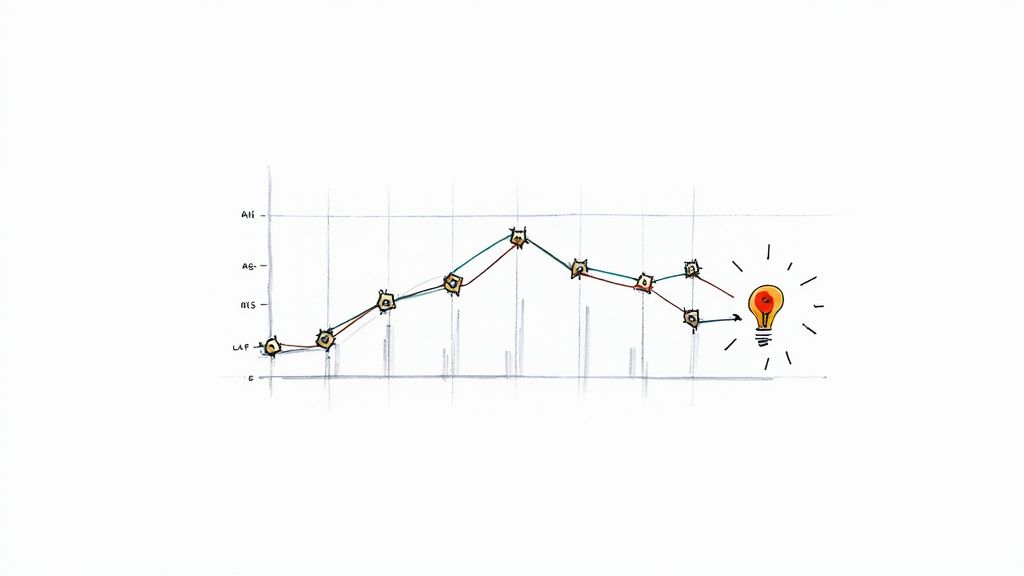
A hand-drawn line graph showing data progression over time, leading to a bright lightbulb.

This shift empowers organizations to move from reactive decision-making based on gut feelings to proactive strategies informed by real-time analytics. With automated dashboards and reports, leaders can instantly identify performance bottlenecks, spot emerging trends, and forecast future needs with far greater accuracy. The result is a more intelligent and agile organization capable of making smarter, faster decisions at every level.

Real-World Impact

  • Retail: A retail company uses automated sales analytics to track product performance across different regions in real time. This data feeds directly into demand forecasting models, optimizing inventory levels and preventing both stockouts and overstock situations.
  • Manufacturing: Sensors on a production line feed data into an automated system that uses predictive analytics to identify when a machine part is likely to fail. This allows for scheduled maintenance, preventing costly unplanned downtime.
  • Financial Services: Banks leverage automation to analyze thousands of transactions per second. The system flags unusual patterns in real-time, providing immediate fraud detection alerts that protect both the institution and its customers.

Key Insight: Automation transforms data from a historical artifact into a live, predictive asset. Instead of analyzing what happened last quarter, you can understand what is happening right now and reliably predict what will happen next.

How to Implement and Measure

To build a culture of data-driven decision-making, you must treat data as a primary output of your automation efforts.

  1. Define Key Metrics First: Before automating, identify the key performance indicators (KPIs) you want to track. What data points will tell you if the process is successful?
  2. Integrate with BI Tools: Ensure your automation platforms can feed data directly into business intelligence tools like Tableau or Power BI. This integration is crucial for creating accessible, visual dashboards for stakeholders.
  3. Establish Data Governance: Implement clear standards for data quality, access, and security. A centralized data platform or data lake can help ensure consistency and reliability across the organization.
  4. Train for Interpretation: Provide your team with the skills to read, interpret, and question the data. The goal is not just to present numbers but to empower employees to draw actionable insights from them.

9. Reduced Time-to-Market and Faster Innovation

In a hyper-competitive market, speed is a critical advantage. Process automation is the engine that accelerates the entire lifecycle of a product or service, from initial concept to market launch. By automating key stages of development, testing, and deployment, organizations can drastically shorten their innovation cycles and respond to market demands with unprecedented agility.

This acceleration is achieved by creating a seamless, automated pipeline that minimizes manual handoffs and delays. Instead of waiting for manual quality assurance or deployment approvals, automated workflows execute these tasks instantly and reliably. This allows teams to iterate, experiment, and deliver value to customers faster, turning ideas into tangible products before competitors can react.

Real-World Impact

  • Software Development: A digital agency implementing a Continuous Integration/Continuous Deployment (CI/CD) pipeline using tools like GitHub Actions or Jenkins can automate code compilation, testing, and deployment. This transforms a multi-day release process into a repeatable, on-demand action that takes minutes.
  • Tech Industry: Companies like Netflix are famous for their DevOps culture, using extensive automation to deploy thousands of changes to their live environment daily. This allows them to rapidly test new features and improve user experience without service interruptions.
  • Product Experimentation: A SaaS company can use automated A/B testing platforms to deploy multiple versions of a new feature to different user segments. The system automatically collects performance data and provides insights, enabling rapid, data-driven decisions on which version to fully release.

Key Insight: Reducing time-to-market isn't just about launching first; it's about increasing the frequency of learning. Automation enables a rapid cycle of building, measuring, and learning, which is the cornerstone of modern innovation.

How to Implement and Measure

To use automation for faster innovation, focus on creating a frictionless development and deployment workflow.

  1. Map the Value Stream: Identify every step in your current process, from idea to launch. Pinpoint bottlenecks and manual handoffs that cause the most significant delays.
  2. Implement CI/CD Pipelines: Adopt DevOps practices by building automated CI/CD pipelines. This ensures that every code change is automatically built, tested, and prepared for release, ensuring quality and speed.
  3. Automate All Testing: Create a comprehensive suite of automated tests, including unit, integration, and end-to-end tests. This provides immediate feedback on code quality and builds confidence for faster deployments.
  4. Track Cycle Time: Measure the time it takes for a task to move from "in progress" to "done." Continuously monitor this metric to identify areas for further automation and process improvement.

10. Improved Customer Experience and Satisfaction

Process automation is a powerful tool for elevating the customer experience, directly impacting satisfaction and long-term loyalty. By automating key touchpoints in the customer journey, organizations can deliver faster, more personalized, and consistently high-quality service. Automation removes friction, provides instant responses to common queries, and ensures that interactions are seamless across different channels, meeting the modern consumer's demand for immediate and effortless engagement.

This enhancement is not about replacing human interaction but augmenting it. Automation handles the high-volume, predictable inquiries, freeing up customer service and account management teams to focus on complex, high-value conversations that require empathy and strategic thinking. This creates a dual benefit: customers get instant answers to simple questions, and they receive more focused, expert attention for complex issues, leading to a far superior overall experience.

Real-World Impact

  • E-commerce: Retailers use AI-powered chatbots to provide 24/7 support, instantly answering questions about order status, return policies, and product details, significantly reducing customer wait times.
  • Airlines: Major airlines automate the entire pre-flight process, sending automated notifications for check-in, flight status updates, and gate changes, creating a smooth and informed travel experience.
  • Banking: Financial institutions offer automated mobile app features for tasks like balance inquiries, fund transfers, and fraud alerts, empowering customers with self-service capabilities that are both fast and secure.

Key Insight: A superior customer experience is built on speed, consistency, and personalization. Automation is the engine that drives all three, creating a scalable framework for delighting customers at every touchpoint.

How to Implement and Measure

To effectively use automation for customer satisfaction, focus on designing workflows from the customer’s point of view.

  1. Map the Customer Journey: Identify key interaction points and moments of potential friction, such as onboarding, support requests, or billing inquiries. These are prime candidates for automation.
  2. Balance Automation and Human Touch: Design systems with clear and easy escalation paths. If an automated chatbot cannot resolve an issue, it should seamlessly transfer the customer to a live agent with full context.
  3. Gather Feedback Continuously: Implement post-interaction surveys (like CSAT or NPS) to measure how customers perceive the automated experience. Use this direct feedback to refine and improve workflows.
  4. Monitor Key Metrics: Track metrics like "first response time," "resolution rate," and "customer effort score." A decrease in response time and customer effort are strong indicators that your automation is improving the customer experience.

Process Automation: 10-Benefit Comparison

🔄 Implementation Complexity ⚡ Resource Requirements 📊 Expected Outcomes (Impact) 💡 Ideal Use Cases ⭐ Key Advantages
Increased Productivity and Efficiency — Medium: initial setup and workflow mapping Moderate: automation platforms, developer time, retraining High: 30–40% faster task completion; higher throughput High-volume repetitive tasks (accounting, marketing automation) Frees staff for strategic work; faster time-to-market
Cost Reduction and Improved ROI — Medium–High: integration and business-case planning High: capital investment, licenses, ongoing maintenance High: 20–30% cost savings; typical 6–12 month payback Processes with high labor or error costs (claims, contract review) Scalable cost savings; improved ROI
Enhanced Accuracy and Quality Control — Medium: precise configuration and validation Moderate: sensors/vision, QA tools, monitoring Very High: up to 99.9% error reduction; stronger compliance Regulated production, transaction verification, QC inspection Consistent execution; fewer defects and rework
Improved Employee Satisfaction and Retention — Low–Medium: change management and engagement Low–Moderate: training, upskilling, communication Medium–High: reduced burnout; higher engagement and retention Roles with repetitive tasks (support agents, HR ops) Better morale; lower turnover costs
Scalability and Business Growth Enablement — High: architecture, integration, planning High: robust cloud infra, modular systems, integration work Very High: handle 10–100x volume without linear cost increases E‑commerce, SaaS platforms, global expansion Enables rapid scale and market entry
Better Compliance and Risk Management — Medium–High: regulatory mapping & updates Moderate: compliance tooling, logging, audit capability High: fewer violations; easier audits; lower fraud risk Finance, healthcare, data‑sensitive industries Strong audit trails; reduced legal exposure
24/7 Operations and Improved Response Times — Medium: monitoring, redundancy, runbooks Moderate–High: uptime infrastructure, failover, alerting High: continuous service; faster incident response Customer support bots, monitoring, automated trading Round‑the‑clock availability; competitive CX edge
Data‑Driven Decision Making and Analytics — High: data integration, governance, pipelines High: data platforms, ETL, analytics talent High: real-time insights; predictive forecasting Retail demand forecasting, predictive maintenance, BI Faster, more informed decisions; predictive advantage
Reduced Time‑to‑Market and Faster Innovation — Medium–High: CI/CD, test automation, governance Moderate–High: DevOps tools, testing frameworks, skilled teams High: 50–70% faster development and release cycles Software products, digital services, iterative R&D Accelerated releases; rapid experimentation
Improved Customer Experience and Satisfaction — Medium: CX design and escalation flows Moderate: CRM, personalization engines, chatbots High: higher CSAT/NPS; increased retention and LTV E‑commerce, banking, service industries Personalized, consistent service at scale

From Automation to Agency OS: Your Next Steps

We've explored the extensive and transformative benefits of process automation, moving far beyond simple efficiency gains to touch every corner of your agency. From boosting productivity and slashing operational costs to enhancing quality control and enabling true scalability, the message is clear: automation is no longer a luxury, but a core strategic imperative for modern agencies.

The journey we've taken through these ten key benefits reveals a powerful, interconnected narrative. Improving employee satisfaction by eliminating repetitive tasks directly fuels faster innovation. Enhancing data accuracy leads to smarter, more strategic decision-making. These advantages don't exist in a vacuum; they create a powerful flywheel effect, where each automated process strengthens the others, compounding your agency's capabilities and competitive edge.

Recapping Your Path to a Smarter Agency

Let's distill the core takeaways from our deep dive into the benefits of process automation:

  • Beyond Efficiency: The goal isn't just to do things faster. It's about creating capacity for high-value strategic work, empowering your team to focus on creativity, client relationships, and innovation.
  • Quality as a Standard: Automation institutionalizes excellence. By removing the potential for human error in repetitive tasks, you deliver consistently high-quality work, building client trust and protecting your agency's reputation.
  • Growth on Your Terms: True scalability isn't about hiring more people to handle more manual work. It's about building systems that can handle a 10x increase in workload without a 10x increase in headcount or operational chaos.
  • Data is Your Compass: Effective automation generates clean, reliable data. This data is the foundation for understanding your agency's performance, identifying bottlenecks, and making informed decisions that drive sustainable growth.

The Pitfall of a Fragmented Approach

However, realizing these benefits comes with a critical warning. Many agencies fall into the trap of adopting dozens of disconnected tools: one for project management, another for CRM, a separate one for invoicing, and various point solutions for specific automated tasks. This "tool sprawl" creates new problems, including data silos, integration headaches, and a disjointed experience for both your team and your clients.

Instead of solving chaos, a fragmented tech stack often multiplies it. Your team wastes precious time switching between platforms and manually syncing information, which completely undermines the core purpose of automation. The true evolution of process automation lies in integration.

Key Insight: The ultimate goal is not just to automate individual tasks but to create a unified, intelligent Agency Operating System (OS). This is a single source of truth where all your core functions, from client acquisition to project delivery and financial management, work in harmony.

Moving Forward: From Isolated Actions to a Unified System

Your next steps should be guided by a holistic vision. Don't just ask, "What task can I automate?" Instead, ask, "How can I build a system that makes my entire agency run smoother, smarter, and more profitably?"

This shift in perspective is what separates agencies that merely survive from those that truly thrive. It's the difference between patching holes and architecting a resilient, future-proof business. By embracing a unified approach, you amplify every single one of the benefits of process automation we've discussed, creating a cohesive operational engine that powers predictable growth and exceptional client delivery. The future of your agency depends not on the number of apps you use, but on the intelligence of the system you build.


Ready to move beyond fragmented tools and build a true Agency Operating System? RGK is the unified platform designed to manage your clients, projects, and finances in one place, with AI-driven automation built into its core. See how you can consolidate your tech stack and unlock the full potential of process automation by visiting RGK to start your journey today.